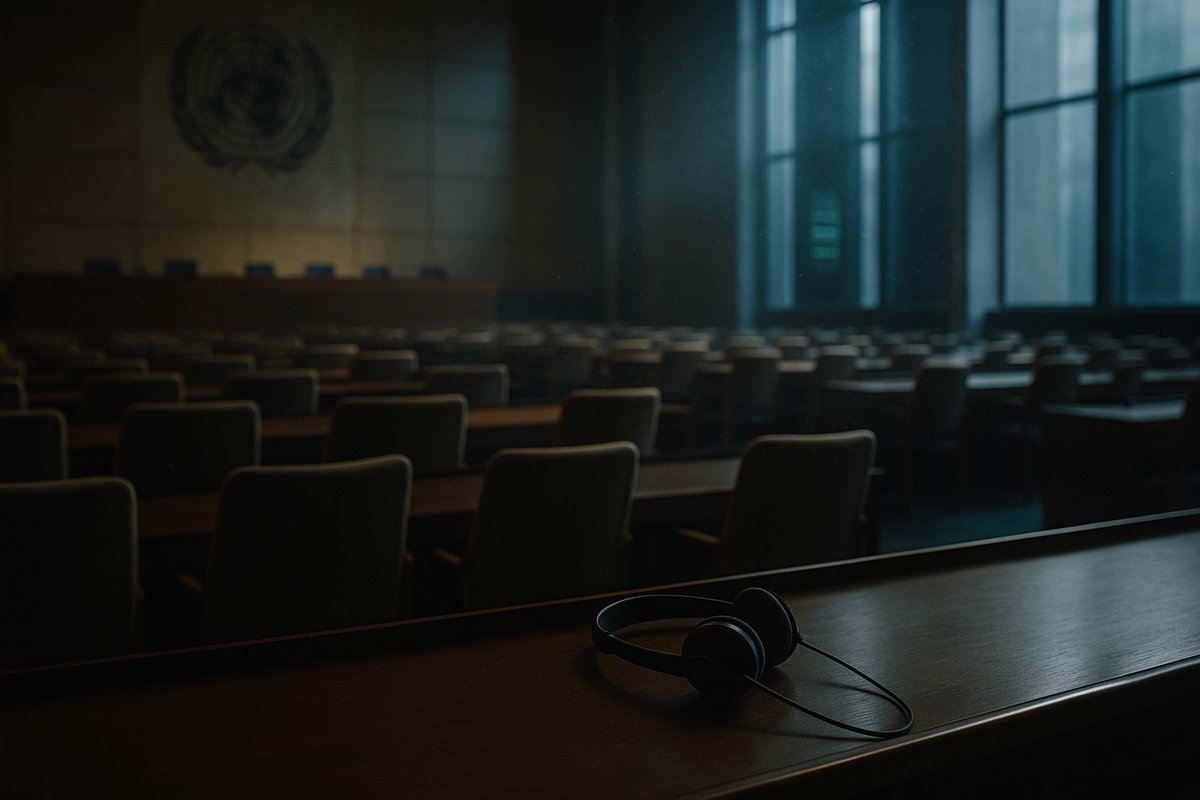
In a UN room in Geneva, two authoritative voices in technology and journalism co-chaired a dialogue on artificial intelligence governance. Yoshua Bengio, Turing Award winner and central figure in deep learning. Maria Ressa, Nobel Peace Prize laureate, who has documented how digital platforms erode democracies. Both warned about catastrophic risks and an AI gap that could exclude entire economies from the future being built right now.
By the end of the day, neither has the tools to force real change. Not because the participants lack credibility — they have plenty — but because the structure itself ensures that authority dissolves into press releases instead of translating into verifiable action. It's a pattern that keeps reappearing in other fields: experts issuing urgent warnings, and those warnings being systematically ignored.
The Global Dialogue on AI Governance in Geneva called for universally accepted guardrails and UN-led multilateral solutions. The phrases sound good in a press release. The problem is that none of them has taken the form of a binding agreement, with verification or implementation deadlines. The expert consensus is of unquestionable quality: Bengio has analyzed the risks of advanced systems at a technical level few can rebut. But that consensus ends up packaged inside an institution with no real enforcement capacity.
The dynamic repeats something we already saw for decades with the Intergovernmental Panel on Climate Change. That body produced reports of nearly irrefutable rigor. Its first report, in 1990, already established that human activity was altering the atmosphere. Agreements followed. Global CO2 emissions didn't go down — they went up. Scientific consensus grew stronger and more urgent. Compliance remained voluntary, with no real sanctions for anyone who ignored its targets.
Now the same constant is playing out with artificial intelligence instead of carbon. A highly prestigious group documents the risk, produces urgent language, and hands the final decision to sovereign states and private corporations whose immediate interests rarely align with the diagnosis. Who benefits from this setup? AI companies that send representatives gain reputational legitimacy at no cost. They can cite their participation in UN forums as evidence of corporate responsibility without changing a single verifiable practice. There are no external audits of their models' weights. There's no obligation to disclose training data. There's no way to confirm whether internal safety policies are actually being enforced.
This dynamic repeats itself in other forums: industry nods along, shares a few lines about ethics, and walks away with the same power intact, just with a better image. States aren't neutral in this scenario either. Some blocs push for strong frameworks because they understand that, without coordination, they'll end up subject to rules set by others. The two powers that control computing infrastructure and the most advanced models prefer domestic regulation. Real power gets negotiated through semiconductor export restrictions and bilateral deals, not in rooms with simultaneous translation.
The repeated mention of the AI gap facing emerging economies follows the expected script: it gets documented at every meeting. But naming the risk isn't the same as transferring resources or capacity to close it. There are no concrete proposals for compute-sharing or preferential access to frontier models for researchers in those regions. The gap gets described with precision and left untouched with that same precision.
From a technical standpoint, any multilateral guardrail depends on an unavoidable precondition: verifiable access to model weights and to the infrastructure where they're trained and run. Without that key, any commitment becomes a promise impossible to audit. The current opacity of these systems makes talk of transparency aspirational, not operational. A UN panel can recommend openness. It cannot demand access to proprietary systems under foreign jurisdiction, nor does it have its own technical tools to validate whatever it's shown.
Real control lies with whoever operates the GPUs, with whoever decides which weights get shared and which get withheld. That's infrastructure before it's diplomacy. Any design that ignores this distinction won't produce effective governance, no matter how many prizes and experts it gathers. I don't have a simple solution, and it would be dishonest to suggest otherwise. Studying power dynamics across different structures, something recurs in the processes that actually deliver results: they seek independent technical verification beyond moral authority. It's worth exploring rotating committees with real auditing power, as an experiment to align those who review with those who control the systems.
It remains to be seen whether any international body will manage to demand that technical access as a real condition of participation, instead of settling for symbolic presence. The IPCC needed decades to produce measurable change, and even so its results remain limited. AI doesn't have that kind of time. Bengio understands this better than anyone, because he helped build the technology he's now trying to rein in from a panel with no executive power. That tension, more than any press release, is what remains.
What would happen if independent technical verification became a precondition instead of a diplomatic aspiration?
Sources
1. UN Global Dialogue on AI Governance, Geneva — co-chair statements (Bengio, Ressa)
2. Intergovernmental Panel on Climate Change (IPCC), First Assessment Report, 1990
3. Kyoto Protocol (1997) and Paris Agreement (2015) — emissions compliance records
4. Prior analyses on incentives and power structures in international forums