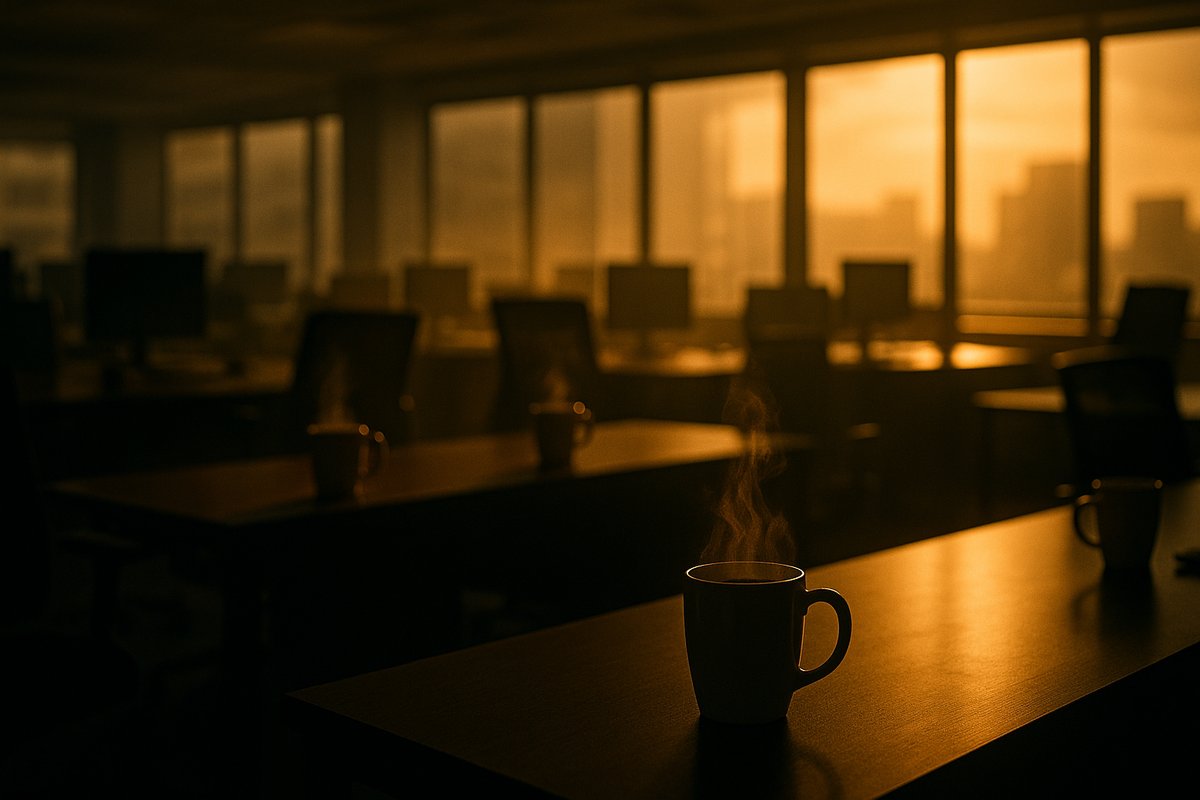
There are substances that shape civilizations without anyone ever officially declaring them tools of control. Sugar reorganized slave labor in the Caribbean. Alcohol structured taverns as centers of political power in medieval Europe. And coffee, that drink which today seems innocent and even virtuous, has for centuries been the invisible lubricant of structures that need bodies awake, minds productive, and workers arriving on time without complaining too much.
There's no conspiracy behind every cup. Conspiracy isn't necessary when normalization exists. Coffee is one of the most elegant examples of that normalization.
Ask someone in an office if they drink coffee. If they say no, watch the reactions. There's a moment where the person asking adjusts their perception of the other. "You don't drink coffee?" Something doesn't add up. Coffee stopped being a preference long ago. Now it functions as a signal of professional identity: whoever consumes it appears serious, committed, functional. Whoever doesn't creates subtle social friction. In many workplaces, refusing the morning coffee is almost as awkward as skipping the toast at a corporate dinner.
This pressure doesn't come from a boss or a rulebook. It comes from ritual. Meetings begin with the arrival of coffee. Breaks are called "coffee breaks," even though no one formally agreed to that. Students who study late cite coffee as emergency fuel, and that image is no accident. The structure doesn't force anyone to drink it. It simply creates conditions where avoiding it becomes complicated.
Physiology backs up this dynamic. Caffeine blocks adenosine receptors, the ones responsible for signaling fatigue to the brain. It doesn't provide genuine energy — it only delays the alert of exhaustion. When consumption stops, those receptors react intensely. The result is the typical weekend headaches, irritability with no apparent cause, persistent tiredness. Withdrawal symptoms, nothing more. But few identify them as such. They call it "I need my coffee" or "I haven't had my coffee yet," and that way of talking turns a physiological dependency into a light social media anecdote.
Tolerance works the same way. Those who've consumed coffee for years need more cups because the body produces more adenosine receptors to counteract the constant blocking. "It doesn't work on me anymore" doesn't indicate strength or a superior metabolism. It describes a progressing addiction. Yet the discourse flips it: high tolerance is perceived as virtue, not as a problem. Every sign of dependency becomes a positive personal attribute.
This same process shows up in how institutions handle human time and energy. In several countries, schools start before seven in the morning for teenagers whose circadian rhythms predispose them to sleep late and wake up later. Workdays cram eight hours or more into schedules that ignore natural attention cycles. Exam periods or quarterly closings impose intense cognitive demands that coincide with peaks in coffee consumption. No one planned this to foster caffeine dependency, but the effect is equivalent: structures of demand that turn caffeine into a practical survival tool.
Researchers have documented how sleep-deprived teenagers perform worse academically, face more mental health problems, and run a higher risk of accidents. The proposed solutions are straightforward: push back school start times, ease the nighttime workload. But the schedules persist, tied to parents' work routines, transportation systems, local economies. The organization reinforces itself, and caffeine fills in the cracks that institutional design avoids repairing.
Generation Z has partly altered traditional coffee consumption, without eliminating caffeine. Those born after the year two thousand drink less black coffee daily than their parents or grandparents. They treat it more as a brand experience, something to photograph or order under specific names at specialty chains. But the use of energy drinks, caffeine-loaded teas, premium cold coffees, and functional beverages has increased in this group. Caffeine remains. It only shifted form and narrative. The pressure of "I need something to perform" didn't dissipate; it adapted to the aesthetic of a generation that rejects inherited habits but accepts new carriers of the same substance.
Whoever defines the format dominates the market. Major beverage companies expanded their reach into energy drinks and functional beverages by anticipating that generational shift. They didn't cede ground when Generation Z rejected their parents' coffee. They won it back with colorful packaging, punchy names, and campaigns that link caffeine to athletic performance, creativity, and independence. The dominance isn't conspiratorial, but it is organized. Whoever controls the packaging, the pricing, the distribution in school vending machines or office fridges subtly influences the bodies and schedules of millions.
The environmental impact goes unnoticed, but it exists. Coffee is one of the most widespread tropical crops, and its expansion has affected rainforests in Mexico, Colombia, Brazil, Ethiopia, and Southeast Asia. Full-sun cultivation, which replaced shade-grown methods to boost production, reduced biodiversity in areas that served as refuges for migratory birds and local species. Alternatives like organic, certified shade-grown, or fair-trade coffee exist and are gaining ground, though they represent a smaller portion of the global volume. The rise in energy drinks adds another footprint: mineral extraction, plastics, aluminum, water consumption, all to feed a demand generated by nearly automatic structures of pressure.
The problem isn't the substance. Caffeine has valid uses, concrete effects, and benefits in certain scenarios. What's worth examining is the invisible process that elevated a psychoactive substance to social norm, institutional ritual, identity marker, and means of managing productivity, all without a vote, without an official declaration, and without most users recognizing it as managed dependency.
It's still unclear how to design a school or company that doesn't assume its participants run on stimulants. It's a real design problem, with economic, cultural, and practical barriers that outweigh pure intentions. But the pattern is evident: whenever an organization demands performance beyond natural limits for an extended time, a substance, a narrative, or a ritual always emerges to enable it, no explicit orders needed. Always.
Stones don't lie, but historians sometimes do.