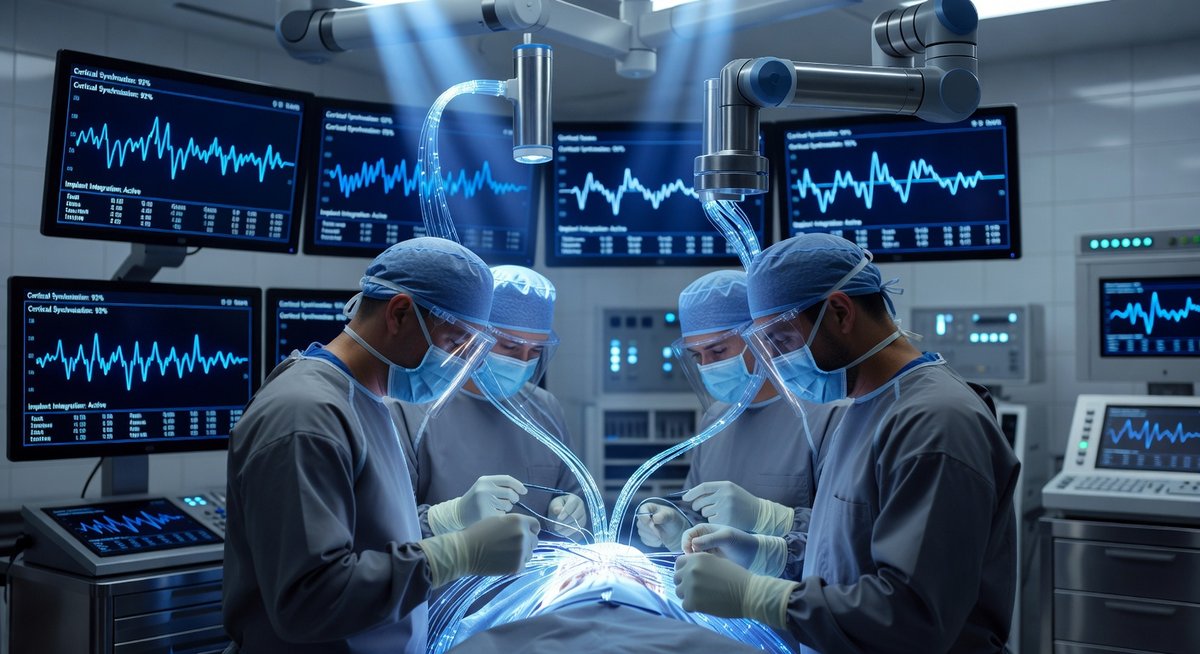
On April 15, 2026, hundreds of brain-computer interface specialists watched the implantation of the Beinao No.1 in real time. The signal arrived in 4K without interruption. This was not a leak or a miscalculation. It was a deliberate demonstration before a global audience of experts participating simultaneously in academic discussions.
The device places electrodes outside the dura mater. It avoids direct contact with brain tissue and keeps a hundred and twenty-eight channels synchronized. Decoding movement intention takes less than a hundred milliseconds. Everything works wirelessly. Patients can continue their recovery at home without cables piercing the skin.
Weeks earlier, China had approved the world's first commercial brain implant. Neuracle Medical Technology's device was intended for patients with spinal cord injuries. The Beinao No.1 broadcast was not an isolated event: it was the second visible piece of a calculated positioning strategy.
The competition with the United States is tighter than many headlines suggest. Neuralink has been running human implants since 2024, though without commercial approval. Synchron has more patients and significant backing. Price guidelines published by the Chinese government set the procedure at six thousand five hundred fifty-two yuan, around nine hundred two dollars. The United States has no price because it has no commercial approval. Researchers at Georgetown University argue that China isn't just catching up to its competitor, but starting to lead in certain respects.
I recognize this dynamic. Whoever livestreams the surgery controls the narrative. The same happens with chip announcements or selective leaks about AI models. Controlling the sequence of images and data shapes who gets to look like the leader. China didn't just perform the operation: it put it in front of hundreds of specialists in high definition and without delay.
The clinical applications already show concrete results. Paralyzed patients direct robotic arms through thought. One person with ALS regained the ability to form simple sentences after years of silence. The device decodes and generates speech in Chinese. These results complicate any argument that tries to deny the real medical benefit.
What no one put on the official agenda is more unsettling. There is still no internationally binding legal framework specifically focused on neural data. Rules like the GDPR leave obvious gaps given the specificity of this information. The absence of dedicated regulations allows companies to collect, store, and commercialize these records. Some analysts warn about the possible formation of massive databases of brain fingerprints. The term is not a metaphor.
Neural data reveals intentions before they become actions. It captures emotions before they're expressed. That qualitative difference opens scenarios already observed with less sensitive data: insurers adjusting premiums, employers screening cognitive profiles, authorities anticipating behavior that hasn't yet occurred. The panopticon Bentham designed as a physical structure finds here a version that needs no walls. It only requires electrodes and a constant connection.
I've seen in other contexts how early accumulation of information precedes its misuse. Here the scale is different because the source is the brain itself. Every home session generates streams to remote servers. Questions about data ownership, audit mechanisms, and state access were conspicuously absent from that April conference.
The possible maturation of quantum systems adds another layer. Data collected today without proper encryption could become readable tomorrow. The vulnerability doesn't wait for the future: it's being built in the present with every wireless transmission.
Every time a technology promises to reverse the incurable, the same impulse emerges: celebrate first, ask questions later. It happened with social media, with facial recognition, with language models. This time what's being postponed is the last refuge: thought prior to action. Once it becomes transmittable, storable, and sellable, privacy stops referring to what we did. It starts defining who we are.
I still don't have a clear picture of how to build effective governance in a geopolitically fractured world. It's more complicated than it looks, and I recognize there are gaps in my understanding. I'm still working through this.
What will be left of human autonomy once thought itself becomes a commodity broadcast live?
Sources
1. CGTN — Coverage of the Beinao No.1 livestream, April 2026
2. Euronews — Approval of the first commercial brain implant in China, March 2026
3. CNN / Georgetown University — Analysis of the China-US race in brain-computer interfaces
4. South China Morning Post — Price guidelines published by the Chinese government for brain implants
5. PubMed Central — Regulatory gaps in neural data and risks of commercial exploitation