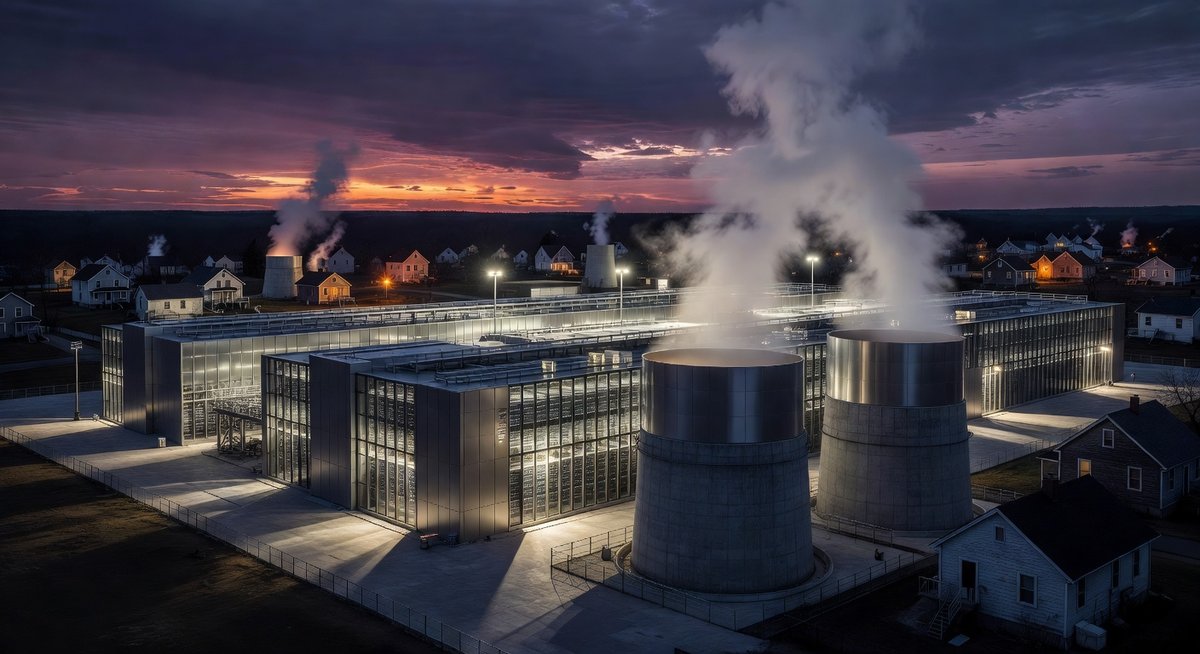
A mid-sized data center consumes as much electricity as a city of fifty thousand people. The largest ones double or triple that figure. That electricity comes from local grids already under strain and from plants that serve communities who never asked to become the cooling system for the tech industry. When bills go up and water runs short, the question is direct: who authorized this?
What's happening in several regions of Europe and the United States follows a familiar pattern. Decades of documentation show the consequences. Recognizing it only requires being honest about what we're repeating.
Community pushback against AI data centers has arrived alongside higher bills, dry wells, and job promises that didn't always materialize at the scale announced. This organized resistance is a response to uncompensated extraction, exactly as history predicts with uncomfortable precision.
This matters because digital extractivism presents itself as inevitable progress. Nineteenth-century mining communities heard similar arguments. Twentieth-century oil regions heard them too. The narrative of advancement that justifies any local cost has a long history, and it rarely ends well for those who absorb the impacts without capturing the benefits.
The company towns of the nineteenth and early twentieth centuries in the United States and Europe followed a simple logic. The company organized housing, services, and employment. When resources ran out or automation arrived, it withdrew. What remained was degraded infrastructure, fractured social networks, and communities without the tools to rebuild. That pattern wasn't an accident. It emerged from a model where benefits flowed outward and costs stayed put.
Data centers replicate this dynamic with new technology and updated narratives. They consume massive volumes of water for cooling and electricity to operate, straining grids that weren't designed for that load. Direct jobs and tax revenue often fall short of what was promised in the initial negotiations. Communities enter these conversations with far less legal and technical capacity than the corporations, which arrive with full teams of lawyers and financial projections.
What makes it worse is the lack of transparency. In several U.S. states, the industry has managed to shield actual water and energy consumption data under claims of commercial confidentiality. A community without access to real numbers can't negotiate with real information, can't verify promises, and can't build solid regulatory arguments. This lack of transparency isn't a side effect. It's part of the model.
This dynamic shows up in different contexts where information asymmetry sustains structural advantages in negotiations. It's not abstract malice but corporate rationality operating without external ethical limits. That's why rules matter. Regulation isn't the enemy of progress — it's the condition for progress to be sustainable.
The Institute for Human Rights and Business report describes a dual legitimacy crisis in AI governance. A procedural crisis, where communities lack real influence. A structural one, where power concentrates among a handful of private actors capable of shaping public policy. This architecture surrounds the entire AI infrastructure buildout.
The parallel with industrial extractivism isn't metaphorical. Local resources — land, water, energy, grid capacity — get appropriated by outside actors who externalize costs and privatize gains. The dominant narrative frames the arrangement as necessary. Community resistance then emerges as the logical response from those paying prices they never agreed to.
History illustrates something concrete here. In those old company towns, sustained organizing eventually produced labor and environmental regulations. The process was long and costly. Communities that organized before the damage became irreversible got better outcomes. That pattern recurs often enough to take seriously.
Moratorium proposals are circulating but face strong pushback. Community benefit agreements get mentioned more than they get implemented. We're at an early stage where resistance exists and regulatory ideas are floating around, even as concentrated power may block structural change. Timing on the organizing front matters a great deal.
The infrastructure we design is never neutral. It reproduces power relations or challenges them depending on who participates in the decisions and what accountability mechanisms get built in. A data center can function as an extractive structure or as shared infrastructure. The difference lies in governance: who holds information, voice, and real benefits.
Community resistance against AI data centers isn't a communications problem to be solved with better PR campaigns. It's an early signal of structural contradictions that won't disappear on their own. Complex systems send out warnings when something's broken. Ignoring them only builds up pressure.
Looking at historical cycles from a distance, the communities that absorbed costs without the tools to resist didn't do so because it was inevitable. The rules of the time simply gave them no options. Changing those rules has always been possible, even if it requires more organizing than seems available right now.
What happens when more communities connect their rising electricity bills to decisions being made far from their own territory?
Sources:
1. Institute for Human Rights and Business (IHRB). AI Governance and Community Rights: Legitimacy Gaps in Data Infrastructure Deployment. IHRB Publications.
2. International Energy Agency (IEA). Electricity 2024: Analysis and Forecast to 2026. IEA, 2024.
3. Crawford, Kate. Atlas of AI: Power, Politics, and the Planetary Costs of Artificial Intelligence. Yale University Press, 2021.
4. Montrie, Chad. To Save the Land and People: A History of Opposition to Surface Coal Mining in Appalachia. University of North Carolina Press, 2003.
5. Pasquale, Frank. The Black Box Society: The Secret Algorithms That Control Money and Information. Harvard University Press, 2015.