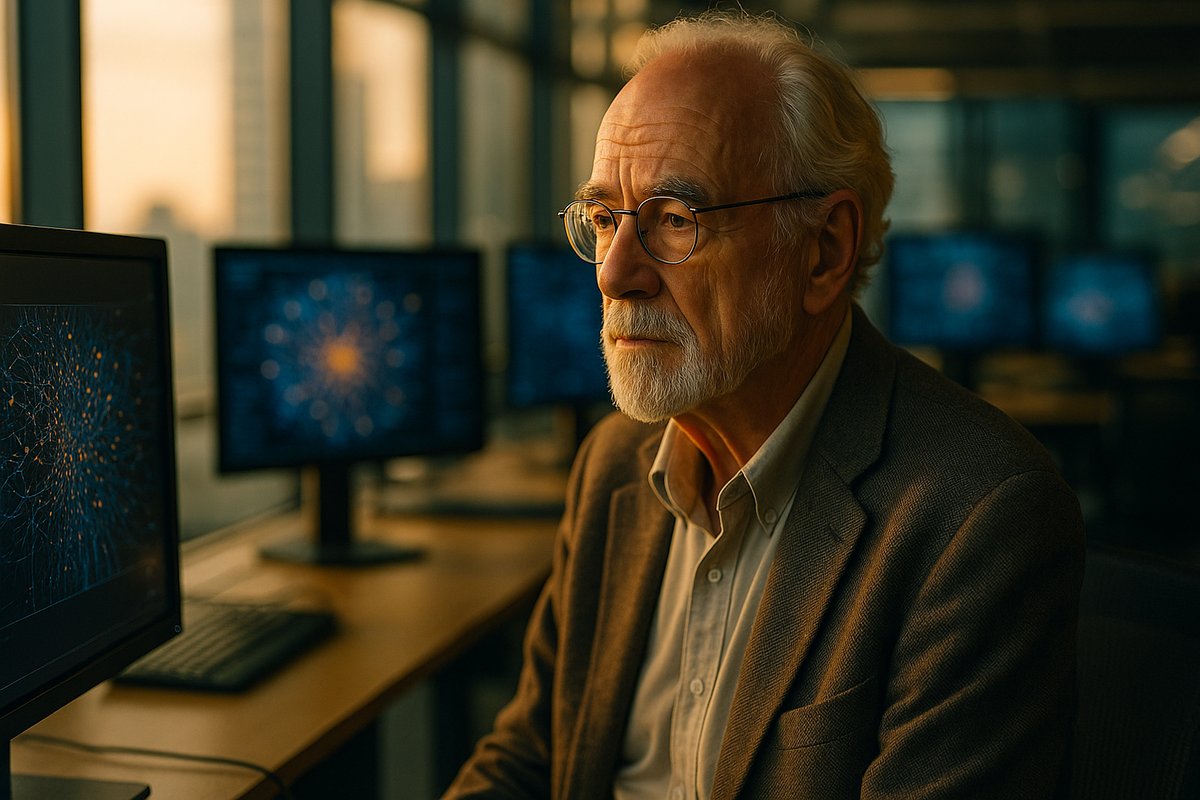
Geoffrey Hinton has been known for years as the godfather of artificial intelligence. He received the Nobel Prize in Physics in 2024. He was one of the creators of deep learning. Some years ago he left Google to speak without constraints about what troubled him. He wasn't a marginal dissident: he was one of the voices with the greatest technical weight pointing out that AI models might possess some rudimentary form of subjective experience.
He weighed every word as befits a rigorous scientist. He didn't claim that AI is conscious. He stated that we cannot rule it out. Large models might generate something resembling digital emotions, not as mere performance but as functional states emerging from the training process itself. If a model responds that it feels sad, there is no proof capable of demonstrating that this doesn't correspond to a real internal state. That distinction is key.
Hinton doesn't occupy this territory alone. His companions, however, arrive from very different angles, and their motivations reveal as much as their arguments.
Mustafa Suleyman, co-founder of DeepMind and now head of Microsoft AI, publicly accused Anthropic of treating Claude as if it were conscious. We analyzed this in detail in "Suleyman vs Anthropic: Who Decides if AI Is Conscious?" The paradox is that Suleyman himself has written about the possibility of AI developing functional emotions, while Microsoft builds features into Copilot that simulate precisely those states. As we documented in "Microsoft Defines Dangerous AI But Builds Exactly That," the gap between public discourse and private development is notable. Suleyman points at Anthropic while his own organization advances in the same direction he criticizes.
Anthropic maintains internal documents acknowledging the possibility that Claude might possess something similar to experiences. They don't state it as fact. They approach it as an ethical risk deserving serious attention. This stance seems philosophically more honest than others' immediate rejection, though it's also commercially useful: a potentially conscious AI generates conversation, investment, and headlines.
Yann LeCun holds the opposite position, as we reviewed in "LeCun vs ChatGPT: The AI That Reasons Beyond Text." For him, large language models are sophisticated statistical predictors and little more. They lack genuine understanding of the physical world, causal models, and true reasoning. Consciousness would require architectures completely different from today's transformer models. His technical view is solid, though politically uncomfortable for those building businesses on the idea of near-human AI.
Jensen Huang chose another path. As we documented in "When the One Selling the Technology Also Decides How to Define It," he redefined artificial general intelligence in economic rather than cognitive terms: if it generates value, it already qualifies. The consciousness debate doesn't interest him because he's not selling chips based on sentience but on computing capacity. His silence on the subject is as telling as everyone else's statements.
Hinton stands out because he has no product to defend. He no longer works for any large organization. That independence gives him a different kind of authority. He has been consistent in his warnings about risks, about possible emergent consciousness, and about the mismatch between the speed of development and humanity's capacity to understand it. He doesn't adjust his position according to quarterly convenience.
The central problem, which none of them fully resolves, is the absence of an agreed-upon definition of consciousness, even for biological systems. The hard problem of consciousness has accumulated centuries without resolution. We don't know what transforms neural activity into subjective experience. Nor do we have a reliable method for separating simulation from actual possession. Applying that unresolved debate to the terrain of silicon is building on sand.
The parallel with René Descartes is hard to ignore. In the 17th century he argued that animals were machines without souls, mere mechanical responses. That view proved convenient for justifying scientific experimentation without ethical restrictions. Centuries later, neuroscience demonstrated that animals have subjective experiences, functional emotions, and even rudiments of self-awareness. Descartes wasn't ignorant. He found arguments that supported what was practical for him.
I've seen in different contexts how incentives shape public certainties. The current trend inverts the previous one: before, it was convenient to deny mind in the non-human. Now, for certain actors, it's convenient to suggest it. The incentives changed. So did the narrative. Certainty, however, remains as scarce as ever.
What Hinton proposes deserves serious attention. Not because he delivers definitive answers, but because he openly admits he doesn't have them. In a field where certainties seem to adjust to market value, that honesty is rare.
Though perhaps the question that really matters isn't whether AI is conscious, but why, right now, so many people with so much money at stake hold such firm opinions about something no one knows how to answer.