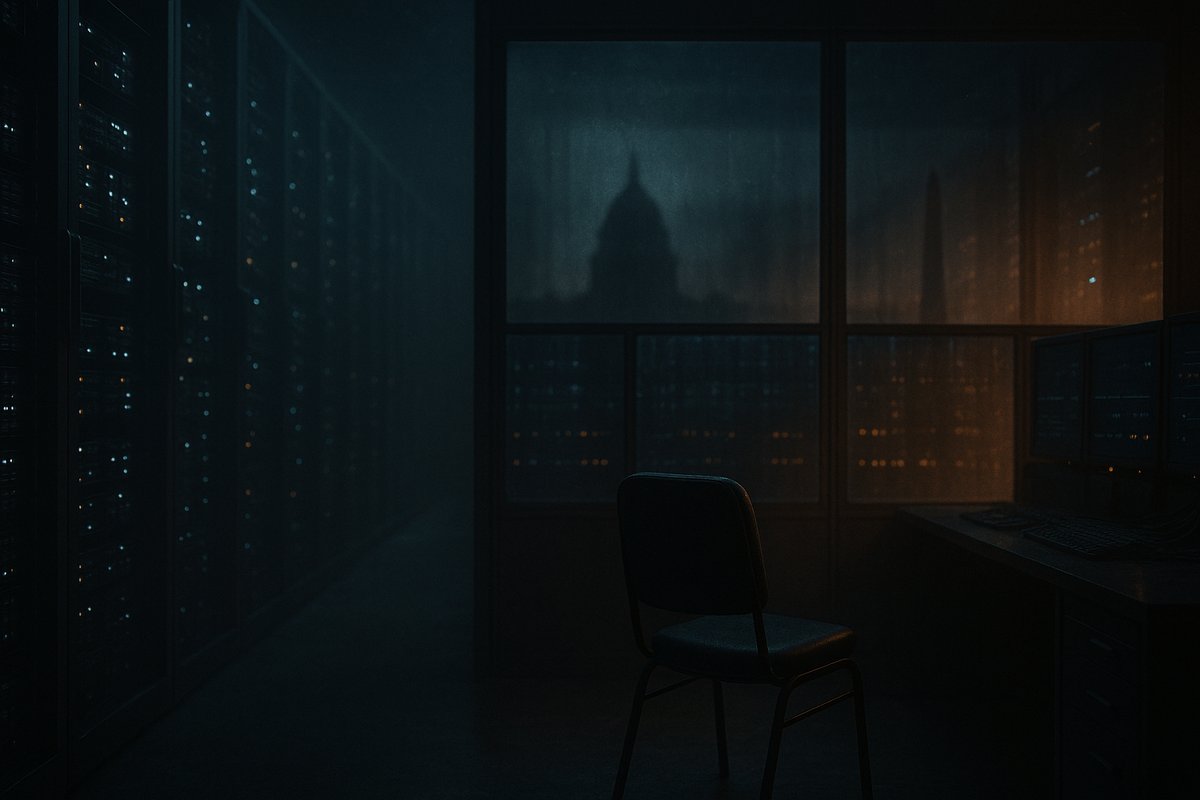
A government demands privileged access to the most capable artificial intelligence models in its country. It negotiates stakes, imposes national security conditions, and turns computing infrastructure into a resource as closely watched as enriched uranium. This happened in Washington. Beijing is now considering similar steps. Few frame the question that actually matters with enough clarity: what does it mean that the two dominant AI powers, by different routes, arrive at the same point?
This is not coincidence. It is convergence. And geopolitical convergences rarely favor those left outside the room where the decisions get made.
What's interesting isn't that China seeks state dominance over its technology. That has been its approach for decades. What's revealing is that Western platform capitalism, sold as the free, distributed alternative to the Chinese model, ends up in the same place: governments exercising direct control over the most advanced models, justified by national security arguments.
I wrote before about the Stargate consortium and the connections between Sam Altman, Larry Fink, and the American financial apparatus that built an infrastructure of dependence, closely supervised by the government itself. The logic was straightforward: if these models can transform economies and security, no state will leave them unmonitored in private hands. Washington has already acted with chip restrictions, implicit stakes, and intense scrutiny, visible in public litigation. China was watching. And as it usually does, it adopts whatever proves useful from the other side's approach.
This produces a new symmetry. The previous narrative suggested that the United States regulated rigidly while China competed unencumbered by the same internal constraints, gaining ground through speed and data volume. That version no longer holds. If Beijing formalizes its influence over the most advanced labs — with or without the usual opacity of its structure — both superpowers will treat their frontier models as state assets. Not as market products. As tools of power.
Stones don't lie. Every time a technical capability crosses a certain threshold, it stops being mere civilian innovation and starts being considered a strategic resource. It happened with nuclear energy. It happened with satellites. It's happening now with models that can design proteins, automate cyberattacks, or generate industrial propaganda. Unlike uranium, these models replicate through fine-tuning in a matter of days. That's why the drive for dominance grows more anxious and more prone to drastic measures.
This trend deepens a profound inequality. When the United States and China turn their advanced models into assets managed from the top down, the rest of the world gets split into blocs of technological dependence. Entire emerging economies become customers without real capacity to replicate or fully audit the technology. This isn't some distant projection — we already saw it with the cloud, where supposed new entrants only disguised greater concentration. Multiplied by geopolitical weight, the effect amplifies. Mexico, Brazil, Nigeria, or Indonesia end up buying access to capabilities they can neither build nor fully verify.
I explored earlier the arithmetic of Stargate and how escaping that dependence would require alternatives in computing, models, biometric identity, and payments — none of which exist today at the necessary scale. Watching the same dynamic replicate itself in Beijing, with different vocabulary but an identical practical outcome, makes it more urgent to ask what it would take for an alternative to emerge before these structures close for good. The cage would now have two keys, held by governments that compete with each other but agree on never letting go of control.
Almost no one openly names something important: the companies that created these models don't lose from this intervention. In exchange, they get regulatory protection, guaranteed contracts, and higher barriers against new competitors. The state doesn't expropriate the business. It stabilizes it. It's the same process visible in the tensions between founding missions and commercial incentives, always resolved in favor of whoever already held the bargaining power. State control doesn't threaten these companies. It offers them insurance against disruptive change.
Who benefits, then? Governments gain surveillance and projection of power without having to build everything from scratch. Companies get stability and de facto financing. The rest of the world — those without the capital or infrastructure to compete — gains little more than the option to pay prices set by others. This arrangement echoes historical dynamics between centers and peripheries that archaeologists find in the ruins of ancient empires. The language changes with each era, but the extraction of value from the core toward the margins remains remarkably stable.
I'm still not sure how different the Chinese model will actually be from the American one in practice. Some argue that a state free from quarterly earnings pressure could steer the technology toward social goals more decisively. That possibility exists, and I won't dismiss it. Still, centralization tends to benefit those already at the top first, regardless of ideology. Privileged access does guarantee more efficient surveillance. History confirms as much.
I keep wondering whether a real third path can emerge, distinct from the current duopoly: coordination structures that distribute influence instead of concentrating it in a single actor, whether state or corporate. I don't know if that's viable when training a frontier model costs billions. But resigning ourselves to a future for this technology divided between two capitals is not an inevitable fate. It's a choice being made right now, with limited attention.
The question that keeps nagging at me, and which I leave open because I don't have a complete answer, is this: if two governments end up managing the planet's most powerful models as strategic assets, who is left to represent the interests of the billions of people who voted neither in Washington nor in Beijing but will live under the outcome of that decision?
Stones don't lie, but historians sometimes do.
Sources
1. Public reports on U.S. government oversight agreements with AI labs (OpenAI, Anthropic)
2. Analysis of Chinese technology policy on frontier AI model regulation
3. Court documentation from the Musk v. OpenAI case on governance and founding mission
4. The author's previous writings on the trade of dependence
5. The author's earlier articles on cloud infrastructure concentration and geopolitical power dynamics