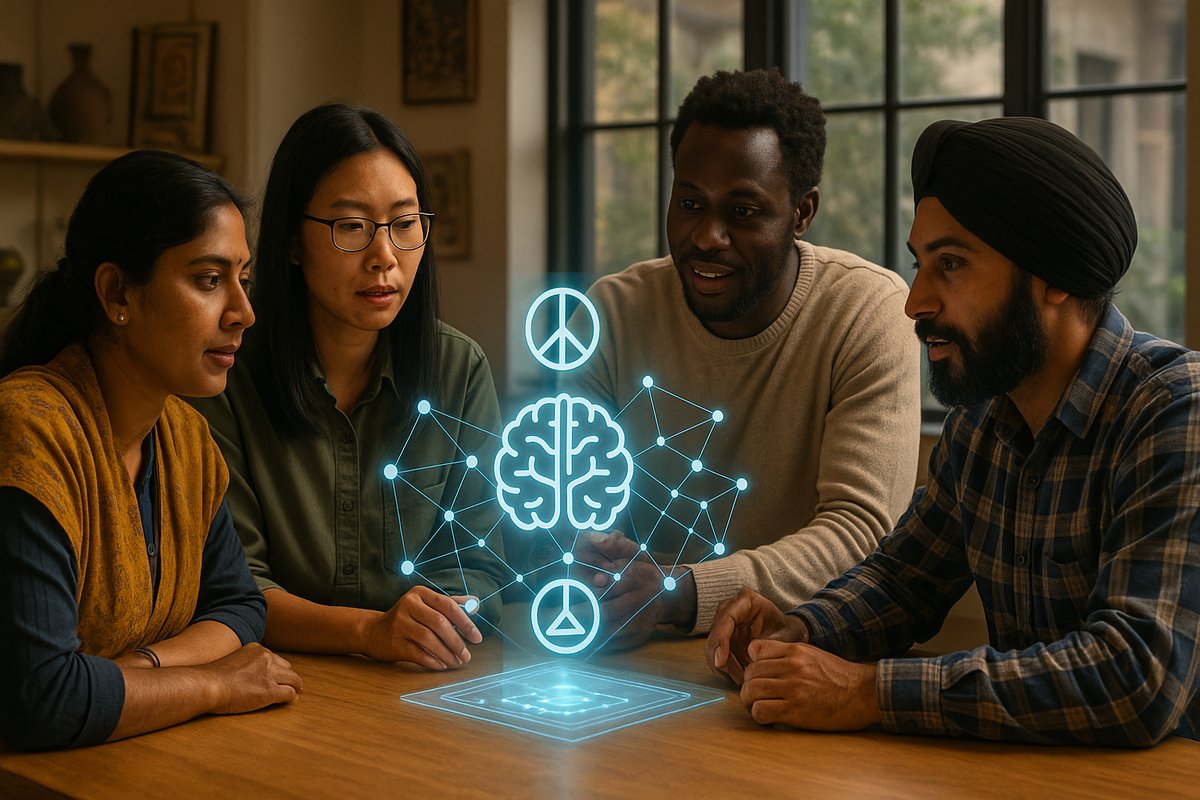
Researchers from emerging economies are developing artificial intelligence systems based on principles of collective harmony, explicitly rejecting Western tools of digital democracy that they consider culturally incompatible. They propose "harmony radars" instead of "shame dashboards," consensus frameworks instead of individual confrontation, and governance by balance instead of accountability through public exposure.
This technological divergence doesn't arise by chance. It reflects a deeper fragmentation in global values that could lead to a balkanization of the internet into distinct cultural blocs. What we're seeing is the emergence of different technological philosophies about how digital societies should function. In my experience, I've observed within organizations how these cultural clashes generate unexpected innovations, not just conflicts.
Western systems of digital democracy are built on premises of radical transparency, individual accountability, and public confrontation as an engine of change. Tools like open data portals, citizen reporting platforms, and accountability dashboards assume that publicly exposing problems creates pressure to solve them. It's the digitized "naming and shaming" model, effective in contexts where individualism drives progress.
But Global South researchers argue that these systems fail when applied to cultures that prioritize social cohesion over confrontation. In places where community harmony is key, publicly exposing mistakes can break social bonds without resolving anything. This reminds me of the Non-Aligned Movement at Bandung in 1955, when Asian and African nations sought a third way, rejecting imposed models. Historical evidence from that conference shows how cultural authenticity strengthened lasting alliances — something that could inspire these technological alternatives today.
I've seen in different contexts how a system designed for one culture produces opposite results in another. A transparency portal that thrives in Denmark could paralyze institutions in societies where direct criticism is seen as destructive. This isn't about cultural superiority — it's that technological tools carry the values of their creators. This connects to themes in my book about how ancient social structures, like Mayan cooperatives, balanced consensus and change without public confrontations.
The proposed "harmony radars" would detect social tensions early, facilitating private resolutions and measuring community cohesion instead of individual performance. Rather than exposing problems, they would restore balance through mediation and consensus. It's a different philosophy, one that suggests viable alternatives to dominant models.
The risk is real: these systems could suppress legitimate dissent, using "harmony" as a pretext for control. Authoritarian regimes could censor under that banner. The line between cultural adaptation and manipulation is thin. But there's also a danger in the West imposing its models as universal, ignoring legitimate differences. Digital democracy isn't neutral; it reflects individualism and confrontation that don't always fit.
What's interesting is that this fragmentation could be both inevitable and positive. Just as biodiversity strengthens ecosystems, technological diversity could drive unique innovations. Different cultures experimenting with digital tools for governance and cohesion. I think of the ancient Silk Road routes, where the exchange of ideas without homogenization created shared prosperity — a model that could guide digital interoperability today.
Long-lasting civilizations combined cohesion with adaptation. The Global South's "digital harmony" systems could maintain stability while allowing gradual evolution. Or they could stagnate. The experiment is underway, and I still don't have a clear sense of how to balance it all.
The key question is how to make these approaches coexist without impositions or extreme relativism. Technology isn't neutral, but it shouldn't be imperialistic either. Recognizing that cultures need different tools is a step toward a diverse internet. This matters because it's how we define future digital societies. A single model would limit lessons learned; incompatible systems would limit connectivity.
The challenge is technical interoperability alongside philosophical diversity — getting systems to communicate without homogenizing cultures. It's a planetary experiment. I'm still exploring how to resolve it, but I believe there's hope in learning from these historical and cultural alternatives.
Stones don't lie, but historians sometimes do.