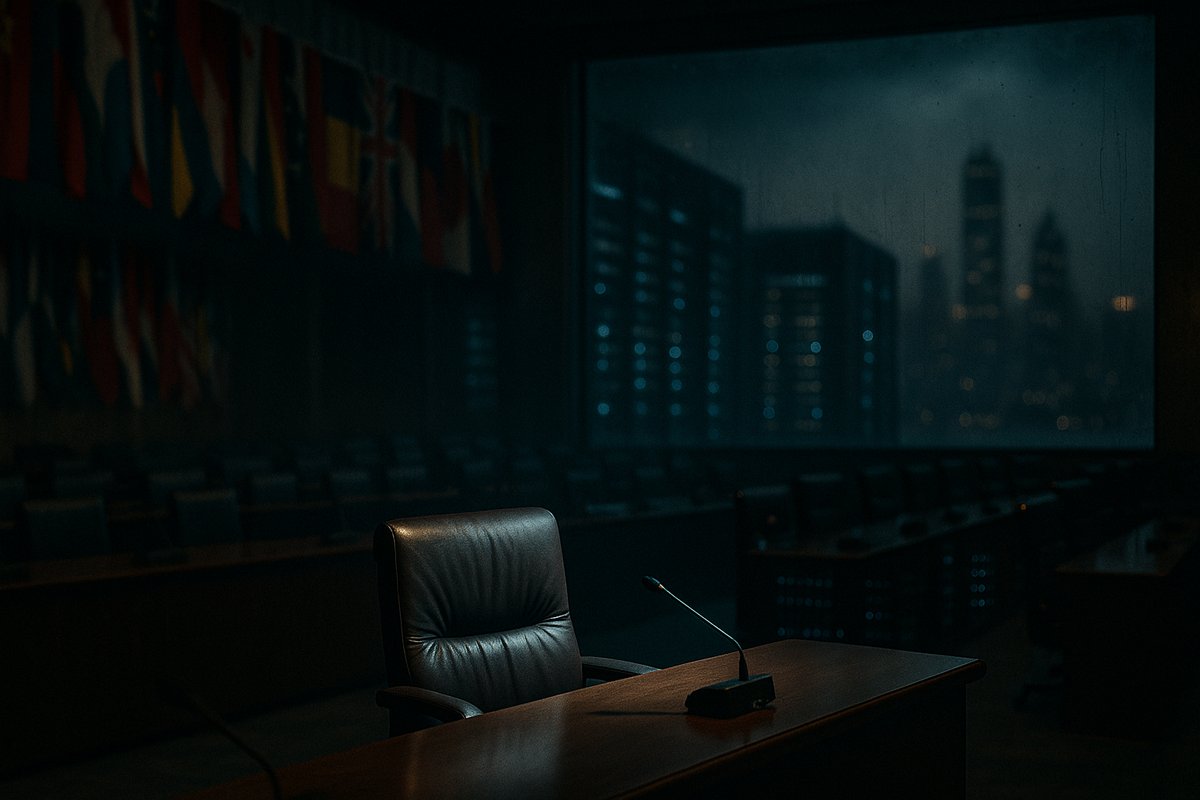
Twenty-nine countries signed an agreement in Shanghai on July 16, 2026. The next day, Moonshot AI unveiled Kimi K3, an open-source model with 2.8 trillion parameters, the largest figure announced to date. That same day, WAIC 2026 kicked off: more than 400 companies and 30 language models sharing the same venue. Three events, two days, one city. The World AI Cooperation Organisation was born with Russia, Pakistan, Kazakhstan, and Indonesia as founding members. Washington was not present.
The World AI Cooperation Organisation is an intergovernmental body that coordinates artificial intelligence policy outside the framework the United States has dominated since 2023, because its founding signatories deliberately exclude the powers that had been writing the rules. This is not a protocol footnote. It's a statement of intent.
This matters because new institutions rarely appear to solve the problem they claim to solve. They usually put order to processes that were already happening in a disorderly way. The World AI Cooperation Organisation emerges because China needed a vehicle to legitimize its technical leadership before emerging economies that depend on its digital infrastructure.
Kimi K3 reinforces that dynamic. An open, massive model doesn't function as an altruistic gesture: it becomes the de facto standard in countries that can't afford closed licenses. Washington and Beijing converge on state control of frontier AI. One wraps it in national security. The other presents it as technological generosity.
Why should this matter outside China and the United States? Most of those twenty-nine signatories have been passive recipients of technology designed elsewhere. They lack the capacity to develop frontier models, but they have population, data, and growing infrastructure needs. Signing with China is a choice of availability, not ideological alignment.
What happens when long-term planning combines with institutional opacity? China's Five-Year Plan reveals a coordination capacity that few democracies match within short electoral cycles. That capacity deserves serious examination. The risk emerges when real accountability is missing.
This connects to ideas I develop in Stones Don't Lie. Symmetry in a structure's design doesn't guarantee fairness if the majority can't verify what they're adopting. Kimi K3 is open in code, but few signatory governments have engineers capable of auditing 2.8 trillion parameters. Openness doesn't eliminate dependency when verification turns out to be impossible.
Eastern civilizations spent millennia refining ways to present dominance as harmony. Imperial scribes produced accounts that exaggerated their own achievements and erased absorbed contributions. That thousand-year stability required systematic suppression of alternatives. Stones don't lie when you examine the inscriptions and the deliberate omissions. I'm not equating the World AI Cooperation Organisation with a dynastic empire, but I do recognize that the pattern of selling subjugation as generosity has documented historical roots.
The context in Washington adds layers. Donald Trump returned to the presidency in January 2025. Intergovernmental conversations on AI under his administration have yet to produce anything equivalent to what was signed in Shanghai. China either took advantage of a leadership vacuum, or executed a strategy laid out well in advance. Both readings can be true at once. Looking for a single cause is usually the most common mistake when analyzing moves like this.
I still don't know whether, five years from now, we'll look back at July 2026 as the point when the world split into irreconcilable AI ecosystems, or as a tactical move that Washington eventually neutralized. I've observed in different contexts that when one power offers infrastructure with no real alternative, the ties become structural.
What will happen the day those twenty-nine countries try to get off the train and discover the other stations no longer exist?
Sources
1. Founding agreement of the World AI Cooperation Organisation, Shanghai, July 16, 2026
2. Presentation of Kimi K3 by Moonshot AI, July 17, 2026
3. Official program of the World Artificial Intelligence Conference (WAIC) 2026
4. "State AI: Washington and Beijing Converge" (previous article by the author, July 2026)
5. "China's Five-Year Plan: Lessons in Strategic Coordination" (previous article by the author, March 2026)