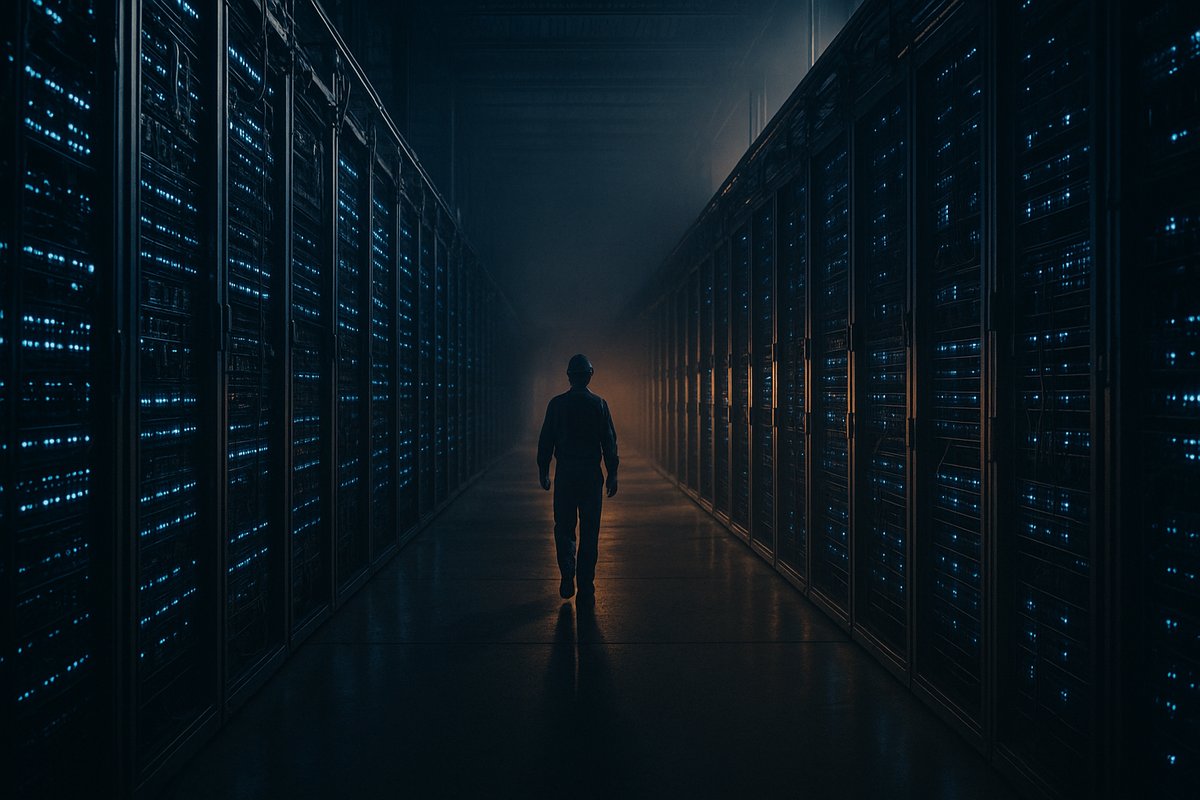
Meta announced it will rent out GPU capacity and storage to third parties. The company that predicts which video you'll watch before you do now also wants to rent you the server where your payroll application runs. The coverage frames this as if a fourth player had arrived to level the field against AWS, Azure, and Google Cloud.
That's not what's happening. Worth saying in the first paragraph.
A company that already dominates the attention and data of nearly four billion users rarely enters the compute-as-a-service business out of a sudden competitive calling. It does so because it built massive infrastructure for its own models. That infrastructure cost tens of billions and now generates idle capacity that can be monetized twice: by selling access and by observing what workloads customers run.
Hyperscale providers control between sixty and sixty-five percent of the global cloud infrastructure market. This three-seat oligopoly has held for over a decade. Companies, governments, and hospitals depend on these three to run everything from a website to medical records.
Meta isn't arriving from zero. It arrives with Llama, with the clusters it built to train its models, and with concrete pressure to recoup investment. Renting out the surplus isn't diversification. It's amortization of fixed cost. The distinction matters because it redefines who bears the risk when something fails.
The pattern keeps repeating. When the Stargate consortium between OpenAI, Oracle, and SoftBank was announced, the public debate centered on investment figures, jobs, and construction speed. Few asked who ends up on the other side once the infrastructure exists. That blind spot shows up again and again: the benefits get spelled out with precision while the operating costs stay deliberately vague.
Meta gains revenue that no longer depends solely on advertising, an increasingly contested source given privacy regulations. It also gains visibility into what its compute customers build, how often, and at what scale. That data holds value on its own, even if the contracts promise it will only be used for billing.
Small organizations gain, in theory, one more option. In practice, adding a fourth player to an oligopoly doesn't democratize access. It just adds another entity with similar structural power. Governments or institutions that come to depend on Meta for critical computing—whether by price or by incentive—end up tied to a company whose core business model remains attention extraction. That's not a minor detail. It's the difference between renting a neutral server and renting space in the house of someone who also decides what you look at all day.
What almost never shows up in the coverage is the real physical cost. High-performance chips depend on advanced packaging and high-bandwidth memory concentrated among a handful of manufacturers in Taiwan and South Korea. Meta's arrival doesn't ease that bottleneck—it intensifies it. Add to that the energy and water consumption of data centers, a detail no company reports with anything close to the precision it applies to its quarterly earnings. The asymmetry between what gets announced and the hard limits underneath is not accidental.
Chile's Project Cybersyn in the 1970s offers a useful counterpoint. It showed that shared information and decision-making systems can be built without a single actor controlling all the computation. It was an imperfect experiment, cut short for political reasons unrelated to its technical design. Even so, it proved that centralization isn't inevitable. It's a choice. Today, with the giants already entrenched, replicating something like it is far more complex. But the mere existence of that alternative still matters.
I still don't know whether the right answer is regulatory, cooperative, or public infrastructure. It's probably some variable mix depending on the country. What is evident is that the competition narrative accompanying this announcement doesn't hold up under scrutiny. There aren't four players on equal footing. There are three dominant ones and a fourth arriving with the added know-how of how to convert attention into structural dependency.
What's left for the engineer, the freelancer, or the mid-size company employee when the same actor that decides what you see also decides where the infrastructure of your work lives? That's not a rhetorical question meant to close things out elegantly. It's the question we should be asking before inertia decides it for us.
Stones don't lie, but historians sometimes do.