A study published in Nature found that nearly six thousand plant species used by Amazonian peoples face extinction. That figure is directly linked to the disappearance of one hundred fifty-six indigenous languages. The combined loss of species and local knowledge reaches between twenty-eight and thirty-four percent. This isn't just about plants. It reveals information structures collapsing before we've even finished reading them.
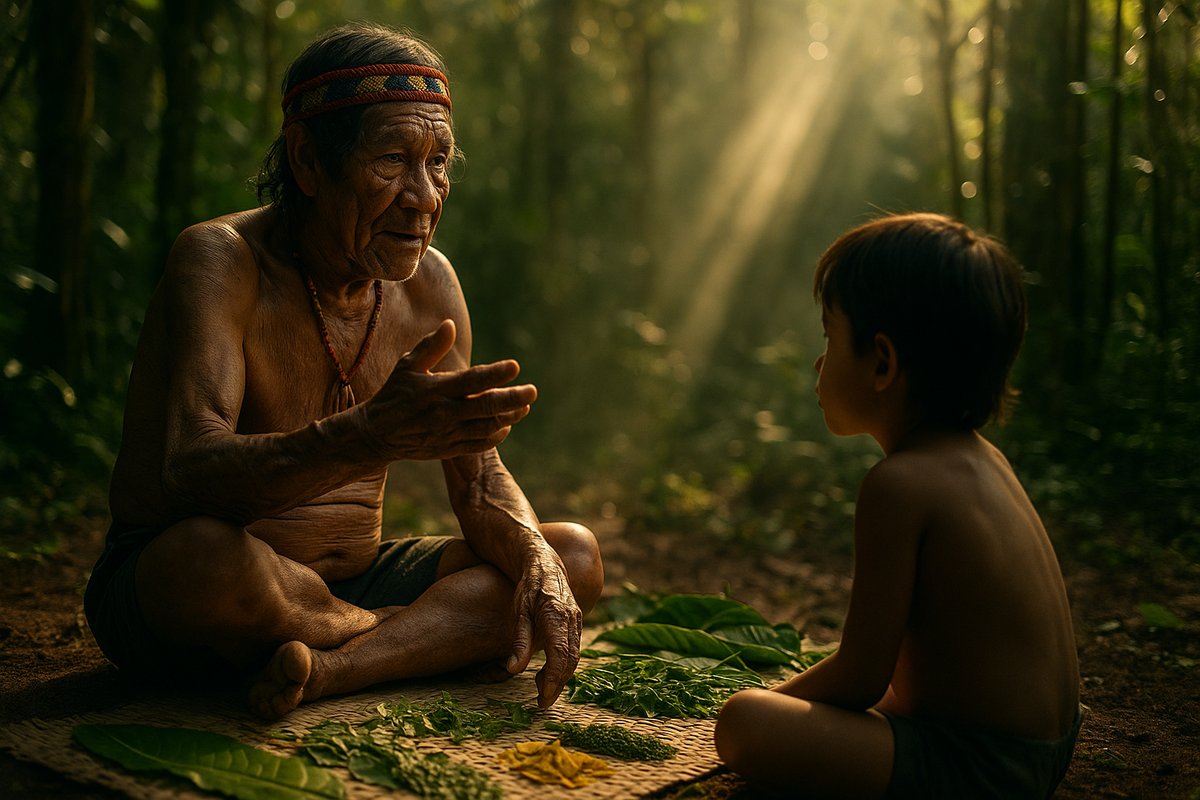
An Amazonian indigenous language is a distributed database because it encodes botanical taxonomies, medicinal uses, and ecological relationships accumulated over generations, with no central repository and no backup copy. When the last speaker disappears, the only functional access to information that Western science never recorded—and which, in many cases, cannot be reconstructed—disappears with them.
Why does this collapse look so much like another one that already happened five centuries ago? Because it repeats the same pattern at continental scale. When Europeans arrived in what is now the Americas, they brought diseases and a demographic collapse so severe that many native languages went extinct before they could be documented. More than ninety percent of native American languages have been lost or are critically endangered since then. The pharmacological and agricultural knowledge those languages carried—complete taxonomies of medicinal plants, techniques adapted to specific microclimates—vanished irreversibly. What little survives arrives fragmented, filtered through colonial chronicles that captured only a fraction of what was observed.
The same process is at work now, with different actors. Climate change displaces communities, deforestation fragments territories, and migration to cities rewards Spanish or Portuguese. Children stop speaking their grandparents' language. The functional outcome doesn't change: a knowledge model shuts down generation after generation without anyone managing to copy it in full.
The study was presented at COP17, where biodiversity conservation dominates the official agenda. Why does indigenous knowledge only become a scientific priority when it's on the verge of disappearing? Incentives explain much of the answer. Documenting endangered knowledge generates high-impact publications, urgent funding, and datasets with potential commercial value. Documenting stable knowledge, with no immediate threat, produces none of those outcomes. Urgency isn't just a diagnosis—it also sustains a model of attention and funding.
This is where the paradox of urgent biological prospecting shows up. While knowledge is documented in order to save it, the institutions that control those records capture the economic and scientific value. The communities that created that knowledge over generations are left out of the benefit. The dataset is offered as support for biocultural restoration efforts—an expression that sounds promising but has yet to translate into formal policies on compensation, shared intellectual property, or actual control by the communities themselves.
Pharmaceutical companies have patented compounds derived from that knowledge without compensating its original creators. The case of ayahuasca and the patent attempts in the United States during the 1990s remains the most cited example. The academics who document this knowledge gain something more subtle than money: narrative power. They become the cited source, the authorized repository. Meanwhile, the governments of Brazil, Peru, and Colombia continue to prioritize resource extraction over indigenous territorial protection, accelerating precisely the displacement that produces the linguistic loss the study laments with such academic precision.
The dynamic of extraction without compensation hasn't disappeared. It's been updated with conservation vocabulary. The Generosity in the Doorway explores a structurally similar process: how those who build the infrastructure of a problem end up managing its remedy as well. Something equivalent happens here. Whoever documents the loss usually ends up controlling access to the rescued knowledge afterward.
Documenting without transferring community control is not neutral. A language is not a static archive that gets digitized and stored away. It's a living model distributed among hundreds or thousands of speakers, where each one holds fragments, contexts, and nuances that no dictionary captures—because they were never needed until transmission started breaking down. When that model collapses, what remains is a void with the exact shape of what used to exist.
This connects to ideas I develop in Stones Don't Lie. The most resilient knowledge systems in human history never depended on a single channel. Mesoamerican civilizations kept critical information in codices, oral tradition, architecture, and parallel records simultaneously. They knew that trusting everything to a single medium is a bet you eventually lose. Amazonian peoples depend almost exclusively on intergenerational oral transmission for their botanical knowledge. Without redundancy, they face exactly the kind of failure that redundancy is meant to prevent.
What does this mean for biocultural conservation? The real window is measured in generations of living speakers. Any genuine effort would have to start by transferring control—not just access—to the communities. That requires recognizing collective intellectual property and funding revitalization programs led by the communities themselves. Neither measure is impossible to imagine. Both are politically uncomfortable because they redistribute power.
I still don't have a clear sense of how to scale these transfers effectively amid such strong pressures. I keep exploring the topic because history shows that distributed models survive better when granted real autonomy rather than well-intentioned external management.
Will we transfer control before the model finishes collapsing, or will we keep documenting the ruins and calling it rescue?
Sources:
1. Study published in Nature on the projected extinction of Amazonian plant species and its correlation with indigenous language loss
2. Discussion context at COP17 on biodiversity and traditional knowledge
3. Historical records on post-1500 American language extinction and the loss of colonial-era botanical taxonomies