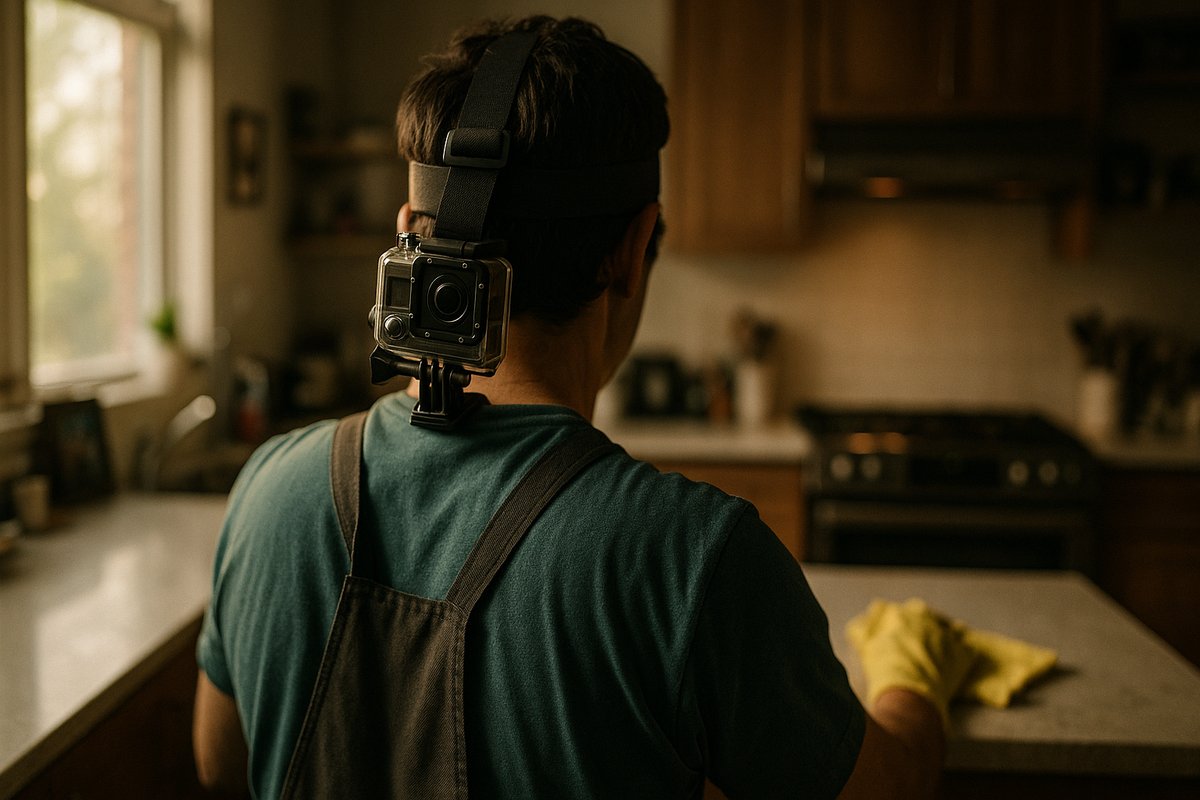
A German startup is offering free home cleaning in New York. The workers wear head-mounted cameras that record every corner of the house while they do the chores. Those recordings feed artificial intelligence labs. Some use them in-house. Others sell them to third parties.
MicroAGI unveiled its Shift app built around this scheme. The free service generates first-person video of household tasks. Models aiming to move autonomously through the physical world require millions of hours like these. Cleaning a kitchen or folding a sheet remain expensive movements to capture any other way. This mechanism turns privacy into currency.
What's emerging here follows a familiar pattern: find a regulatory gap and build an entire model around it. Data on human behavior in intimate spaces is worth a fortune for training robots. Previous projects poured huge sums into chasing exactly this. Paying with a free cleaning session disguises the real scale of the value being transferred.
The workers occupy an ambiguous position. They record environments that don't belong to them. Homeowners sign an agreement. Neighbors who appear through a window, documents left on a table, or personal items caught on camera fall outside that consent. In most states, the law doesn't require universal consent. That gap remains largely unmapped.
New York has been engaged in intense privacy debates. The federal framework leaves room when consent comes only from the primary occupant. The European data protection regulation would block this scheme in the company's home country. Exporting it to the United States isn't a coincidence. It's a deliberate choice of terrain.
This pattern shows up in different contexts. When a practice proves too aggressive in a regulated market, it gets shifted to another with weaker defenses. The resource being extracted has changed: it used to be raw materials or labor, now it's sequences of everyday action inside private spaces. The logic stays the same.
The workers' situation adds further layers. Classified as independent contractors, they wear the camera as a condition of the job. They generate value that multiplies inside AI labs. In return, they receive only the service rendered. This echoes other forms of invisible labor that prop up model training. The exchange is hard to measure fairly.
Offering money would make the price of data visible. Paying with a cleaning session whose cost is easy to estimate keeps the asymmetry opaque. An hour of vacuuming and folding has a known rate. An hour of quality footage for robotics can be worth orders of magnitude more. Most people opening their door have no idea of that gap.
I'm not sure how regulators will respond. New York could act quickly, or let the model take hold first. The recent track record of other technologies suggests delay. By the time rules arrive, the data will have already served its main purpose.
When studying ancient sites, archaeologists find traces of operations that maximized extraction before clear rules existed. The physical remains tell versions that the official records of the time left out. That historical layer offers a useful lens for reading the present.
The regulatory void doesn't look accidental. When a model's viability depends on the law not yet existing, arbitrage becomes the actual product. Those who bear the cost tend to be the ones with the least information and the least bargaining power: both the ones wearing the camera and the ones opening their door.
How much of our daily routine will end up as fuel for machines whose ultimate reach we can't even begin to imagine?