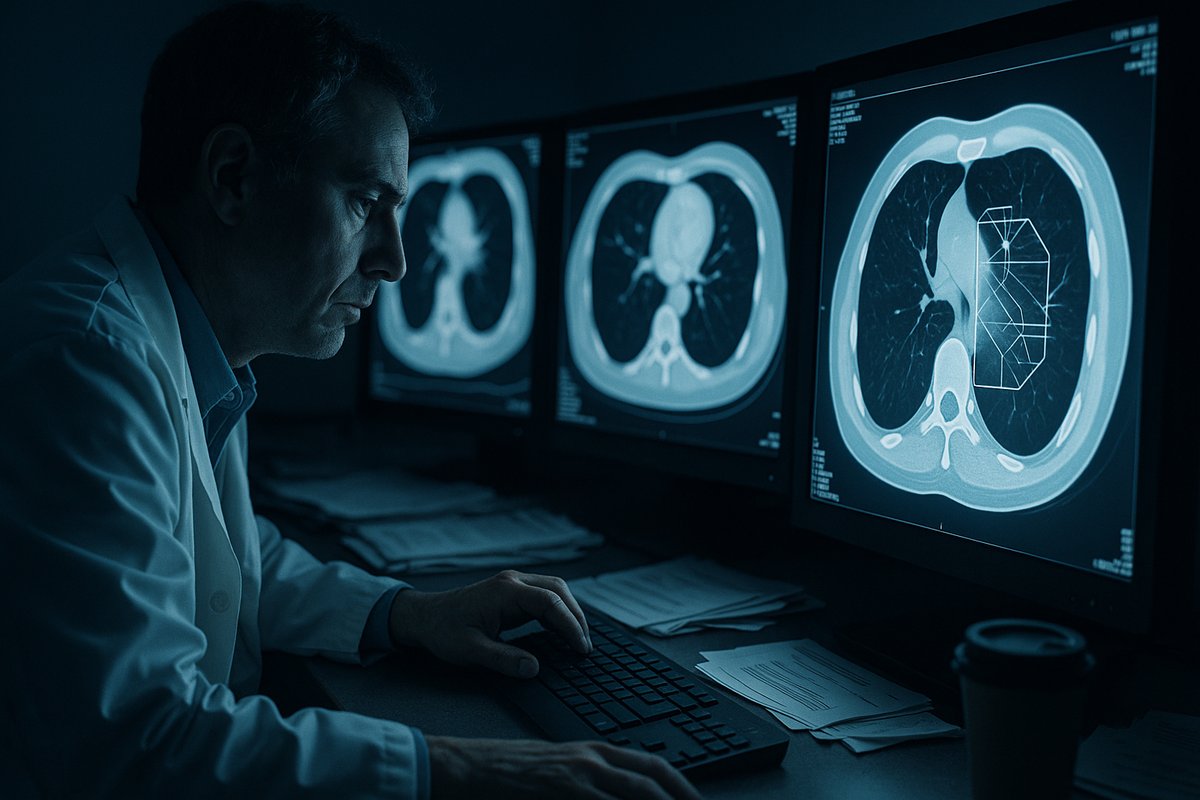
A company known for generating images from text announces its entry into medical diagnosis. If that doesn't stop the reading for a second, it might be worth rereading it. Midjourney, the image generator that popularized visual AI on social media, is developing what it describes as an artificial intelligence-based medical device. The move is bold. It also follows a trend that, when observed in other contexts, generates more questions than enthusiasm.
The relevant question isn't whether AI can bring something valuable to medicine. It already does, in specific areas. What matters is what it means for a company whose foundation is visual generation to compete where errors stop being aesthetic and become clinical.
This matters because the speed of entry into the medical market frequently outpaces scientific validation. It's not an unprecedented problem, but its current acceleration deserves sustained attention.
Midjourney's move fits into an environment where the FDA faces growing pressure to speed up approvals of AI devices. It also comes after we've seen how executive directives shortened years of validation in cases like ibogaine and psychedelics, when media and political pressure aligned the incentives. When visible influence replaces rigorous process, results become unpredictable. Patients end up absorbing that unpredictability.
What's known about Midjourney's device remains fragmentary. The company talks about medical image analysis, possibly oriented toward diagnostic imaging. That field already has players formed within the clinical context who have accumulated years of real hospital testing. Midjourney arrives from outside, with an architecture designed to produce plausible images, not to interpret pathology.
Here Yann LeCun's warning takes on direct clinical weight. Generative models optimize visual coherence and aesthetic plausibility. They don't grasp causality or reason through biological processes. A system that generates convincing healthy lungs doesn't necessarily detect actual pathology. The gap between these two capabilities separates a correct diagnosis from one that merely looks correct.
Accountability raises another concern. Medicine already faces oversight limitations even within established institutions. When a company whose culture was formed in visual entertainment enters the field, concrete questions arise: who answers when the algorithms fail, how transparently they operate, who audits their biases.
Meta's example is illustrative even though the field is different. Internal documents showed that harmful consequences were not accidents but predictable outcomes of decisions that prioritized business metrics. The incentive structure made it more profitable to ignore them. That same structure persists in any tech company entering medicine under pressure to grow and meet investor expectations.
There are successful cases of diagnostic AI that followed a different path. Google's model for detecting diabetic retinopathy, validated in real populations in India and Thailand, shows what happens when the process is rigorous and specific. The difference with Midjourney's announcement isn't technological but methodological.
Excavations at ancient Mesopotamian sites reveal that medical innovations adopted without sufficient controls generated complications that took generations to recognize. Stones don't lie. That record invites us to examine the current pace with care.
A rarely discussed aspect is the impact on emerging economies. When a device is approved in the Global North, it arrives in Latin American and African markets with much weaker regulatory oversight. Biases trained on specific populations get deployed onto different genetic, environmental, and social realities. From Mexico, this asymmetry is perceived with particular clarity. We are not the laboratory, but we are the destination of adoption.
The narrative of linear progress is tempting: because AI improved certain areas of diagnosis, more AI in more areas will automatically be better. Progress doesn't work that way. It requires specific validation, active vigilance, and the honesty to recognize when a tool isn't ready for the context where it's meant to be used.
I still don't have a clear answer for how to regulate this without paralyzing innovation or letting market speed outpace patient safety. It's a genuinely difficult balance. What does seem clear is that the right question isn't whether Midjourney can do this, but under what conditions, with what validation, with what accountability mechanisms, and who else takes part in that decision besides the company and the regulators.
Medicine has absorbed technological transformations before. Some brought lasting improvements. Others took us decades to recognize as mistakes. The difference was never just in the technology but in the adoption process. An image generator competing in medical diagnosis could deliver real value. The path between technical capability and clinical reliability, however, isn't traveled through announcements or investor pressure.
What conditions would make this expansion genuinely strengthen medicine without repeating already documented mistakes?
Sources
1. Midjourney — Official announcements on expansion into medical devices (company statements, 2025-2026)
2. FDA — Regulatory framework for AI/ML devices in medicine: Artificial Intelligence and Machine Learning in Software as a Medical Device (fda.gov)
3. Topol, E. — Deep Medicine: How Artificial Intelligence Can Make Healthcare Human Again (2019) — clinical validation of diagnostic AI
4. LeCun, Y. — Technical publications on the limitations of generative models in causal understanding (Meta AI Research, 2023-2024)
5. Beede, E. et al. — A Human-Centered Evaluation of a Deep Learning System Deployed in Clinics for the Detection of Diabetic Retinopathy, CHI 2020 — Google Health case in India