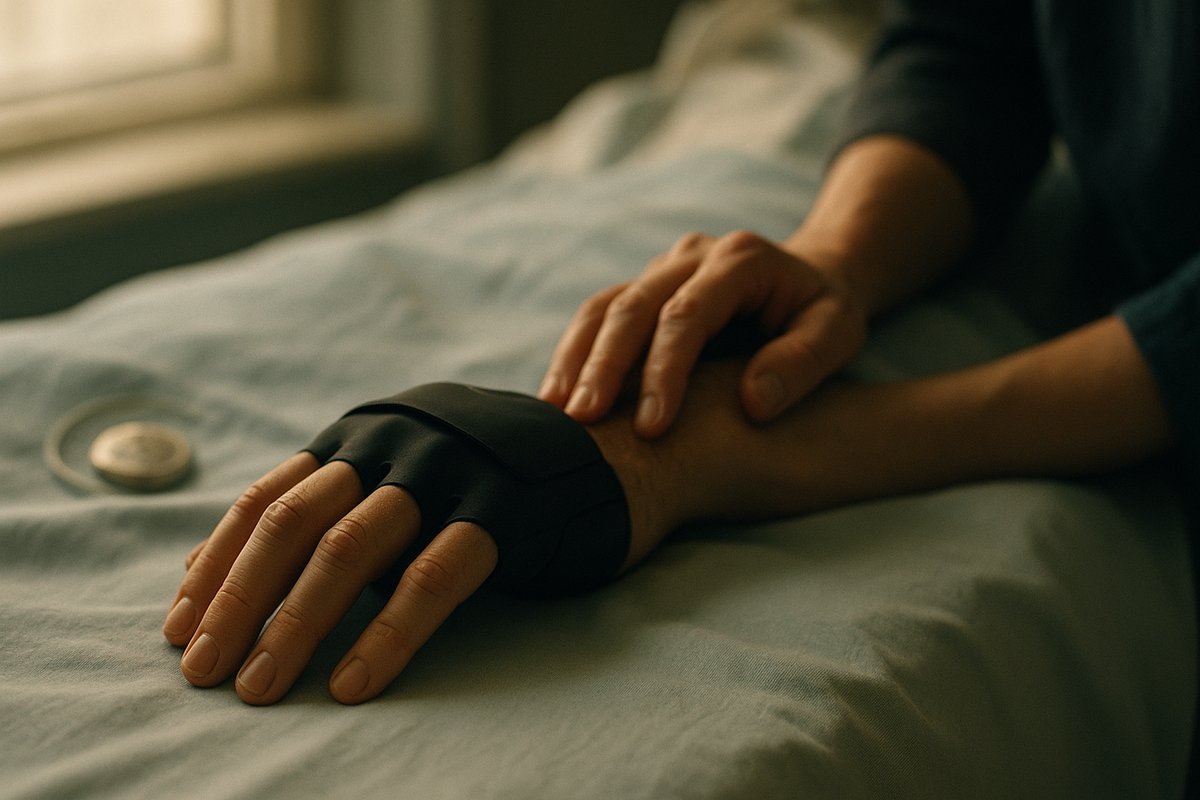
An implant the size of a coin lets a patient with a spinal cord injury move a robotic glove by thought alone. In March, Neuracle received the world's first commercial approval for an invasive brain-computer interface. It was granted by China's National Medical Products Administration. The NEO device captures electrical signals from the sensorimotor cortex, and it's already being prescribed.
A brain-computer interface is a translator, because it converts neural electrical impulses into commands that an external device executes: the brain generates measurable electricity every time it plans a movement. NEO translates the intention to move a hand into a signal that activates the glove. China turned a laboratory experiment into a regulated product, complete with a health registration number and a distribution channel.
I wrote before about this same device, exploring what it means for a country to arrive first at the market for neural data. The regulatory approval deserves its own analysis: it's no longer a question of whether this will happen, but what comes next now that it has.
In Stones Don't Lie I devote a chapter to the universal dynamics of dominance and to the idea that whoever controls the clock controls life. The same logic operates here. An implant that reads the sensorimotor cortex doesn't just detect motor intention: it captures the internal rhythm of decisions, the microseconds of hesitation, the fatigue curve, the flow of attention. It is the most intimate possible way of reading the biological clock.
After years studying social experiments, I recognize echoes of programs like MKUltra. Those tried to dominate the mind and ended up finding something more efficient: reading it in real time. The difference today is the legal framework. No one needs to force anything. The patient asks for it because they need it. That real need changes everything.
What does this approval add to the book's thesis? It shows that medical legitimacy accelerates the adoption of surveillance technologies faster than any coercion could. No one forced the patient with the spinal injury. He simply needed to regain mobility. This same regularity shows up again and again throughout history: people accept structures of dominance when they arrive wrapped in immediate solutions to concrete problems, from the ancient irrigation works of Mesopotamia to this robotic glove.
What challenges the original view is the regulatory speed. Structures of dominance used to consolidate over generations. Here, only a few years passed between the first experimental surgeries and national approval. The Chinese agency didn't create new categories: it adapted existing medical implant protocols to a type of data that no international regulation, not even the European one, yet treats as distinct from a conventional medical record.
Why didn't this happen first in the United States, with Neuralink, which has more time and resources? The answer has less to do with engineering than with risk tolerance. The American agency requires years of follow-up before authorizing broad commercial use. China considered that movement recovery in a paraplegic patient was sufficient evidence. Oversight would come later. This decision echoes a familiar tendency: ignoring limits when urgency makes them negotiable. Except here the terrain isn't a geological swamp, but a human brain.
Who controls the data the implant generates once it leaves the patient's body? That question becomes more relevant than the medical feat itself. A nationally approved device is governed by that country's rules, not by an international consensus that simply doesn't exist. NEO inherits that void. There is no global convention or World Health Organization standard comparable to the one governing genetic data.
This connects directly to The Generosity in the Doorway and the question of who owns the value generated by signals that previously had no price. A patient's sensorimotor cortex now produces a commercial data stream. The informed consent they signed probably doesn't anticipate what will happen to that information two decades from now. I keep exploring this subject, and I still don't know how it should be regulated without blocking the real help it offers.
Neuracle did nothing illegal. It followed the combined logic of medical need and market. That very normalcy is precisely what's unsettling. No villain was needed, only a regulatory void and a hand that needed to move again.
What will we do when these neural rhythms, the most intimate that exist, start feeding systems that go far beyond medicine?