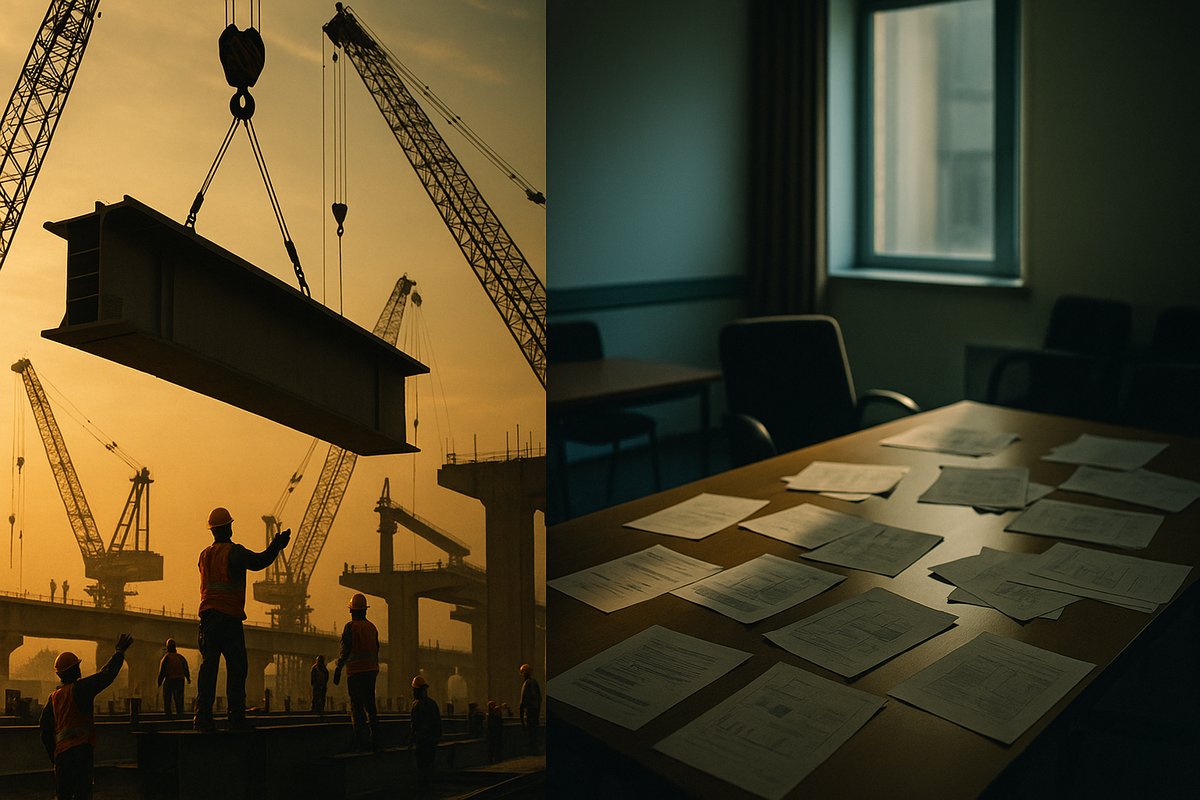
The team at @SimonLevyMx recently published an analysis of China's XV Five-Year Plan on their Patreon that deserves attention. They capture the essentials well: the 2026 Two Sessions are not a bureaucratic formality, but the formal approval of a roadmap for 2026-2030, a hinge moment according to geopolitical analysts. China doesn't announce vague intentions. It executes a plan with a name, dates, and an assigned budget.
That clarity stands in stark contrast to what happens in this region.
The plan bets on concrete sectors: quantum technology, biomanufacturing, hydrogen energy, energy fusion, brain-computer interfaces, embodied intelligence, and sixth-generation communications. This isn't a wish list. It's a state-scale allocation of resources. Unlike previous plans, this one doesn't chase accelerated growth but rather a re-engineering of the model: reducing dependence on exports and foreign investment, boosting domestic consumption, and prioritizing technological self-sufficiency. A deep redesign, not a superficial adjustment.
Simon and his team's analysis is right to highlight this shift in logic. What could enrich it is exploring why this transformation is viable in China and so elusive here.
The explanation lies in structural design, not just ideology. China has held the world's largest manufacturing value added for sixteen consecutive years — not because of superior ideas, but because of conditions that sustain execution. The world's largest hydroelectric dam isn't an isolated engineering feat. It reflects a decision on industrial competitiveness with a fifty-year horizon. No Western political system incentivizes decisions at that scale: four-year electoral cycles structurally collide with five-year plans.
I've observed this pattern across different contexts: when institutions fail to align incentives with long-term goals, the solid ideas that emerge from summits dissolve before they're ever executed. Coordination fails at the implementation stage. It's not that accurate diagnoses are lacking. The structures reward analysis and penalize sustained execution.
China's plan integrates childcare, pensions, and family support measures that are usually read as social policy, but they function as productive policy. They free up labor capacity precisely when the West faces aging populations and labor shortages. It isn't philanthropy. It's coherent optimization: integrated programs, not isolated initiatives competing for funding.
Where @SimonLevyMx's analysis could gain precision is in the tensions the plan doesn't fully resolve. Emerging industries alone are unlikely to drive enough investment for five percent growth. That keeps export dependence alive, with a trade surplus of $1.2 trillion in 2025. The plan promises to reduce that dependence, but current data contradicts that goal. This isn't a technical footnote. China is in the middle of a model shift, not at the end of one. Distinguishing between process and outcome matters.
Integrating artificial intelligence into ninety percent of the economy by 2030 requires more scrutiny. Not because it's unachievable, but because in a centralized organization, AI as cross-cutting infrastructure accelerates existing dynamics more than it transforms them. New tools within old structures don't alter them — they amplify them. This applies to any nation, China included.
The question about Latin America raised in the analysis is on point, but incomplete. It's not just whether the education systems of Mexico, Argentina, or Colombia are preparing people for the world of 2030. It's whether these structures can be redesigned in time. The honest answer is uncertain. Without an equivalent plan with a name, a date, and a budget, what we have are scattered intentions across electoral cycles that cancel each other out.
China has historical, demographic, and institutional conditions that can't be replicated by decree. I'm not arguing we should copy its model. What I am arguing, based on studied regularities, is that the absence of long-term strategic planning in our systems is not inevitable. It's a revisable design. There are historical cases of communities and organizations that aligned short-term incentives with lasting goals without a centralized state. These aren't utopias. They're successful experiments under specific conditions, from which practical lessons emerge.
What matters isn't what China achieves with these industries. It's what we do with our own structures. That answer demands an honest internal look — the same kind that China applies, with mixed results, to its own contradictions.
Stones don't lie, but historians sometimes do.
Sources:
1. English.gov.cn — Official text of the XV Five-Year Plan, 2026 Two Sessions
2. World Economic Forum — Analysis of China's economic model rebalancing
3. IndraStra Global — Internal tensions of the plan and export dependence
4. Wikipedia — Chinese manufacturing value added, 16 consecutive years as global leader
5. Patreon / @SimonLevyMx — Original analysis prompting this counterpoint