Gustave Le Bon wrote it in 1895 and no one wanted to listen. Or worse: those who did listen decided to use it as an instruction manual.
The Psychology of Crowds —originally published as Psychologie des Foules— is one of those books that operate in silence while most people remain unaware they exist. It's not on school curricula. It's not discussed on the evening news. And yet its foundations have been at work for more than a century behind every political campaign, every mass movement, every advertising strategy designed to make you buy something you don't need or vote for someone who doesn't serve your interests.
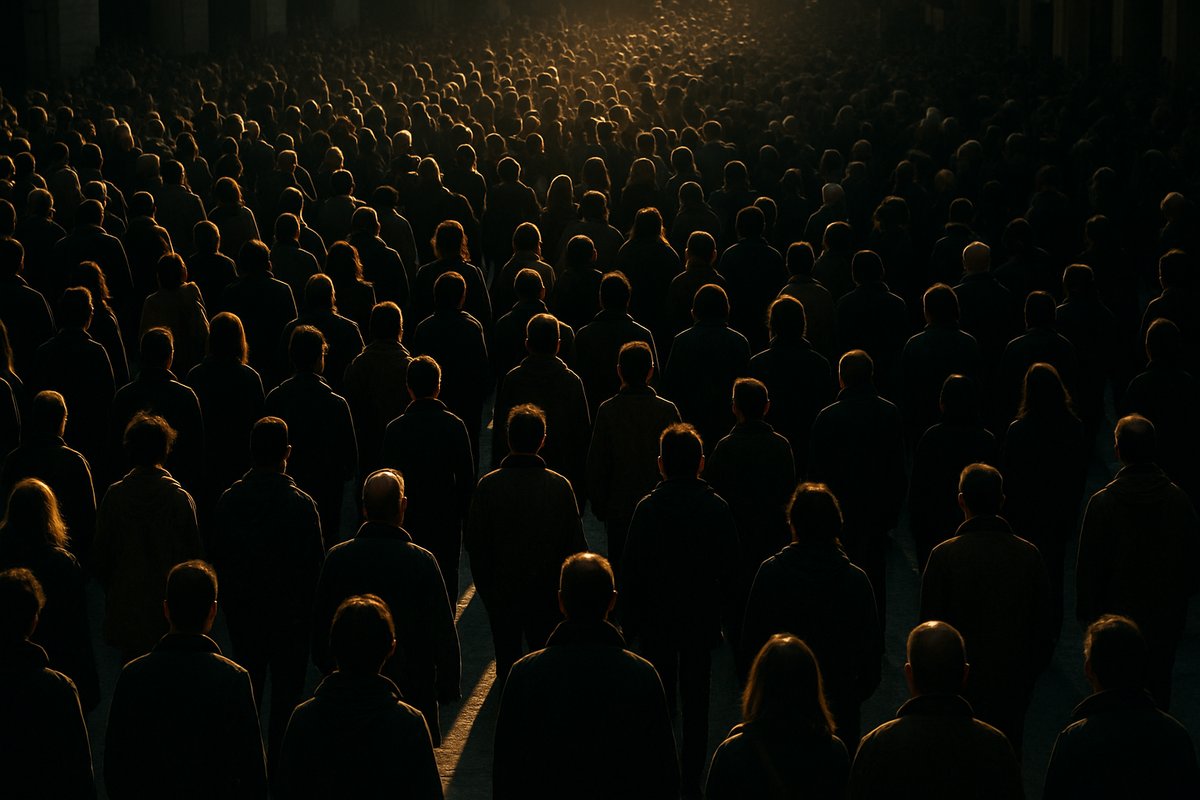
Le Bon was a physician, anthropologist, amateur physicist, and a ruthless observer of human nature. He lived through the Paris Commune, watched crowds destroy centuries of civilization in a matter of days, and set out to understand why. His conclusion was clear: when individuals merge into a crowd, they don't pool their intelligence. They lose it. They fuse into a new entity with its own characteristics, and that entity operates at an intellectual and moral level lower than that of any of its members taken separately.
He called it the "soul of the crowd" —l'âme des foules— and described three processes that produce it. First, anonymity: within the crowd, the individual feels their personal responsibility vanish. No one is guilty because everyone is responsible, which in practice means no one is accountable. Second, contagion: ideas and emotions spread without critical filter, person to person, amplifying with each jump. Third, suggestibility: the crowd enters a hypnotic-like state, where it accepts claims without verifying them, where image outweighs argument, where repetition breeds conviction.
Le Bon wasn't just describing medieval mobs or violent revolutions. He was describing any sufficiently large and emotionally charged human gathering. A stadium. A political convention. A religious congregation. A television audience. A social network. The process is the same: when the individual dissolves into the group, reason is suspended and instinct takes over.
Le Bon didn't write this book as a warning to crowds. He wrote it as a guide for those who wanted to lead them. He was explicit about it. He said the modern era was the "era of crowds" and that power would no longer reside in institutions but in whoever knew how to manipulate multitudes. He described with clinical precision what kind of leader a crowd needs: someone with magnetic presence, capable of repeating simple statements with absolute conviction, who appeals to images rather than arguments, who conjures a clear enemy, and who promises greatness.
Mussolini read Le Bon. So did Hitler. But not only them. Edward Bernays —Freud's nephew and the founder of modern public relations— took those ideas and applied them to the marketplace. His 1928 book Propaganda is essentially Le Bon adapted to sell soap and presidential candidates with the same method. Walter Lippmann, influential in shaping U.S. foreign policy for decades, drew from the same well. The premise they all shared: crowds cannot govern themselves, therefore they need to be guided, and guiding them is a technical art that requires understanding their irrational dynamics.
This is the knot that can't be ignored. Le Bon got his diagnosis right, but he stayed silent about who has access to that knowledge and who doesn't. The manual on how crowds work isn't taught in public schools. It's taught in business schools, in political communication programs, in the marketing departments of major corporations. Researchers have spent decades documenting how the techniques Le Bon described were refined through Skinner's behavioral psychology, Asch's conformity studies, Milgram's obedience experiments, and more recently through social media algorithms designed to maximize the emotional contagion Le Bon described.
The same process Le Bon identified in the public squares of the nineteenth century operates today in news feeds. The crowd no longer needs to be physically together. It's enough for it to share the same stream of information designed to generate outrage, fear, or euphoria. Emotions spread just the same. Critical thinking gets suspended just the same. The leader with a magnetic image and simple statements works just the same. Only now the scale is global and the speed is instantaneous.
I've observed these dynamics in organizations where collective decisions were often worse than individual ones — not because people were foolish, but because the group format activated exactly what Le Bon described: the desire for consensus crushed critical thinking, the leader's authority suspended doubt, and social pressure turned dissent into betrayal. This isn't a phenomenon exclusive to mobs. It operates in boardrooms, in parliaments, in families.
What Le Bon didn't explore sufficiently is whether these processes are inevitable, or whether there are ways of organizing that counteract them. There are signs that there are. Indigenous Australian governance models that combine slow deliberation with individual accountability, decision-making structures in some cooperatives that require every voice to be heard before a vote, structured dissent protocols that some organizations have adopted to avoid groupthink. These aren't definitive solutions. They're experiments suggesting that collective irrationality isn't a fixed fate but a consequence of specific structures that can be designed differently.
The problem isn't that people are stupid. The problem is that the organizations in which we sit down to think together are designed, often deliberately, to activate irrational dynamics rather than rational ones. As long as that remains true, as long as Le Bon's knowledge remains the property of those who want to lead crowds rather than of those who don't want to be led, the equation doesn't change.
Reading The Psychology of Crowds isn't an academic exercise. It's an act of self-defense. Understanding how the process works is the first step toward not being an unwitting part of it. It guarantees nothing. But ignorance does guarantee something: that you'll keep being exactly the raw material someone else needs to build their crowd.
Stones don't lie, but historians sometimes do.
Sources:
1. Le Bon, Gustave. Psychologie des Foules (1895). Spanish edition: La Psicología de las Masas, Morata, 2005.
2. Bernays, Edward. Propaganda (1928). Spanish translation: Melusina, 2008.
3. Asch, Solomon. "Opinions and Social Pressure." Scientific American, 1955.
4. Milgram, Stanley. Obedience to Authority (1974). Harper & Row.
5. Lippmann, Walter. Public Opinion (1922). Harcourt, Brace and Company.