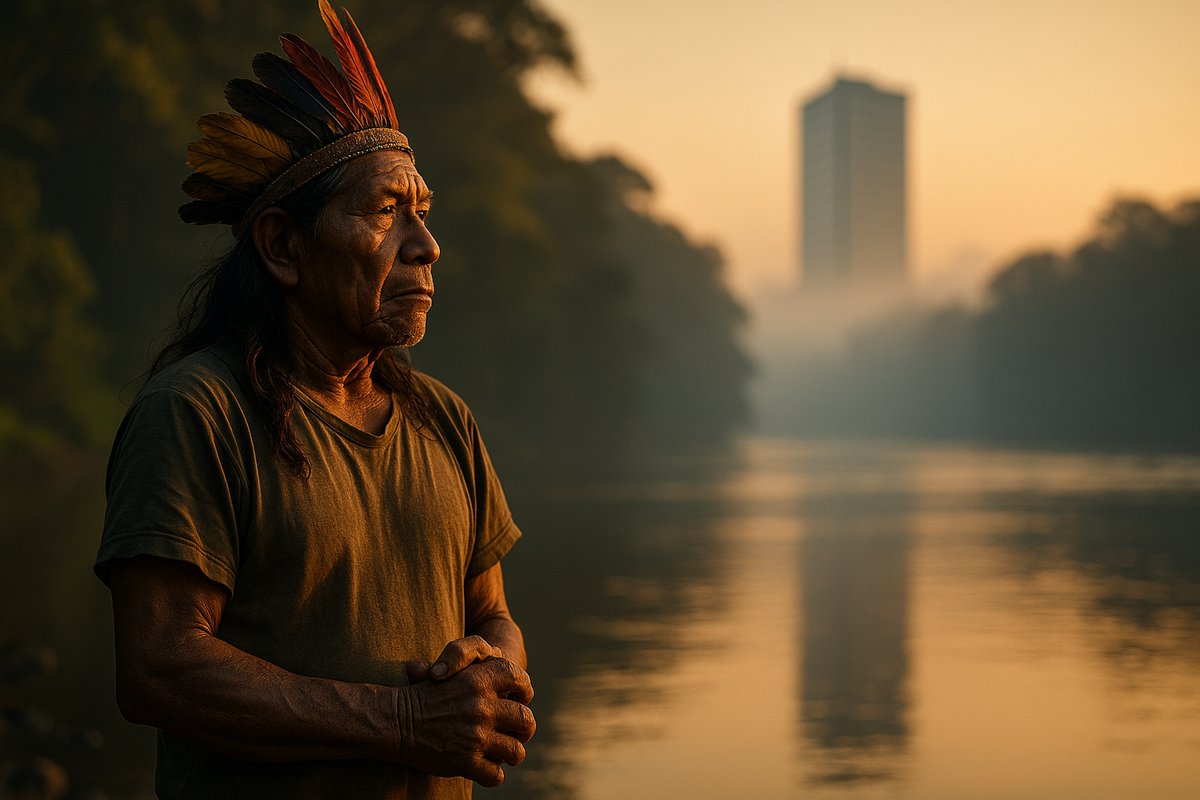
In an interview published by Mongabay Latam, a Latimpacto spokesperson dropped an uncomfortable figure: of every dollar committed to climate financing in the Amazon, only a minimal fraction reaches the indigenous organizations and local communities that manage the territory. The rest gets lost among consultancies, executing agencies, and successive layers of administration supposedly there to guarantee the proper use of resources.
This figure surprises no one who follows the issue. But stating it with a name and an institution attached changes its weight. The problem this piece dissects isn't the mere existence of the diversion, but the structure that makes it possible—even logical—within the current climate financing model.
The dominant narrative, the one that shows up at summits, UN communiqués, and multilateral bank reports, paints a picture of decisive progress. Billions get announced to protect the rainforest. The pledge of $1.7 billion at COP26 for indigenous peoples and local communities as guardians of tropical forests sounds like a turning point. Green funds, carbon credits, and payments for environmental services would complete the equation: countries in the North pollute, countries in the South conserve, and money balances out the asymmetry.
There's something worth salvaging in that idea. Recognizing that the Amazon provides planetary services no laboratory can replicate—carbon capture, water regulation, biodiversity—deserves compensation. It's conceptual progress compared to decades of treating the rainforest as a free resource. These financing mechanisms correct, in theory, a historic market failure. Specific cases in Ecuador, Peru, and Brazil show that money sometimes arrives directly and produces effective forest management. Not everything is a façade.
And yet, the same report points to gaps that in some programs exceed eighty percent between what's announced and what's actually disbursed. This isn't a technical detail: it's the difference between a declaration and an actual operation. Reports from the Climate Policy Initiative document that a large share of funding earmarked for the Amazon stays put in donor capitals or regional offices, paying for feasibility studies, capacity-building consultancies, audits, travel expenses, and meetings to decide how to distribute what still hasn't been distributed.
This pattern replicates, almost precisely, what was observed in the IMF and World Bank's structural adjustment programs during the 1980s and 1990s. Loans conditioned on reforms arrived wrapped in a bureaucracy dedicated to verifying that nothing strayed from the script written in Washington. Joseph Stiglitz described how those programs impoverished millions while institutional documents celebrated macroeconomic stabilization. Indigenous communities have managed these territories for centuries, as confirmed by archaeological findings and historical records of sustainable practices that sustained the rainforest long before any modern climate fund existed.
The parallel with today's climate financing is structural. An actor from the North designs the rules, sets the conditions, hires the intermediaries, and then reports the original commitment as a victory. Only the vocabulary changed: from structural adjustment to climate governance. The retention at each layer remains identical. Those who design the process rarely face its direct consequences on the ground.
Who benefits from this persistent gap? Institutional intermediaries charge management fees ranging from fifteen to thirty percent before a single dollar touches the rainforest. Donor governments get to declare compliance to voters and the UN without detailed public verification. Multilateral institutions retain control of the success narrative. No one has a real incentive to close the gap, because the gap itself is what sustains the model.
I see this same pattern in other contexts: protocols that promise openness end up reinforcing concentrated nodes; designs that announce the elimination of intermediaries generate new, more opaque ones. It's not conspiracy—it's the regularity of incentives. The distance between promise and execution captures value before it ever reaches its destination.
Almost no one at the summits asks why we keep measuring progress in dollars committed, rather than in hectares actually protected, effective territorial control, or verifiably declining deforestation. Reports celebrate announcements. Independent audits with public data remain absent. That absence isn't bureaucratic oversight—it's functional for those who benefit from the narrative going unverified.
Models of direct cooperation between Amazonian organizations and Southeast Asian conservation networks are starting to emerge. They share extractive pressures, fragile territorial rights, and the same frustration with intermediaries from the North. These exchanges are still experimental. Whether they'll scale enough to displace the current structure remains unclear, and their limits are still open territory.
What's verifiable, according to analysis by Rainforest Foundation Norway, is that funds with a single intermediary show forest conservation effectiveness rates up to three times higher. Efficiency doesn't lie in the size of the announcement, but in the shortest distance between whoever promises and whoever receives.
What flow architecture would it take for money to cross that distance without getting lost along the road of good intentions?
Sources
1. Mongabay Latam — Interview with Latimpacto on climate financing gaps in the Amazon
2. Climate Policy Initiative — Reports on disbursement vs. commitment in global climate financing
3. Joseph Stiglitz, "Globalization and Its Discontents" — analysis of IMF and World Bank structural adjustment programs
4. Rainforest Foundation Norway — Studies on the effectiveness of direct financing to indigenous communities
5. United Nations, COP26 — $1.7 billion commitment for indigenous peoples and local communities (2021)