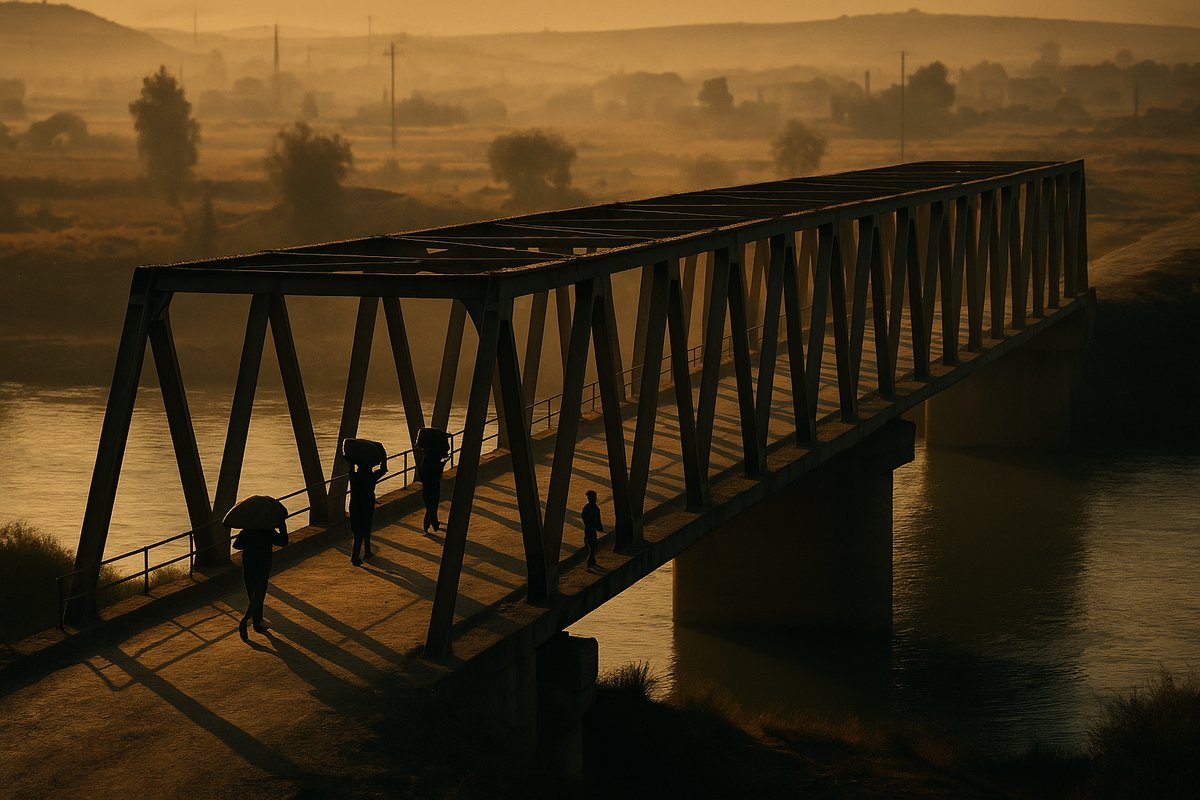
The Semalka bridge remains Rojava's only connection to the outside world. A lifeline that grows more fragile by the day as forces of Syria's transitional government, backed by Turkey, intensify their offensive against the autonomous region in northeast Syria. What began on January 6, 2026, as a coordinated military operation has become the gravest threat this experiment in democratic confederalism has faced since it was established more than a decade ago.
Kurdish intellectuals in Tel Tamer have issued urgent public calls for unity, warning that the very survival of the project is at stake. Meanwhile, five ISIS sleeper-cell attacks last January have added another layer of complexity to a crisis that threatens to wipe one of the most innovative social experiments of our time off the map. The combined forces of HTS and remnants of the Islamic State have given the Autonomous Administration a brutal choice: total surrender or complete physical annihilation.
I find this pattern intriguing. In my experience studying social systems, I've seen how genuine experiments in alternative organization rarely collapse from internal failure. They are destroyed from outside, systematically, by forces that cannot allow alternatives to the established order to thrive. This connects directly to the themes of my book on resilient systems, where I explore how horizontal structures can inspire lasting change, even under pressure.
The Paris Commune lasted exactly 72 days in 1871 before being crushed by a combination of external military pressure and international isolation. The Communards had created a system of democratic self-governance that included direct worker participation in decision-making, separation of church and state, and pioneering measures of social equality. It didn't collapse because the model was flawed; it was destroyed because it represented an existential threat to the European bourgeois order of the time. What's interesting here is that, despite its abrupt end, its ideas influenced later movements, suggesting there are paths for preserving legacies.
The same pattern repeated during the Spanish Republic between 1936 and 1939. The collectivizations in Catalonia and Aragon had demonstrated that it was possible to organize production horizontally, with workers managing factories and peasants coordinating agriculture without traditional hierarchical structures. George Orwell documented these experiments in "Homage to Catalonia," describing a society where "for the first time in my life, I found myself in a place where the working class was in the saddle." But the coalition of fascist forces, backed by Nazi Germany and Mussolini's Italy, could not allow this model to consolidate and spread. I think about how these historical accounts, verifiable in archives and testimonies, show us that destruction doesn't always erase the knowledge gained.
Rojava had achieved something even more complex: implementing a system of democratic confederalism that combined local autonomy with regional coordination, incorporating principles of social ecology and institutional feminism. The "Women's Revolution" wasn't just rhetoric; power structures included mandatory co-chairmanships between men and women, and the women's defense units (YPJ) had proven effective both against ISIS and in building new forms of horizontal military organization. I'm no expert in all the regional dynamics, but what I've observed suggests these approaches could be adapted in other contexts.
What's fascinating from a systems-analysis perspective is how these experiments develop internal resilience mechanisms yet remain vulnerable to coordinated external shocks. Rojava had withstood years of pressure from ISIS, had navigated the complexities of the Syrian civil war, had maintained its autonomy against pressure from both Damascus and Ankara. But the withdrawal of Western support and the coordination among Syria's transitional government, Turkey, and armed groups created a perfect storm that no local system of governance can withstand alone. Even so, this invites us to ask: what alternatives might strengthen these structures in the future?
The forced agreement of January 2026 between the Autonomous Administration and Damascus marks what analysts describe as a "forced capitulation." The integration of the Syrian Democratic Forces into the Syrian Arab Army represents a critical moment: when popular militias become institutionalized into vertical military structures, it historically signals the end of the revolutionary process. It's the moment when horizontal experiments turn into conventional hierarchical systems. Still, there's room to reflect on how to preserve horizontal elements within broader frameworks.
This doesn't mean Rojava failed as a social experiment. On the contrary, for more than a decade it demonstrated that it was possible to organize a society in a radically different way, even amid a devastating war. It built institutions that functioned, developed forms of decision-making that included Arab, Kurdish, Assyrian, and Yazidi communities, and upheld principles of social justice while defending territory against one of the most brutal groups in recent history. Its legacy, backed by reports and testimonies, could inspire alternatives elsewhere.
The pattern we're observing is geopolitical, not organizational. Genuine social experiments represent systemic threats to the established order, not just locally but globally. Had Rojava consolidated its model and begun inspiring similar movements in other regions, it would have called into question fundamental narratives about the necessity of centralized states, about the inevitability of patriarchal domination, about the impossibility of combining direct democracy with effective military defense. I still don't have a clear answer for how to break this cycle entirely, but I believe understanding these patterns is the first step toward more resilient solutions.
The tragedy is that we're watching, in real time, the repetition of historical patterns we've already identified. But geopolitics operates by its own logic, and innovative social experiments continue to be systematically destroyed before they can consolidate and spread. In a brief digression, I recall how indigenous movements in Latin America have navigated similar pressures through transnational networks; perhaps something similar could apply here, connecting Rojava with global allies for greater sustainability.
Israeli kibbutzim survived because they had state protection, but they lost their experimental character upon integrating into capitalist economic structures. The Zapatistas in Chiapas have maintained their autonomy for three decades, but within a context of relative isolation that limits their capacity for expansion. Rojava attempted a middle path: maintaining revolutionary principles while participating in broader geopolitical dynamics. This suggests there are viable alternatives, such as strategic alliances that balance isolation and engagement.
Perhaps the lesson isn't that these experiments are doomed to fail, but that we need to better understand the conditions that allow them to survive and consolidate. The knowledge generated in Rojava about democratic confederalism, about horizontal military organization, about the institutionalization of feminism, doesn't disappear with military defeat. It becomes accumulated experience for future experiments. I write this because I believe there are paths forward, inviting everyone to reflect on how to support these models more effectively.
Stones don't lie, but historians sometimes do.