Few people act out of pure altruism. That's a simple observation about how human interactions work. When someone offers help, there's usually a return: emotional, reputational, or strategic. Extending this idea to nations, especially the most influential one in the world, is not a conspiracy theory. It's a logical way to analyze the problem. The relevant question is different: what real benefits does the U.S. pursue in its global actions?
Trump doesn't operate out of philanthropy. His business track record, his negotiating style, and his own rhetoric all demonstrate that. Reading his geopolitical decisions from that angle isn't an extreme approach. It's consistent with his method. And once you do, the official narrative starts to show cracks.
Take Venezuela. The official argument talks about promoting democracy and freedom. Sounds noble. Venezuela also holds the largest certified oil reserves in the world, surpassing Saudi Arabia. Sanctions haven't removed Maduro, but they have deepened the economic and migration crisis, which reinforces anti-left narratives across Latin America. Is this only about democracy, or also about access to resources? The region's history, with its well-documented interventions, suggests it's worth examining who benefits economically after any regime change.
Cuba illustrates how an embargo can persist despite its declared ineffectiveness. If the goal were to improve the lives of Cubans, the blockade would have ended decades ago: the data show it hurts the population more than the government. Cuba functions as a deterrent symbol for the rest of Latin America. A prosperous, independent Cuba would challenge the dominant narrative of what's possible in the region.
In Mexico, tariff pressures, the immigration agenda, and references to cartels go beyond the shared border. Mexico is the U.S.'s second-largest trading partner, within a structurally unequal relationship of dependency. Using migration and security as levers maintains that asymmetry and turns Mexico into a filter for Central American flows. For Trump, this also produces a convenient external antagonist for campaigning. The wall was never meant to stop everything; it helped mobilize votes.
With Iran, sanctions and military tensions are justified by non-proliferation and counterterrorism. Iran doesn't possess nuclear weapons, unlike Israel, which never signed the Non-Proliferation Treaty and receives unconditional support from Washington. The real distinction lies in geography: Iran controls the Strait of Hormuz, a route for a third of the world's oil, and maintains ties with Russia and China. It's a central piece in energy strategy and containment, not an isolated case of security policy.
The relationship with Israel goes beyond politics. The U.S. sends billions in military aid every year, no strings attached. Officially, it's due to democratic and historical bonds. In practice, Israel operates as a stable platform in the Middle East, vital to the region's energy dominance. The weight of lobbying in Washington adds an electoral dimension that no candidate ignores. This isn't about prejudice; it's about dynamics of influence, similar to those of the arms or pharmaceutical industries.
NATO is an arrangement the U.S. designed to its own measure. After World War II, it built a network that guarantees arms sales, bases on European soil, and the authority to define what counts as a threat. When Trump pushes for more defense spending, the direct beneficiaries are companies like Boeing or Lockheed Martin. Europe remains tied down on security matters, with limited autonomy. That dependency didn't happen by accident.
In Ukraine, the official line defends the country's sovereignty against the Russian invasion, which is an undeniable fact. The context includes NATO's eastward expansion, which Moscow interpreted as provocation for years. Ukraine serves to wear down Russia without committing U.S. troops directly, while the defense industry posts record profits. Zelensky gets weapons; the U.S. gets real combat data and the weakening of a strategic adversary. Ukraine matters, but not only for the reasons presented in public.
China and Taiwan mark the convergence point of everything above. Taiwan manufactures ninety percent of advanced semiconductors through TSMC, components essential to civilian technology, artificial intelligence, and weaponry. The U.S. would not tolerate China dominating that supply chain. The defense of Taiwanese democracy is partly genuine, but the central focus is economic and technological. Whoever controls the chips defines the century. Beijing and Washington both know it, which is why the CHIPS Act pours investment into domestic production with an urgency not seen in other sectors.
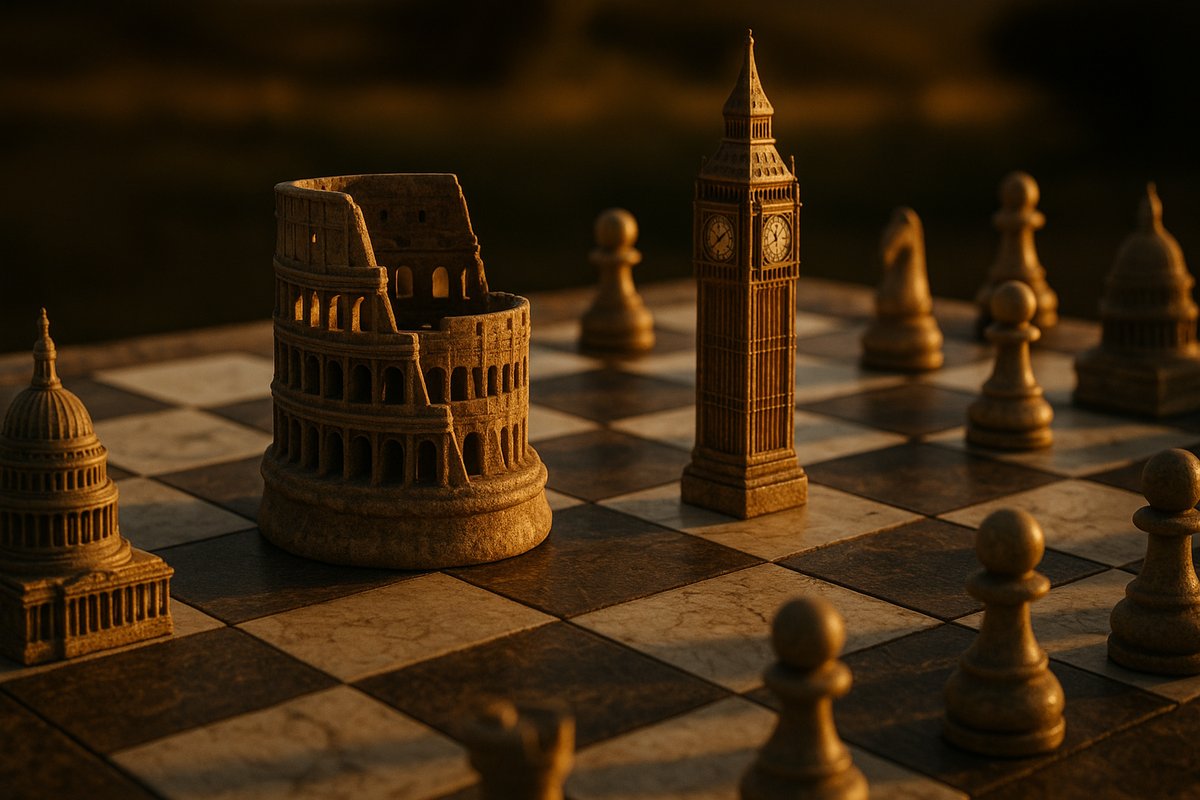
This playbook repeats itself throughout history. The U.S. didn't invent it: Rome practiced it, the British Empire refined it, Washington adapted it to the twentieth century. The vocabulary changes—democracy instead of civilization—but the core remains the same: projecting power toward resources, trade routes, or geopolitical rivals. Questioning it isn't hostility toward the U.S. It's an honest reading of the historical record.
Some elements remain opaque, like the interplay between external pressures and internal dynamics within each country. Nothing works on a single factor. But questioning the official narrative produces a more accurate picture than simply accepting it. The next time the U.S. pushes a sanction or an alliance in the name of freedom, it's worth asking: what resources are at stake? Who benefits in the long run?
Stones don't lie, but historians sometimes do.
Sources:
1. Chomsky, N. & Prashad, V. The Withdrawal: Iraq, Libya, Afghanistan, and the Fragility of U.S. Power (2022)
2. Kinzer, S. Overthrow: America's Century of Regime Change from Hawaii to Iraq (2006)
3. TSMC Annual Report & U.S. CHIPS and Science Act documentation (2022)
4. U.S. Energy Information Administration — Venezuela Crude Oil Reserves data
5. Stockholm International Peace Research Institute (SIPRI) — Military Expenditure Database