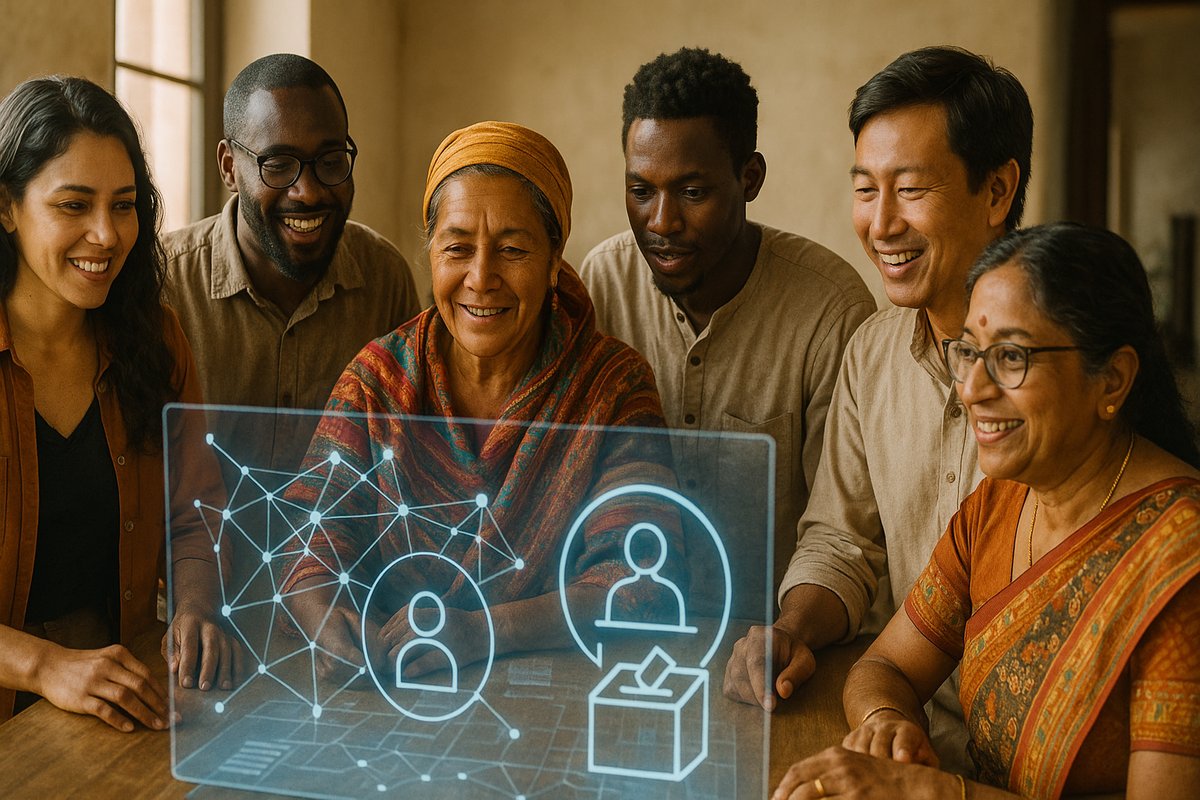
BRICS countries have approved a Declaration on global AI governance that departs from the usual Silicon Valley voices. Rather than focusing on efficiency or rapid growth, they prioritize protecting the most vulnerable and algorithmic transparency in service of citizens, not tech elites. This shift in narrative invites us to consider real alternatives to the dominant models.
While the United States and Europe debate regulations for Big Tech, nations in Latin America, Africa, and Asia are exploring bolder approaches: AI systems built from the ground up to foster citizen participation. This isn't about tweaking imported algorithms, but building options tailored to local contexts. In my experience, I've seen how these initiatives emerge from concrete needs, echoing themes from the book about how technology can empower rather than centralize power.
This calls to mind the participatory budgeting experiment in Porto Alegre, implemented for several years at the end of the twentieth century. There, citizens directly allocated public resources, cutting out political intermediaries. It reduced corruption and boosted overall satisfaction. It required civic education and sustained commitment. The technology was simple: meetings, paper ballots, manual calculations. Today, with AI, the possibilities expand.
An intriguing historical parallel is the Mondragón cooperatives, which since the mid-twentieth century have shown that horizontal structures can outperform corporate hierarchies in efficiency. They coordinated complex decisions among thousands of worker-owners using the tools available at the time. Today's AI could replicate that at a larger scale, across municipalities or entire countries. What's interesting here is how these historical lessons, like the ones I explore in the book, suggest that innovation arises from the ground up.
In the Global South, current experiments are moving down that path. Simulation platforms let people foresee the impacts of policies before deciding. Participatory budgeting systems process mass proposals and surface shared priorities. Tools translate official documents into indigenous languages using local AI models. A brief digression: I wonder whether these linguistic adaptations don't just inform, but actually preserve oral cultures at risk—a theme that connects to archaeological evidence of how ancient societies transmitted knowledge without centralized writing.
What's notable is that these countries are innovating without waiting for Big Tech's approval. They're developing lightweight AIs for modest infrastructure, with algorithms open to citizen audits and designs that strengthen communities rather than exploit data. Who controls the design makes all the difference. Facebook's or Google's platforms chase engagement and data; those of marginalized communities chase transparency and real control.
I recognize similar patterns in other fields. The strongest technological solutions are born when users co-design them. It's no surprise that successful digital cooperatives come from groups excluded from tech centers. This matters because it opens doors to viable alternatives, not just criticisms of the status quo.
The risk persists: like so many e-governance projects in the Global South in past decades, these could fail and end up benefiting only urban elites. But there's now greater awareness of biases and tools to audit them. Furthermore, geopolitical pressure from the United States and China is pushing a third way: multipolar technological sovereignty, independent of superpowers.
This isn't about instant perfection. There will be failures, adjustments, and opposition from elites who prefer opacity. The key is to learn from mistakes, as in Porto Alegre, rather than abandoning ship at the first stumble. I still don't have a clear answer for how to balance privacy in open systems or prevent seemingly neutral algorithms from worsening inequalities. That uncertainty justifies experimenting, not resigning ourselves.
The margins have long been seedbeds of social innovation: cooperatives, unions, civic movements, all from communities kept apart from power. Now they have access to coordination tools once exclusive to governments and corporations. Perhaps we're witnessing the dawn of technology that serves citizens rather than extracting value. It won't be flawless or fast, but it's worth attempting. The alternative is ceding decisions to algorithms that are foreign and unrepresentative.
Stones don't lie, but historians sometimes do.