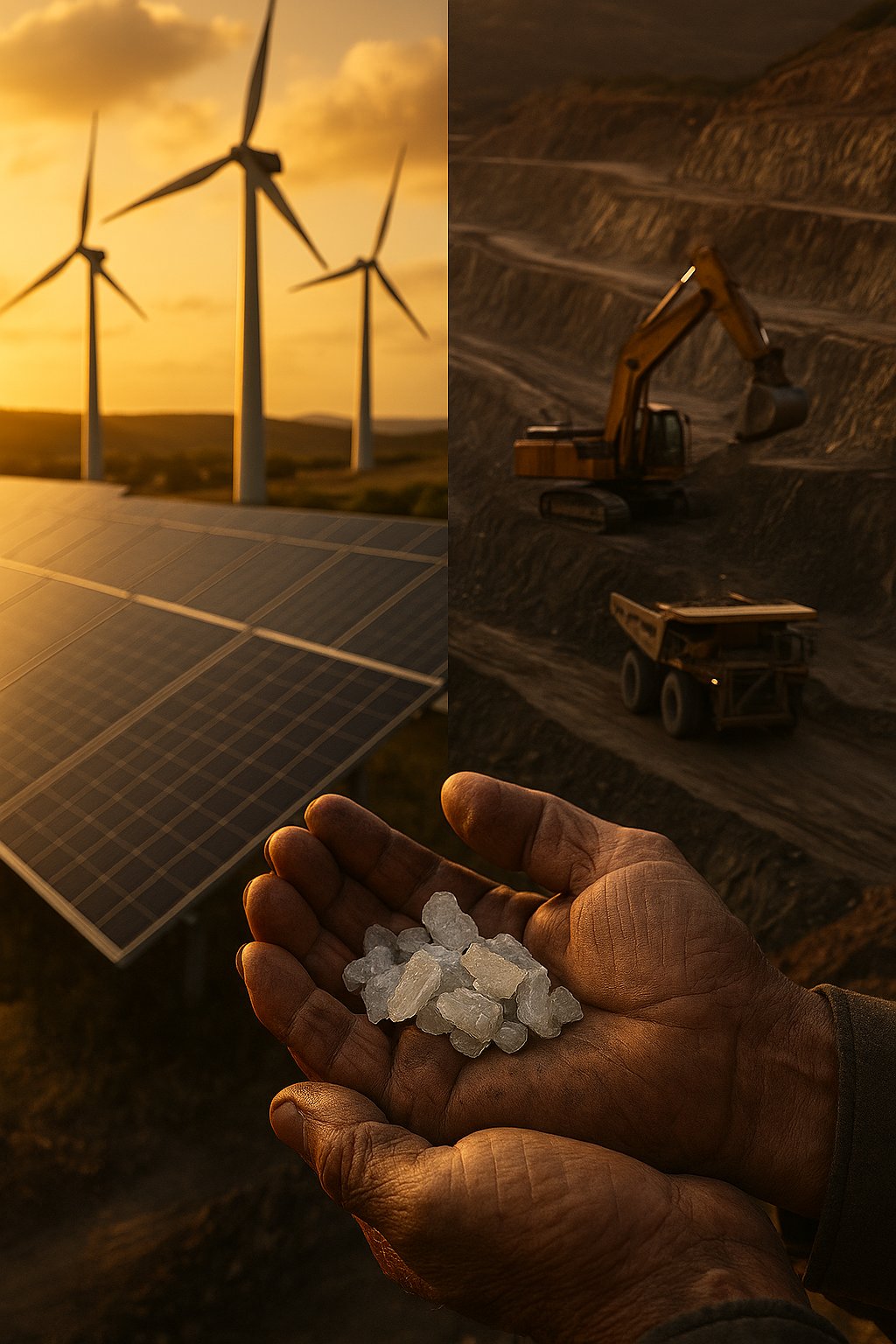
The energy transition sounds, in the mouths of those who promote it, like a story of redemption. We leave fossil fuels behind, embrace sun and wind, and the planet breathes easier. It's a powerful story. And like every powerful story, it deserves careful scrutiny, because between the promise and the reality there is a distance worth measuring.
The data are clear on one point: coal, oil, and natural gas still dominate the global energy matrix. Despite decades of commitments, climate summits, and decarbonization policies, fossil fuels still account for roughly 80% of world energy consumption. Renewable energy is growing, yes, but it's growing on top of a base that also keeps expanding. We are not replacing the old system; we are building a new one on top of the previous one. That has consequences that don't always make it into official speeches.
This is not an argument against the transition. It's an argument for understanding it better.
The European Union represents perhaps the most ambitious experiment in energy policy at a continental scale. Its goals are concrete: emissions reduction, energy independence, industrial decarbonization. The IMF has analyzed the macroeconomic implications of this agenda, and the picture is complex. Europe's transition could generate significant inflationary pressure in the short and medium term, affect industrial competitiveness against less-regulated economies, and redistribute economic weight among sectors and countries in ways that current models are only beginning to capture. It's not that the direction is wrong. It's that the path has real costs someone has to pay, and the question of who pays them rarely gets an honest answer.
The point where the story gets more complicated is critical minerals. Building solar panels, wind turbines, lithium batteries, and electric vehicles requires materials that don't fall from the sky: lithium, cobalt, nickel, rare earths, copper. And this is where the story turns uncomfortable, because the geography of these resources reproduces, with startling fidelity, the patterns of colonial extractive economics we're supposedly leaving behind.
The Congo produces more than 70% of the world's cobalt. Chile, Argentina, and Bolivia hold most of the known lithium reserves. Indonesia dominates nickel. China controls a disproportionate share of rare earth processing. What's happening around these resources isn't just trade; it's active geopolitics. Competition among powers, the resource nationalism resurfacing in several of these countries, and supply chains reorganizing in real time are creating tensions that the "green transition" narrative prefers not to name directly.
A recent analysis from the East Asia Forum puts it with uncomfortable precision: new energy transition narratives are reproducing old extractive costs. Countries rich in these minerals face pressure to open up their resources quickly, under regulatory frameworks that frequently benefit foreign companies more than local communities. The environmental damage from lithium mining in the Andean salt flats, the pollution associated with cobalt in Africa's copper belt, or the impact on aquatic ecosystems in Asian mining regions don't show up in the carbon ledger we celebrate when we buy an electric car.
The same pattern repeats throughout history with a regularity that should give us pause. When Europe needed cotton for its industrial revolution, the price was paid by plantations in the southern United States and African colonies. When it needed rubber, the Congo of Leopold II paid it. When it needed cheap oil, the Middle East and Latin America paid it with decades of political instability. Now it needs minerals for its green transition, and the distribution of who extracts, who processes, who benefits, and who absorbs the damage hasn't changed as much as we'd like to believe.
Large-scale technological shifts are never neutral. They always reorganize power. The relevant question isn't whether there will be an energy transition, but who designs its terms and in whose favor.
This is more complicated than it appears because the transition also offers real opportunities for countries that have historically been on the receiving end of extraction. Bolivia, for instance, has at various points tried to control its own lithium value chain instead of exporting the raw mineral. Mexico has significant deposits and active debates about their governance. If these countries manage to capture more value along the chain, the story might be written differently this time. But that requires political will, institutional capacity, and above all, resistance to pressure from actors who prefer the traditional extractive model because it's more convenient for them.
Some researchers have spent decades pointing out that real sustainability cannot be built on injustices simply displaced elsewhere geographically. Claiming a country has net-zero emissions while its mineral and manufacturing imports carry enormous environmental and social damage somewhere else is a form of creative accounting, not a solution. Carbon footprint matters, but it's not the only indicator that does.
I still don't have a clear answer for how to resolve the tension between genuine climate urgency and the need to avoid reproducing colonial patterns in the transition. I suspect no one has fully resolved it. But recognizing the tension is the first step toward not ignoring it. Community-based resource governance models, local processing initiatives in producer countries, real (not cosmetic) technology transfer agreements, and traceability frameworks that make socio-environmental costs visible across the entire chain are directions worth exploring seriously—not as idealism, but as concrete experiments with growing evidence of viability.
The energy transition is necessary. The planet doesn't have time for endless debates about whether climate change is real or whether fossil fuels have a future. But necessary doesn't automatically mean fair, or well designed, or free of contradictions. Urgency can't be an excuse to avoid the uncomfortable questions. Who finances the transition? Who absorbs its costs? Who decides which technologies get prioritized? Who controls the resources that make it possible? These questions don't slow the transition down; they make it more solid, because structures that ignore their own contradictions accumulate fragility until they collapse.
The difference between an energy transition that transforms the system and one that simply swaps the fuel while keeping the same power hierarchies intact lies in whether we're capable of asking ourselves these questions and acting accordingly. That's not pessimism. It's the condition for hope to have any real foundation.
Stones don't lie, but historians sometimes do.
Sources:
1. Energy transition - Wikipedia: https://en.wikipedia.org/wiki/Energy_transition
2. The EU's Energy Transition - IMF Working Paper (2026): https://www.imf.org/en/publications/wp/issues/2026/03/09/the-eus-energy-transition-574537
3. New energy transition narratives, old extractive costs - East Asia Forum (2026): https://eastasiaforum.org/2026/03/10/new-energy-transition-narratives-old-extractive-costs/