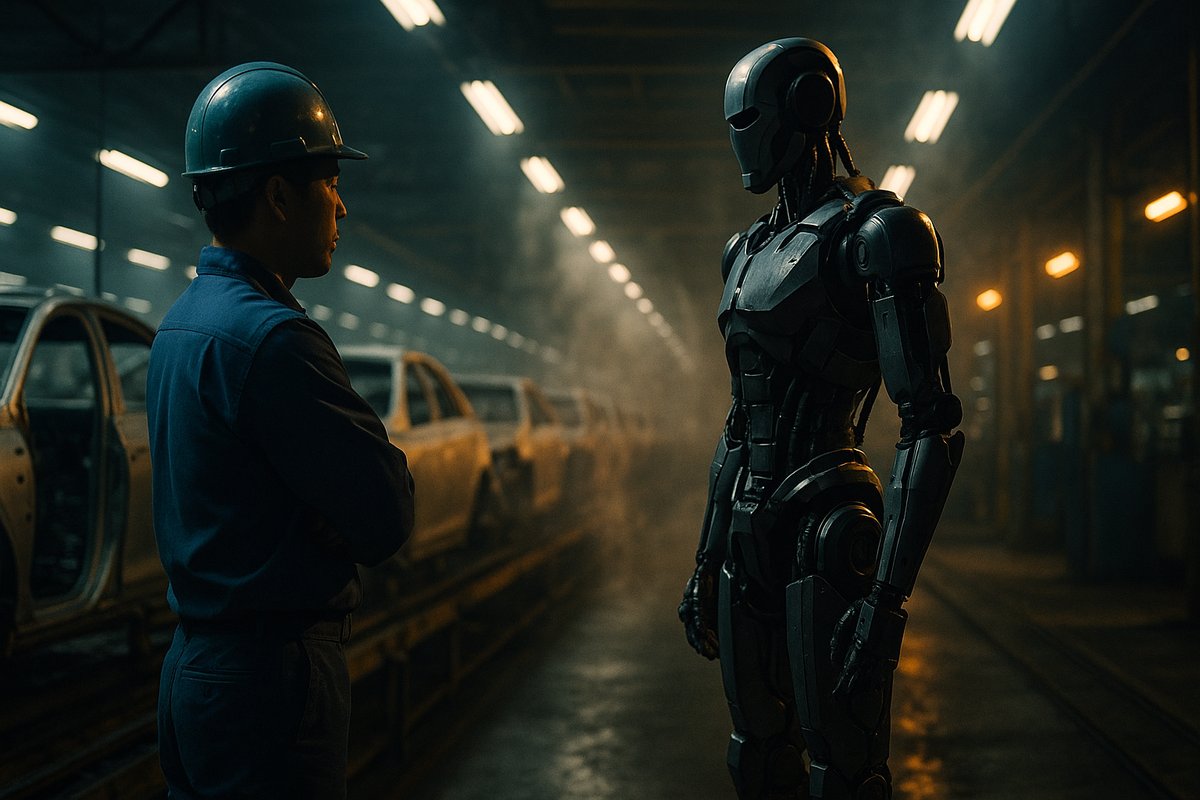
At the Ulsan plant, the assembly line stops at seven in the morning. It's not an electrical failure or a supply problem. Workers form a cordon in front of the section Hyundai has set aside for testing Atlas, the humanoid robot developed with technology derived from Boston Dynamics, the company Hyundai acquired in 2021. They're protesting a machine that walks, rotates its torso, holds tools with articulated hands, and physically occupies the space where a human worker used to perform that same job.
This strike is the first documented labor action specifically motivated by the deployment of humanoid robots in an automotive plant. The humanoid robot amounts to a complete substitution because it doesn't merely automate a process: it deliberately imitates the physical presence of the worker it replaces. That distinction between form and function sits at the center of everything that follows.
South Korean unions have spent years negotiating wage increases, safety conditions, and schedule adjustments. They never had a mechanism for collective bargaining over automation. The decision on Atlas arrived already made, as it usually does.
The English weavers of 1811 to 1816, known as the Luddites, didn't destroy looms because they hated machinery. They targeted specifically those introduced by employers who cut wages without negotiating terms or sharing productivity gains. The Frame Breaking Act of 1812 made destroying a loom a capital offense. Authorities deployed more troops against them than Wellington had on the Iberian Peninsula fighting Napoleon. The repression was brutal. Even so, the question of who decides, who benefits, and who gets left out of the conversation survived.
Anthropomorphic design is not neutral. It serves a narrative function: it communicates, without words, that the worker is replaceable as a whole person and not merely as a bundle of tasks. This intensifies the crisis of labor identity. The Marienthal study that Marie Jahoda, Paul Lazarsfeld, and Hans Zeisel conducted after a textile factory closed in 1931 already showed that erosion without any robots involved: job loss unravels one's sense of time and agency long before the money runs out.
I've seen similar patterns in other contexts of automation. When the machine replicates not just the task but the movement and the bodily space, the substitution becomes more personal. What's interesting here is that the adversary stops being abstract.
Hyundai gains cost reduction and, above all, speed of decision-making: a robot doesn't demand shifts, doesn't get sick, and doesn't organize. Humanoid robot manufacturers get a high-profile use case that validates their technology for other industrial clients. The South Korean government reinforces its narrative of technological leadership in a sector where it already registers, according to the International Federation of Robotics, a high density of industrial robots per worker.
This dynamic feeds the story of technological inevitability. Automation gets presented as a natural phenomenon that it would be absurd to resist. That story surfaces whenever efficiencies are cited to cut staff without offering a real transition, and whenever scoring systems hide managerial responsibility behind an algorithm. In every case, the machine absorbs the blame that actually belongs to the decision to deploy it without prior negotiation.
Why doesn't automating a factory require the same prior consultation as changing safety conditions? No corporate statement answers that question. There is no legal framework in most Asian industrial economies, nor in many Western ones, requiring that technological deployment be negotiated the way wages are negotiated. The price of labor gets discussed, but never its future existence.
Ulsan is not an isolated case: it's a pilot. If Hyundai normalizes the humanoid at its flagship plant without lasting reputational cost, the model will be replicated across supply chains in Eastern Europe and in plants in Brazil and Mexico. Unions in those regions are watching, because the precedent is being set without their participation.
After years of studying social experiments I wrote Manifiesto Ludista, still in preparation. I started from a question that this episode answers with uncomfortable precision. The Luddites smashed looms because they were anonymous and replaceable. The Hyundai worker faces something that moves like him, rotates its torso like him, and will probably occupy his locker by the end of the shift. I still don't have a clear answer for how to balance technological progress with labor dignity. No one in the decision-making rooms has explained why the robot needed to resemble the man it replaces so closely.
What role will workers have once machines start inheriting not just their tasks but their very shape?
Sources:
1. International Federation of Robotics — reports on industrial robot density in South Korea
2. Historical record of the Frame Breaking Act (1812) and the military repression of the Luddite movement, 1811-1816
3. Jahoda, M., Lazarsfeld, P., Zeisel, H. — Marienthal: The Sociography of an Unemployed Community (original study, 1933)