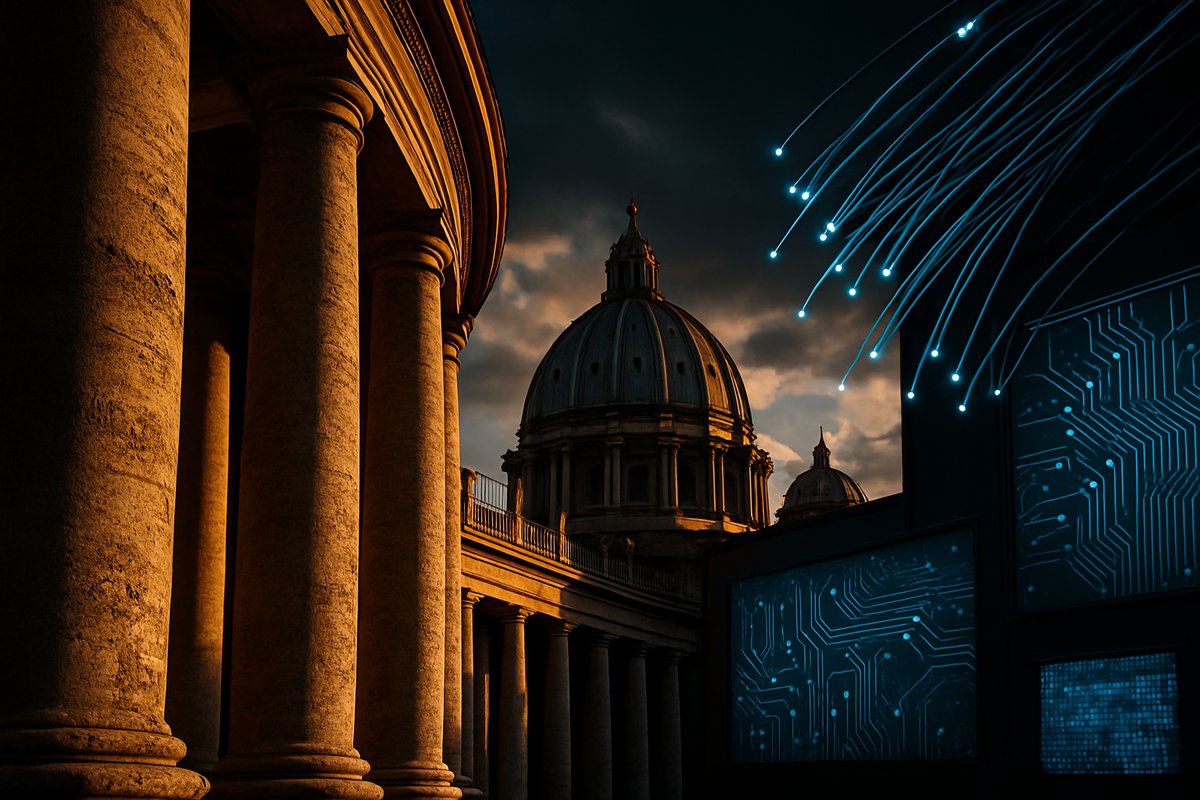
There are documents that go unnoticed because they arrive wrapped in Latin and ancient ritual. Pope Leo XIV's apostolic letter on artificial intelligence breaks that pattern. It's the first time a pontiff has devoted an entire magisterial text to a specific technology. It doesn't talk about the internet in general terms, or about social networks and young people. It goes straight for AI. That deserves attention even if the Vatican's beliefs feel far removed from the topic.
The question that matters isn't whether the document gets everything right. What matters more is why a two-thousand-year-old institution decided this required an urgent statement. When the Vatican moves, it's usually because something has been moving underneath for a while.
And what's moving is a conversation that most technical and political institutions still don't know how to hold.
The text starts from a premise any engineer would recognize: technology is never neutral. Designs carry bias from the first piece of data and from the goals of whoever builds them. The document doesn't use that terminology. It speaks of human dignity under threat. Underneath, it's pointing to the risk of optimizing for the wrong measures at massive scale.
History offers useful context here. The Church has responded to technological and social transformations late, but with its own vocabulary. Rerum Novarum addressed the conditions of the Industrial Revolution. Pacem in Terris spoke of nuclear disarmament in the thick of the Cold War. It arrives late. Even so, it contributes a moral vocabulary that governments and companies rarely manage to articulate, because their incentives get in the way.
This document aims for exactly that: to provide an ethical framework for debates that markets and states keep confined to technical terms or great-power rivalry. When a company negotiates with defense agencies over military uses of AI, it's making ethical decisions under a different name. Reports that rank AI above terrorism as a national security threat are describing a problem of power. The Vatican names it from the outset as an ethical question.
We should be clear about its limits. A magisterial text includes no verification and no measurable consequences. Game theory would flag this immediately: declarations of good intentions without structural incentives end up being mere aspirations. The same pattern shows up in other contexts, where even the most elaborate frameworks evaporate in the face of strong interests.
The document speaks of the algorithmization of human existence as a threat to freedom. It doesn't reject algorithms. It warns that when they replace contextualized human judgment — in justice, medicine, education, or labor — something is lost that more data doesn't bring back. Findings on bias in judicial systems, in automated hiring, and in the amplification of polarization confirm that the concern is concrete.
A tension emerges that the text doesn't resolve. The Church itself is a hierarchical structure with a long history of concentrating information and authority. Criticizing the concentration of power in AI from that position produces an irony. This doesn't invalidate the argument. It shows that nearly every institution currently sounding the alarm about power risks in AI is, in turn, a concentrator of power. Governments, corporations, churches. All of them talk about distributing benefits while protecting their own position.
What's genuinely valuable here isn't doctrinal authority. It's that the letter brings the AI conversation to religious communities in emerging economies. Those communities represent hundreds of millions of people who will live with the effects of these technologies but who rarely have a seat at the forums where they're designed. It reaches parishes in Lagos, in Guatemala City, in Manila, in Nairobi. It does so through local networks that no technical press release ever touches.
I'm not sure that reach will translate into real pressure on the people making the technical and regulatory decisions. The gap between declaring that AI must serve human dignity and building verifiable processes to ensure it remains enormous. No institution — religious, state, or technical — has closed it yet.
Some researchers have long argued that AI's central problem isn't technical but political: who controls the systems, with what data, and for whose benefit. The pope arrives at that same conclusion through theology. Safety engineers arrive at it through cryptography. Economists arrive at it through market analysis. That such different paths converge on the same point suggests the problem is real. What's missing are structures that don't depend on the powerful voluntarily deciding to limit themselves.
That's harder to put into an apostolic letter.
Ancient inscriptions and archaeological remains show how past societies negotiated with innovations that upended their power structures. Stones record those tensions without embellishment, though historians sometimes read them through their own lenses. This is more complicated than it looks.
What happens if these diverse voices — from parishes to laboratories — manage to gain influence before today's incentives freeze solid inside the code?