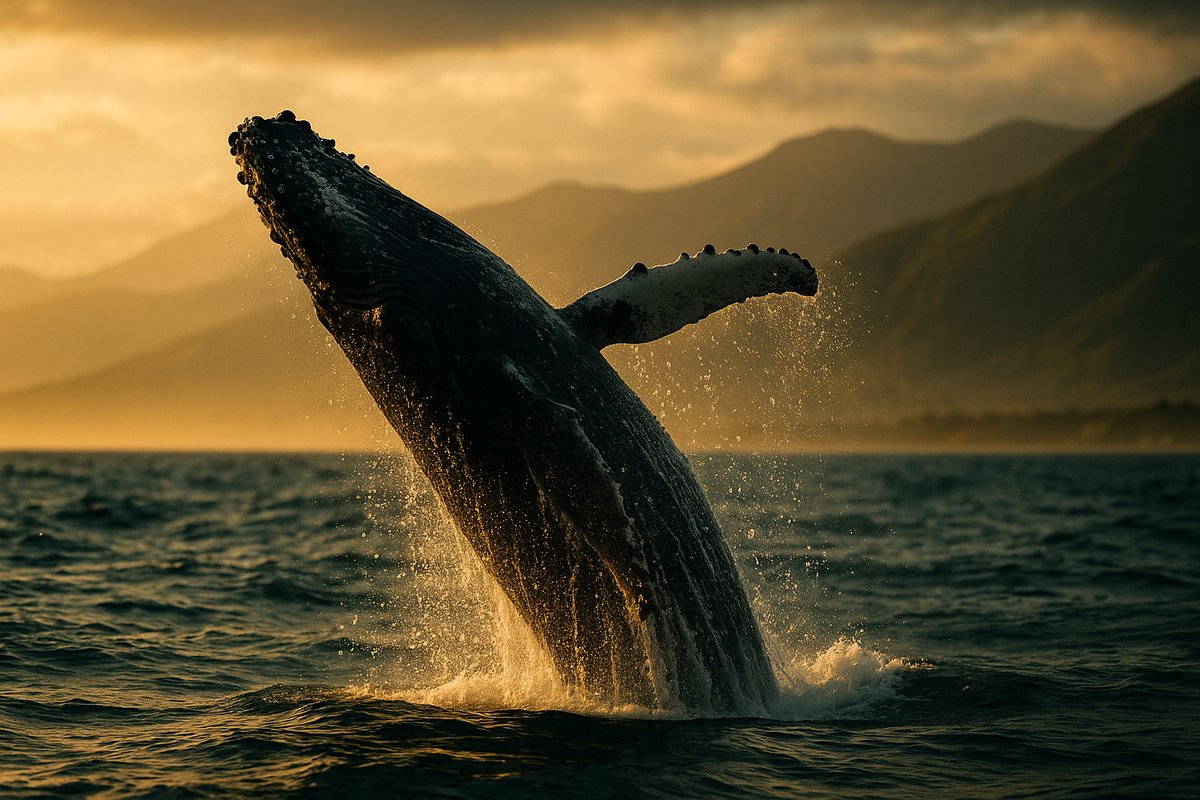
There's an argument that resurfaces every time the legal circle of who counts as a person tries to widen. It's nearly identical regardless of era or place: that entity cannot exercise rights or assume responsibilities, therefore it cannot be a subject of law. It was used against enslaved people. It was used against women. It's used today against corporations when convenient, and to defend them when it isn't. Now it's aimed at whales.
The interesting thing isn't that the argument is false. It's that it has never stopped the expansion.
New Zealand is advancing a treaty that would grant legal rights to whales. The text is built in part on Māori knowledge about humanity's relationship with these animals. The treaty hasn't been signed or ratified — that much is clear — but the process itself reveals something worth paying attention to: a Western legal system is seriously considering a non-Western epistemology as valid legal grounding. Not as folklore. Not as cultural decoration. As evidence.
This matters because it alters how law operates, beyond just who gets protected by it.
The closest precedent already exists and is in force. In 2017 New Zealand granted full legal personhood to the Whanganui River, the first in the world to receive it. The basis was the Māori worldview that understands the river as a living ancestor, not a resource. Two human guardians were appointed to represent it in court. It didn't solve every problem: jurisdictional conflicts remain open, enforcement mechanisms are imperfect, and the debates will likely stretch on for decades. Even so, the model spread. Bangladesh adopted it partially. India and Ecuador are exploring similar paths with rights of nature.
I recognize this pattern in other contexts. When an imperfect solution names a problem that the dominant structure couldn't even describe, it eventually becomes inevitable. Not immediately. Not without resistance. But inevitable.
Whales introduce complications the Whanganui River never posed. A river has fixed coordinates. A humpback whale might be in New Zealand waters in summer and in international waters months later. Which court has jurisdiction then? Does recognition of its personhood travel with it the way it travels with a citizen crossing borders? These are questions without clear answers. I don't claim to have them. They are exactly the questions international law will have to face if the treaty moves forward.
Western maps draw sharp lines over territories and species, but marine life ignores those lines. That disconnect helps explain why recognizing agency beyond the human also requires rethinking the boundaries of legal authority.
What usually goes unnoticed is the epistemic validation the whole process carries. Māori records on whales accumulate observations across many generations: behavior, migrations, population health, relationships between species. Researchers have spent decades arguing that this traditional ecological knowledge should be treated as valid scientific evidence in environmental policy, not as anecdote.
When a legal framework adopts it as the basis for creating rights, it isn't being poetic. It's acknowledging that a functional model existed long before the Western one arrived. I've seen in various contexts how information gets discarded simply because it doesn't arrive in the expected format. The result is decisions made with incomplete data even when the most accurate information exists in another language. The Māori worldview described ecological dynamics that Western science took decades to formalize. The question isn't whether that knowledge is valid. It's why it took us so long to incorporate it.
The fishing and whaling industry, predictably, prefers the debate stay symbolic. A treaty that sounds good in headlines but lacks real enforceable mechanisms is, from their standpoint, the ideal scenario. The same thing happened in the early years with the Whanganui River: lots of ceremonial recognition and few instruments with real litigating power. The rights-of-nature movement is after precisely the opposite: precedents that can be taken to court, not just celebrated.
The historical expansion of who holds rights has always followed the same arc. First the idea seems absurd or dangerous. Then an imperfect framework gets built. Then that framework gets used, stretched, improved. The abolition of slavery didn't eliminate racism. Women's suffrage didn't resolve gender inequality. But both changed what was legally possible, and that changed what was politically imaginable. The Whanganui River didn't fully clean up its waters. But it made it possible to sue on its behalf.
Whales represent the next stage of that expansion, and they do so from a foundation we didn't inherit from Roman-Western law. What's remarkable is that New Zealand's legal system doesn't collapse trying to incorporate it. It expands. Which is what living structures do when they're working.
I'm still exploring this tension between indigenous knowledge and Western law. I still don't have a clear answer to the question that emerges from all this: if traditional ecological knowledge turns out to be the most reliable record for tracking long-term environmental change, and legal frameworks start accepting it as valid evidence, what other knowledge have we treated as folklore without ever examining it first?
Stones don't lie, but historians sometimes do.
Sources
1. Te Awa Tupua (Whanganui Claims Settlement) Act 2017, Government of New Zealand.
2. Borrows, John. Canada's Indigenous Constitution. University of Toronto Press, 2010. (Reference framework for indigenous epistemologies in law.)
3. Berkes, Fikret. Sacred Ecology: Traditional Ecological Knowledge and Resource Management. Taylor & Francis, 1999.
4. O'Donnell, Erin and Julia Talbot-Jones. "Creating Legal Rights for Rivers: Lessons from Australia, New Zealand, and India." Ecology and Society, 2018.
5. Kauffman, Craig M. and Pamela L. Martin. The Politics of Rights of Nature. MIT Press, 2021.