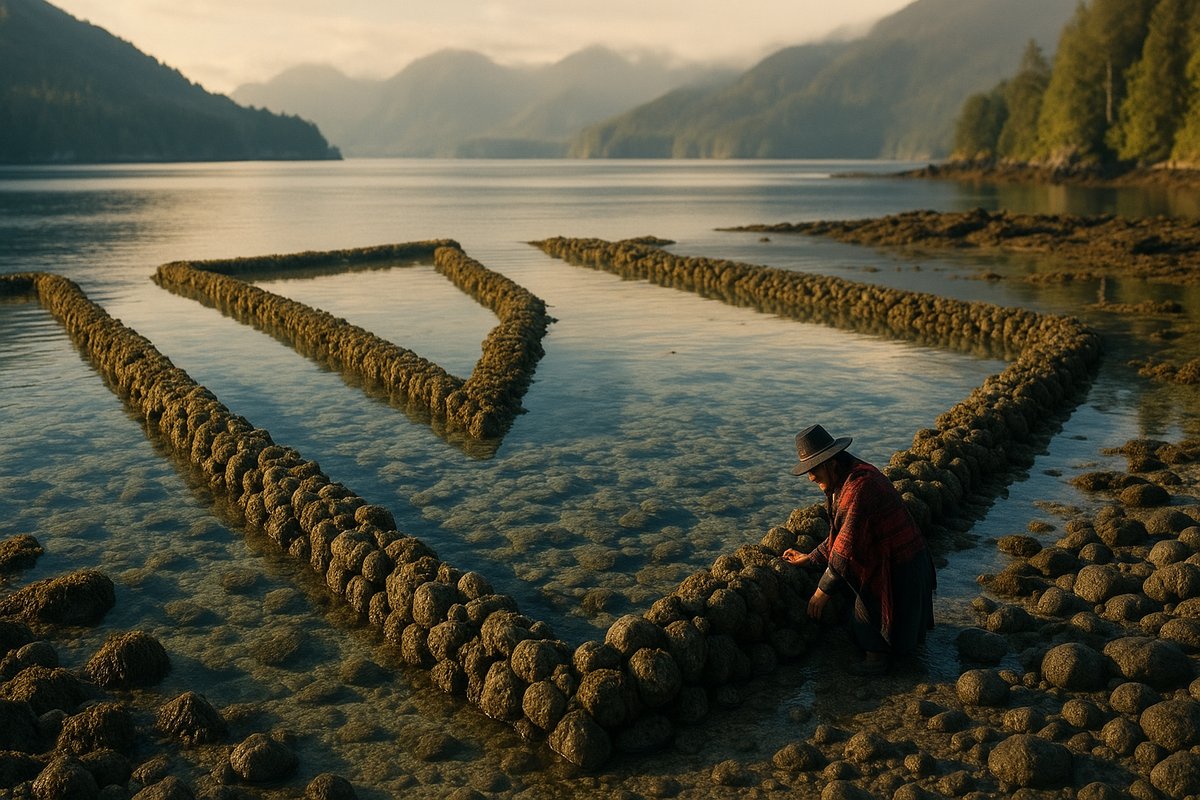
There's something hard to shake when I think about structures that persist for millennia. Not the ones that last a few years or decades. The ones that adjust, learn, and respond as time passes. That level of resilience doesn't happen by accident. It has an architecture.
The clam gardens of the Pacific Northwest have been operating for roughly four thousand years. They were built by Indigenous coastal nations, primarily the Laich-kwil-tach, Tla-o-qui-aht, and dozens of other communities. They're V-shaped or crescent-shaped stone structures placed in intertidal zones to create shelters where clams can grow away from predators and strong currents. Ecological engineering, plain and simple.
What's telling isn't just how long they've lasted. It's that they still work. Researchers working alongside Indigenous communities find that these active sites produce clams at notably higher densities than unmanaged areas. Four thousand years later, the structure still does exactly what it was built to do.
This matters because the dominant narrative about shared resources has been pessimistic for decades. In 1968, Garrett Hardin published his piece on the tragedy of the commons and convinced a lot of people that without private property or state regulation, collapse was inevitable. That idea justified enclosures of every kind.
Elinor Ostrom spent her career showing that Hardin was overgeneralizing. She won the Nobel Prize in Economics in 2009 for studying communities that manage common resources sustainably without privatizing them or relying on the state. Her examples ranged from irrigation systems in Valencia to fisheries in Japan and grazing lands in Switzerland. All of them shared clear boundaries, place-adapted rules, participation from the people who actually use the resource, ongoing monitoring, and graduated sanctions.
Clam gardens anticipate all of those foundations by thousands of years. While the cases Ostrom documented had several centuries of record, these structures far exceed that. Stones don't lie, and what they reveal is that sustainable commons management isn't a recent idea. It's a historical constant whenever communities achieve enough continuity to learn from their mistakes.
The signaling mechanics are what intrigue me most from a design standpoint. A clam garden isn't just a stone wall — it operates as a set of living indicators. Clam density tells you whether the harvest was moderate. The condition of the rocks indicates whether maintenance has been sufficient. Certain algae give away the health of the seabed. People who know the place have been reading these signals for generations, long before any technical vocabulary existed to name them. That's negative-feedback regulation. Applied homeostasis. Exactly what we're after when we try to build organizations that self-regulate.
Here's a key difference from many present-day organizations. In bureaucracies, knowledge tends to live in documents, protocols, and regulations. If the institution fails or the papers get lost, the knowledge disappears with them. The knowledge behind these gardens, by contrast, lives in the practice itself. It's passed down through building, through observing, through deciding together in the moment. When Indigenous communities were displaced or their practices banned under colonialism, many gardens fell into disuse. The knowledge wasn't entirely erased — it survived, fragmented, in memories and gestures, because it was distributed among people rather than concentrated in texts.
What's happening with these gardens today is promising and complicated at the same time. Co-management between Indigenous communities and scientific institutions is growing. Marine biologists are combining sensors with accumulated traditional knowledge. There's real potential here. But an uncomfortable question remains: when that Indigenous knowledge gets validated through peer-reviewed publication, are we looking at genuine integration, or a new form of extraction that pulls knowledge out of its relational context to feed institutions that once ignored it?
There's no clean answer. Researchers have been flagging that tension between documentation and community sovereignty for years. Recognition can strengthen land claims, but it can also reduce complex practices to data that anyone can cite without the obligations that sustain them. Both things can be true at once.
Clam gardens raise something deeper about the kind of knowledge we need to manage complex organizations. For a long time we believed formal scientific knowledge was enough — that with enough data and models we could understand any ecosystem. These structures suggest that certain dimensions only emerge from sustained relationship with a place across generations. Not for mystical reasons, but because some regularities only become visible on timescales that no conventional research project can cover.
Four thousand years of continuous observation, adjustments, mistakes, and corrections. A track record no modern organization has managed to match yet.
I keep turning over what this means for the organizations we'll need in the coming centuries. If living practices generate more resilience than archives do, are we building structures that know how to learn, or just structures that know how to file things away?
Stones don't lie, but historians sometimes do.