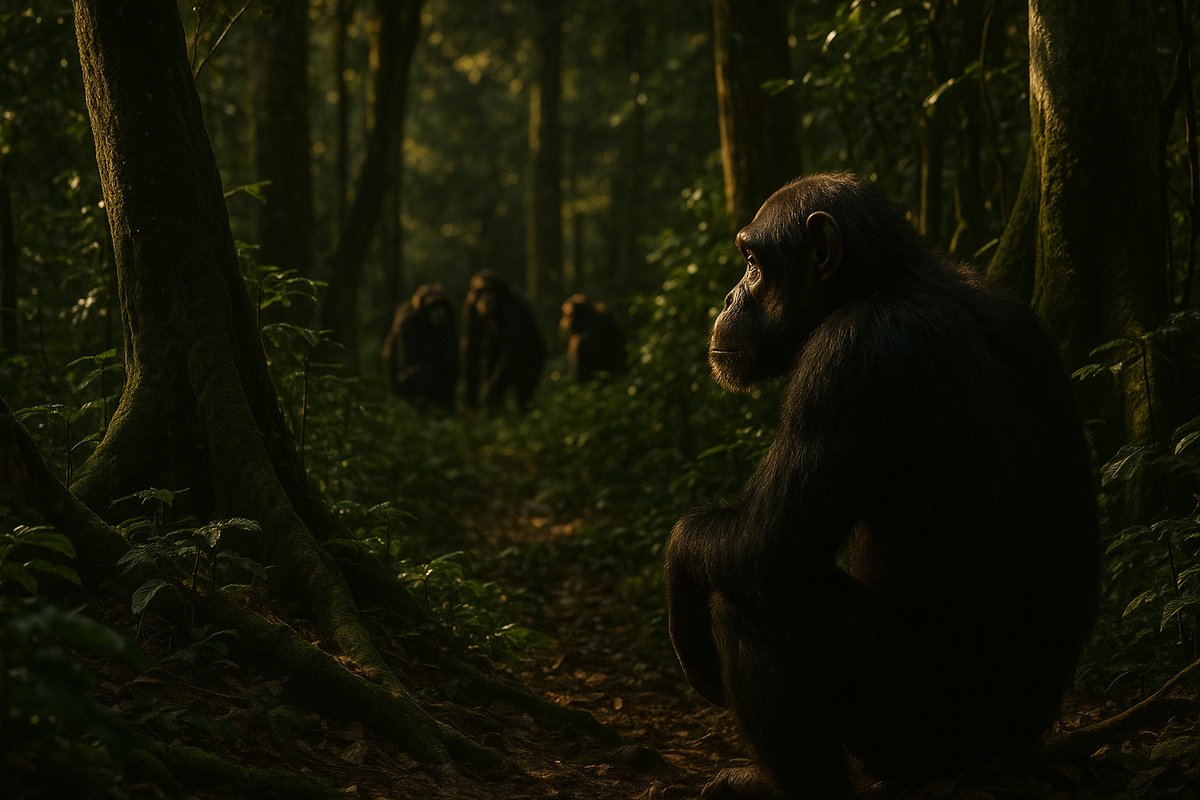
A study published in Science produced that specific kind of discomfort that shows up when something confirms what you'd been suspecting for a while, though not in the way you expected. Chimpanzees are the primate closest to humans. We share between ninety-eight and ninety-nine percent of our DNA. What they do isn't a zoology anecdote. It's a mirror. And this particular mirror is rather uncomfortable.
For decades, a community of roughly two hundred chimpanzees lived together in Kibale National Park, Uganda. The Ngogo group was large and relatively stable by the standards of the species. With no resource scarcity, no external invasion, and no obvious catastrophic event, the group began splitting into two factions around 2015. By 2018, the last social bonds had completely dissolved. Then came the lethal attacks between individuals who had grown up together and slept in the same trees. The conflict is still ongoing.
What stops you cold isn't the violence itself. It's the trigger. It wasn't hunger or competition for territory. It was the erosion of the individuals who acted as bridges between subgroups. The death of key connectors, a shift in the dominance hierarchy, and a disease outbreak destabilized the established order. Once those bonds disappeared, the very idea of "us" collapsed. What followed was, in hindsight, predictable.
The researchers documented something so simple it hurts to state. When you stop spending time with someone, you stop seeing them as part of the same group. That can lead to violent consequences in a surprisingly short period. No ideology. No scarcity. No prior cultural differences. Just accumulated social distance. That observation should show up in manuals on institutional design, in urban planning frameworks, and in any serious conversation about political fragmentation. It doesn't, because it comes from chimpanzees, and we'd rather believe we're something else.
The debate over the origins of human warfare gains new weight from this work, though it isn't settled. Some researchers have argued for decades—Richard Wrangham among them—that intergroup violence has deep evolutionary roots shared with chimpanzees: not a cultural invention but part of our biological wiring. Others, like Douglas Fry, maintain that organized warfare is a relatively recent phenomenon and that the archaeological record predating ten thousand years ago shows no systematic evidence of mass conflict. The Ngogo case lends support to the first position, but with a twist that reframes the conversation: violence doesn't require scarcity or prior differences. It's enough for the bonds to dissolve. That doesn't settle the debate. It usefully reframes it.
What sets humans apart isn't that we're less violent. It's that we have language. And language works as an amplifier in both directions. The Ngogo chimpanzees can't plan a coordinated act of revenge or gather to decide what to do about the other faction. Humans can. That same tool lets us scale both conflict and cooperation to dimensions no other primate reaches. It all depends on the narrative that activates it.
When you look at structures of social cohesion throughout history—from ancient civilizations to today's platforms—a pattern emerges. As long as bonds hold, through shared rituals, trusted intermediaries, or inclusive narratives, the whole thing works. When they erode—through extreme inequality, the loss of connecting figures, or discourse that redefines the neighbor as a threat—the collapse follows a logic that the Ngogo chimpanzees display without any cultural intermediaries at all. Just biology and social dynamics. That's what makes the example so clean.
Modern cities accelerate that same distance. Shared spaces disappear, and digital bubbles reinforce isolation—not just physical isolation. They also open up the possibility of building new bridges, if you go looking for it deliberately. But that possibility doesn't activate on its own.
The same study documents a paradox worth taking seriously. Before the internal fracture, the Ngogo group killed at least twenty-one chimpanzees from neighboring groups and significantly expanded its territory. Internal cohesion and external violence aren't opposites. They often reinforce each other. A group that feels vulnerable from within can consolidate itself by attacking outward. The human historical record shows this tendency with a clarity that needs no further elaboration.
The researchers honestly acknowledge that they don't fully understand why the fracture happened exactly when it did. They have identified factors, but no confirmed causality. Complex structures can collapse for reasons that are only understood in hindsight. That admission isn't a weakness of the study. It's a reminder of the limits of any predictive model when specific individuals matter in ways that diagrams don't capture. Anticipating those breaking points with precision remains an open problem.
The Ngogo chimpanzees don't tell us that war is inevitable. They tell us that social cohesion is fragile, that it depends on individuals who function as bridges, and that losing them can trigger what comes next in very little time. That's not pessimism. It's design information. If we know that connectors matter, we can protect them. If we understand the consequences of accumulated distance, we can ask ourselves what structures are accelerating it today.
Why do we keep designing organizations that weaken precisely those bridges, that reward polarization, and that turn disconnection into a product?
Sources
1. Original study published in Science (2026) on the fracture of the Ngogo chimpanzee community, Kibale National Park, Uganda.
2. Wrangham, R. (1999). Demonic Males: Apes and the Origins of Human Violence. Mariner Books.
3. Fry, D. P. (2013). War, Peace, and Human Nature: The Convergence of Evolutionary and Cultural Views. Oxford University Press.
4. Mitani, J. C., et al. (2010). "Lethal Intergroup Aggression Leads to Territorial Expansion in Wild Chimpanzees." Current Biology.
5. Watts, D. P. & Mitani, J. C. (2001). "Boundary patrols and intergroup encounters in wild chimpanzees." Behaviour.