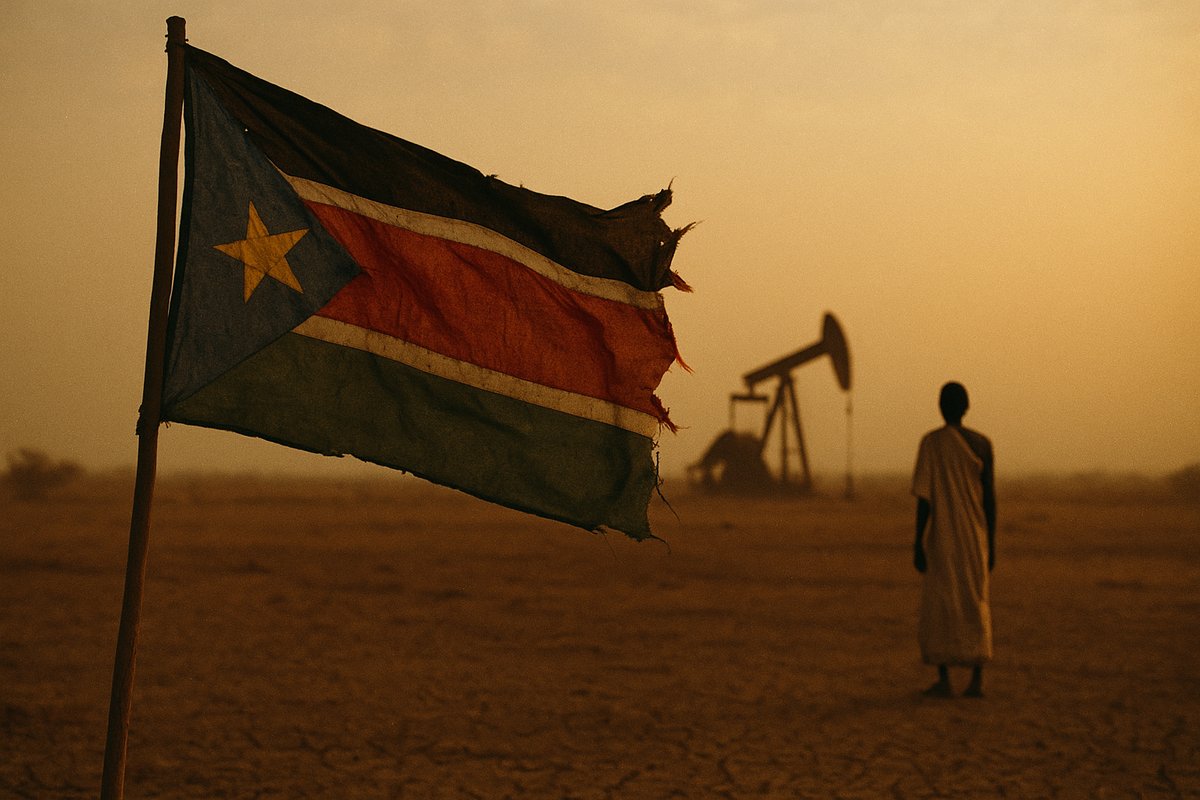
South Sudan reaches fifteen years as a nation. The celebrations have grown muted, overshadowed by a collapsed economy and a conflict that never fully died out. Fifteen years after gaining its own state, a flag, and a seat at the UN, the country still hasn't held a single national election.
Salva Kiir has held the presidency since the beginning in 2011. He has never faced the ballot box. Elections have been postponed five times since 2015. Riek Machar went from vice president to rebel leader, then to signatory of peace deals, and today remains detained on treason charges. The war that broke out in 2013 left hundreds of thousands dead.
What exactly was it that achieved independence?
Oil covers close to 95% of the state budget. That figure explains more than any diagnosis of institutional fragility. A state that depends on an extractive resource doesn't need to weave broad consensus with its population. It doesn't need to diversify taxation or answer to farmers, merchants, or industrialists, because its survival doesn't run through them. It depends on controlling wells and routes. Whoever controls that flow controls the distribution of positions, contracts, and loyalties.
GDP per capita approached fourteen hundred dollars in the first years after separation. Now it's below five hundred. Four out of five people need humanitarian assistance to survive. These numbers aren't abstractions from reports. They show how much stayed the same in daily life when only the name on the map changed.
Blaming culture or supposed inherent incapacities is an easy way out that explains nothing. The failure is structural and repeats itself in very different contexts: concentrated rents, scarce accountability, and outside actors who intervene according to their own interests. Uganda deployed troops to prop up Kiir. Spillover from Sudan sends refugees and weapons southward. The international community celebrated the 2011 independence as a triumph of self-determination and then had to manage the consequences of a fire it helped light.
This pattern appears in other institutional vacuums. When no outside force demands verifiable rules, whoever controls the resources follows the same old logic: distribute posts, buy support, and delay elections under security pretexts. That playbook works as long as no one with real power challenges it.
The international community keeps treating the holding of elections as synonymous with legitimacy. Without first dismantling control over the army, oil rents, and the security apparatus, ballots don't redistribute power. They revalidate it. They grant the same elite an international seal to continue as before, only now with a vote attached. The phenomenon extends well beyond this single case.
The pattern recalls, with enormous distances kept in mind, other historical independences. The separation of the colonies in North America shifted the collection of rents from London to local hands, but left slavery, territorial dispossession, and the exclusion of majorities intact. It wasn't redistribution. It was a relocation of benefits. South Sudan didn't invent that script out of some peculiarity of its own. It followed it because it was the script available when a structure is born without dismantling the prior processes of extraction.
Game theory illustrates the incentive clearly. Without verifiable reputation mechanisms or real consequences for breaking agreements, every rational actor accumulates power preemptively. Trusting first amounts to losing. Kiir and Machar have spent more than a decade in that zero-sum game where every pact is just a tactical truce.
I still don't have it clear how a cycle like this gets broken. The elites who have run South Sudan since 2011 have lived off the same well, literally and figuratively, while four out of five inhabitants depend on outside aid to eat. That disconnect between those who govern and those who are governed arises when income doesn't require the population's active consent.
I don't have a clean formula. The problem was never the absence of elections as an event. It's the absence of a fiscal and security base that doesn't depend on the favor of whoever controls the resource. As long as 95% of the budget comes from a well managed by a few, any vote will be cosmetic.
A question arises that also applies elsewhere, including Mexico. How much of our faith in elections as a remedy rests on the fragile assumption that it's enough to change who holds office without touching who decides the underlying rules?
Stones don't lie, but historians sometimes do.
How many more flags will have to change before the deep structures of power actually transform?
Sources
1. United Nations reports on the humanitarian situation in South Sudan (OCHA)
2. Reuters and BBC coverage on the postponement of elections since 2015 and the arrest of Riek Machar
3. World Bank data on South Sudan's GDP per capita
4. International Crisis Group analysis on Uganda's role and the spillover of the Sudanese conflict