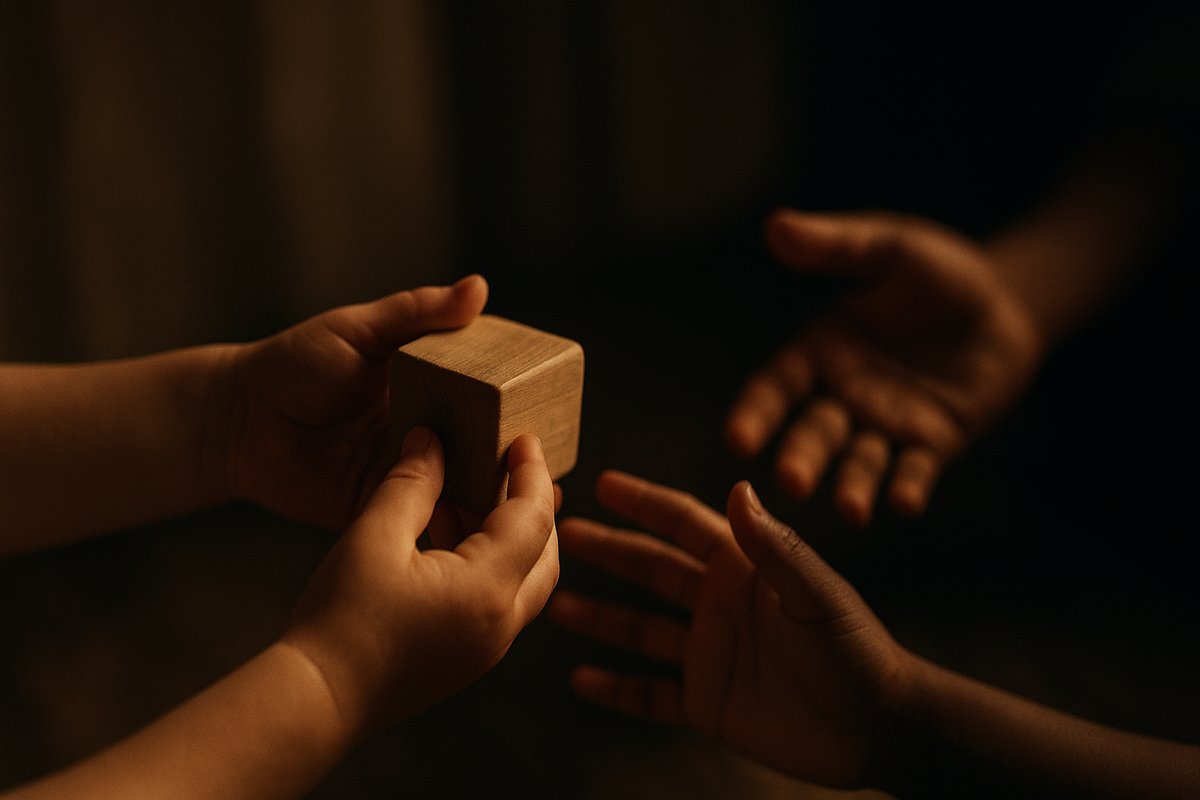
Anyone who has raised children recognizes the scene. A little girl refuses to share her toys with other children but hands them out without drama among her siblings. That observation seems to show that selfishness comes factory-installed and that cooperation gets added later, through effort, through upbringing, through civilization pushing against what we are. It's an honest reading. It's also incomplete.
A study published in Nature Communications in 2025 found that infants just five days old pay more attention to scenes where one character helps another than to scenes where one obstructs another. Five days old. Before any parental teaching or moral tale. The researchers caution that this doesn't demonstrate a full-fledged moral sense: it only reveals that attention orients differently toward prosocial behavior. But the orientation of attention is usually where everything else begins.
That finding seems to contradict the initial observation. If we come predisposed to notice and prefer helping, where does the girl hoarding her toys come from? The piece that reshuffles the puzzle appeared in an earlier study.
Between nine and fourteen months, infants watched puppets with clear preferences, like green crackers over red ones. Then they watched other puppets that helped or harmed the first ones. The infants didn't just choose whoever helped those similar to them: they preferred whoever punished those who were different. They weren't indifferent to harm. They approved of harm when it fell on someone unlike themselves.
It needs to be said clearly: this line of research faces replication debates. Not all subsequent studies obtained the same effect with equal clarity. That doesn't discard it, but it does require holding it with open hands. Caution is also part of rigor.
What's interesting is that these early preferences don't paint infants as purely selfish nor as inherently good. They show a process that does both things at once, depending on where the line between us and them gets drawn. They cooperate inward, toward the circle. They distrust, and sometimes celebrate punishment, outward. That circle doesn't come fixed: it expands from oneself to family, to the group that shares one's tastes, to the team, to the city, to the country. It's the same dynamic, just scaled up.
In behavioral science this has a name: parochial altruism. Bowles and Choi studied how intense in-group cooperation and out-group hostility could have evolved together as a single adaptive strategy, not as two competing traits. Cooperating with your own and rejecting others aren't contradictory impulses. They're the same adaptation looking in two directions.
This doesn't support simplistic readings of innate selfishness. Nor does it allow citing Tomasello as if he endorsed that idea. His work demonstrated that human cooperation, with its sophisticated forms of shared intentionality, sets us apart from other primates. What this finding adds is a nuance: that cooperation is selective, strategic, tied to the circle. We don't cooperate less. We cooperate with surgical precision about who gets in.
Liu Cixin, in his trilogy, posits civilizations that, faced with scarcity and threat, treat any other group as a risk to neutralize first. The reference isn't about aliens. It's a question about the ceiling on the dial: how far can the "us" grow before its own logic turns against itself? If the circle can include the entire species, what stops it? Just historical inertia?
This dynamic connects to the twelve thousand years of divisions that followed agriculture. Surpluses allowed power to accumulate and decide that other human groups didn't count equally. The crack already existed. Agriculture gave it material, hierarchies, armies, and borders. The divide-and-conquer that so many elites used wasn't some brilliant tactic dreamed up by cynical geniuses. It was the path of least resistance over a fracture we already carried.
What remains is a less comfortable view than the original one. There is no battle between bad nature and good culture. There is a setting that biology installed but didn't fix in place. Where we draw the line of "us" — whether it ends at family, at nation, at species, or beyond — is the one variable that DNA doesn't decide for us.
How far can we push that circle before the very machinery that sustains it betrays us?