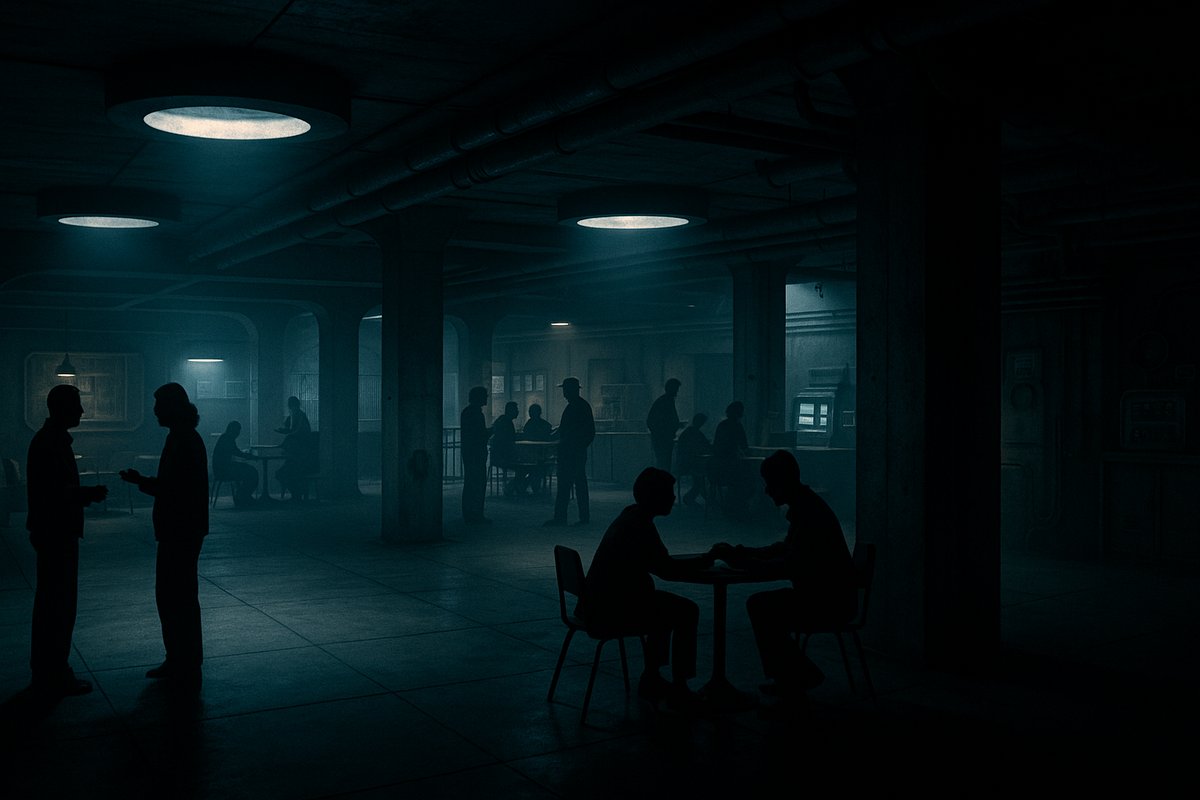
I recently finished watching the second season of Fallout and I wonder why I didn't include references to these video games in the book. I played from the first Fallout through Fallout 4; Vault 76 I barely started but never got far into. All of them present fascinating social experiments, ranging from the different vaults to, as the series reveals, the real experiment: the social organizations that emerge among those surviving in the wasteland.
Fallout's Vault-Tec designed controlled social experiments that would make any 20th-century psychologist blush. A vault populated only by men except for one woman. Another where direct democracy decided everything by vote. Yet another where drugs were mandatory. The full catalog reads like a dystopian version of the experiments humanity has attempted over millennia, but compressed into closed spaces and under extreme conditions.
What strikes me is how these fictional experiments reflect real patterns from human history. Göbekli Tepe, at 12,000 years old, shows us that societies have been experimenting with social organization since we stopped being nomadic hunter-gatherers. The builders of that site coordinated specialized labor without evidence of rigid hierarchies. It was a social experiment that worked for millennia before being deliberately buried. I'm no archaeologist, but this makes me think about how fragile even what seems eternal can be.
Fallout's vaults operate under the premise of limited resources and threatened survival — conditions that have historically produced both social collapse and extraordinary innovation. During the siege of Leningrad, citizens developed exchange and solidarity systems that kept the city alive. In the Mondragón cooperatives, born during Francoist repression, scarcity forced experiments in collective ownership that are still running decades later. These real examples suggest that even in crisis, there's room for forms of organization that endure.
But Fallout's real narrative genius lies in recognizing that the most interesting experiments happen outside controlled laboratories. In the post-apocalyptic wasteland emerge the New California Republic, Caesar's Legion, the Institute — each representing a different organizational response to collapse. That's where the video games connect with something profound about human nature: when structures collapse, we experiment. What if this invites us to try our own alternatives today?
This pattern repeats in real contexts. After the collapse of the Soviet Union, social experiments appeared ranging from organized mafias to agricultural cooperatives that kept entire towns running. In Detroit, after industrial collapse, community urban farms and barter systems emerged that operated parallel to the formal economy. Experiments don't need laboratories, they need necessity. In my experience, I've seen similar organizations emerge in moments of change, reminding us that there are options beyond the established order.
Fallout's developers understood something we often lose sight of: diversity of organizational responses is an evolutionary strength. Each wasteland faction represents a different bet on how to organize collective survival. Some are authoritarian, others democratic, some technological, others tribal. This diversity isn't chaos — it's distributed experimentation at social scale. I still don't have a clear answer for how to apply this perfectly, but I think it's worth exploring.
I recognize these patterns of social experimentation in less dramatic contexts, connecting with the themes of organizational alternatives I explore in the book. The organizations that survive crises are those that maintain experimental capacity, that can try different structures when previous ones fail. Those that cling to a single form of organization tend to collapse when conditions change.
Nigeria, India, and Vietnam are simultaneously experimenting with digital cooperatives that could represent alternatives to the extractive models of dominant tech platforms. Like Fallout's factions, each country is betting on different structures, but all are seeking technological sovereignty against dependence on centralized systems. This recalls the vault experiments because they operate under similar constraints: limited technological resources, external pressure from established powers, and the need to develop systems that work for specific populations. The difference is that these experiments are real, and their outcomes could influence how we organize digitally over the coming decades. It's encouraging to see how these initiatives propose new paths.
Fallout's real value as speculative fiction isn't in predicting a post-apocalyptic future, but in reminding us that social organization is experimental by nature. The structures we take for permanent are actually temporary bets that work under specific conditions. When those conditions change, we experiment or we perish.
Maybe that's why the Fallout video games remain relevant after decades. Not because we believe we'll end up living in underground bunkers, but because we recognize the inevitability of change and the need to maintain our experimental capacity. In a world where climate, technological, and economic crises challenge our current forms of organization, we need the wasteland mindset: diversity of experiments, structural adaptability, and the understanding that there's no single correct way to organize human society. I invite you to reflect on this: what experiments are we willing to try in our own wasteland?
Stones don't lie, but historians sometimes do.