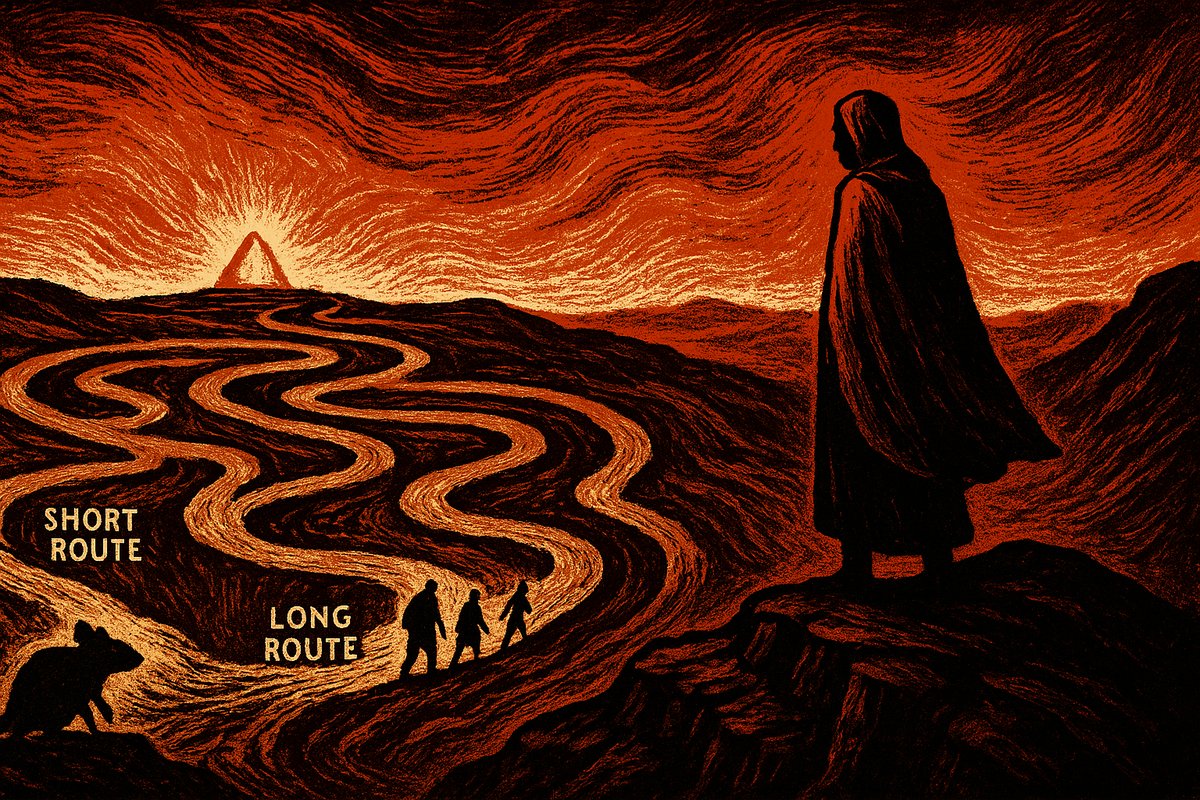
A rat learns to drive a small car toward a cereal reward. That alone is surprising. What Kelly Lambert discovered turns out to be more revealing. When rats could choose between a short route and a long route to the same reward, two out of three chose the long one. Not by mistake. It was preference.
Lambert shared this in her TED talk "I taught rats to drive. They taught me to enjoy the ride." The video went viral. Her lab explores a basic question: what does a mammalian brain need to function well? The answer isn't reducible to the final reward. It includes the stretch in between.
The process is part of the reward because the mammalian brain is wired to find value in anticipation and effort, not just in the destination. It shows up in behavior. No need to attribute feelings.
Lambert documented three elements. Rats raised in enriched environments showed greater neuroplasticity. They learned to drive faster and handled new tasks with more ease. The preference for the long path activated reward systems during the journey itself. The "Wait For It" program trained rats to wait before receiving a reward and produced greater persistence in the face of difficulty.
None of these findings imply that rats are happy in any human sense. Lambert stays rigorous. She talks about observable behaviors, choice tendencies, markers like the Straub tail associated with dopamine. No anthropomorphizing. The pattern replicates. That's enough.
Stones Don't Lie devotes a chapter to foundations for sustainable human systems. That's where Bruce Alexander's Rat Park experiment appears. Rats in isolation self-administered morphine to the limit. In enriched environments with space, company, and stimulation, fewer than ten percent showed compulsive behavior. Context determined the pull of the shortcut. Lambert approaches the same thing from a different angle: the environment surrounding the brain decides what gets activated and what atrophies.
What happens when we design structures for work, learning, or entertainment that eliminate that stretch? If the journey is where the reward lives, any model that removes it isn't optimizing anything. It disconnects the brain from what it needs. I've seen in different contexts how instant gratification erodes the capacity to persist. Tolerance for delay erodes too, just as the "Wait For It" program showed.
This lines up with flows that deliver constant stimulation without real effort. Endless scroll. Gacha systems. They don't build anything. They wear you down. It brings to mind Ulsan, where Hyundai workers stopped the line in front of the Atlas robot. The resistance had to do with the value of the craft, with the path required to master it. It also connects to Neuracle, the brain-computer interface approved for commercial use in China. If anticipation is necessary for neuroplasticity, what happens to a brain that receives rewards without that biological step?
I still don't have a clear answer. I'm still exploring this. The environment isn't decoration for cognitive capacity. It's its condition of possibility. Rats in enriched cages developed different brains.
Different in connections. In resilience. In contexts like the ones seen in Mexico, certain educational models prioritize immediate delivery. They produce brains adapted to that.
The Luddite Manifesto proposes a system of experience and progression with XP, levels, and skill points. It rests on the idea that what's valuable happens along the way. Lambert offers a biological basis for that. Aligning the journey with that mechanic doesn't invent motivation. It responds to how we're built. I'm not claiming this is the complete solution. More like a lens. Having considered Lambert's work, it becomes clearer. Insisting on process, on waiting, on effort isn't mere nostalgia. Biology asks that we preserve the path.
What environments are we creating, and what brains are we getting as a result?
Sources
1. Kelly Lambert, "I taught rats to drive. They taught me to enjoy the ride," TED Talk, University of Richmond.
2. Bruce Alexander, Rat Park experiment, referenced in Stones Don't Lie (Chapter 19: Principles for Sustainable Human Systems).
3. Edward Deci and Richard Ryan, Self-Determination Theory.