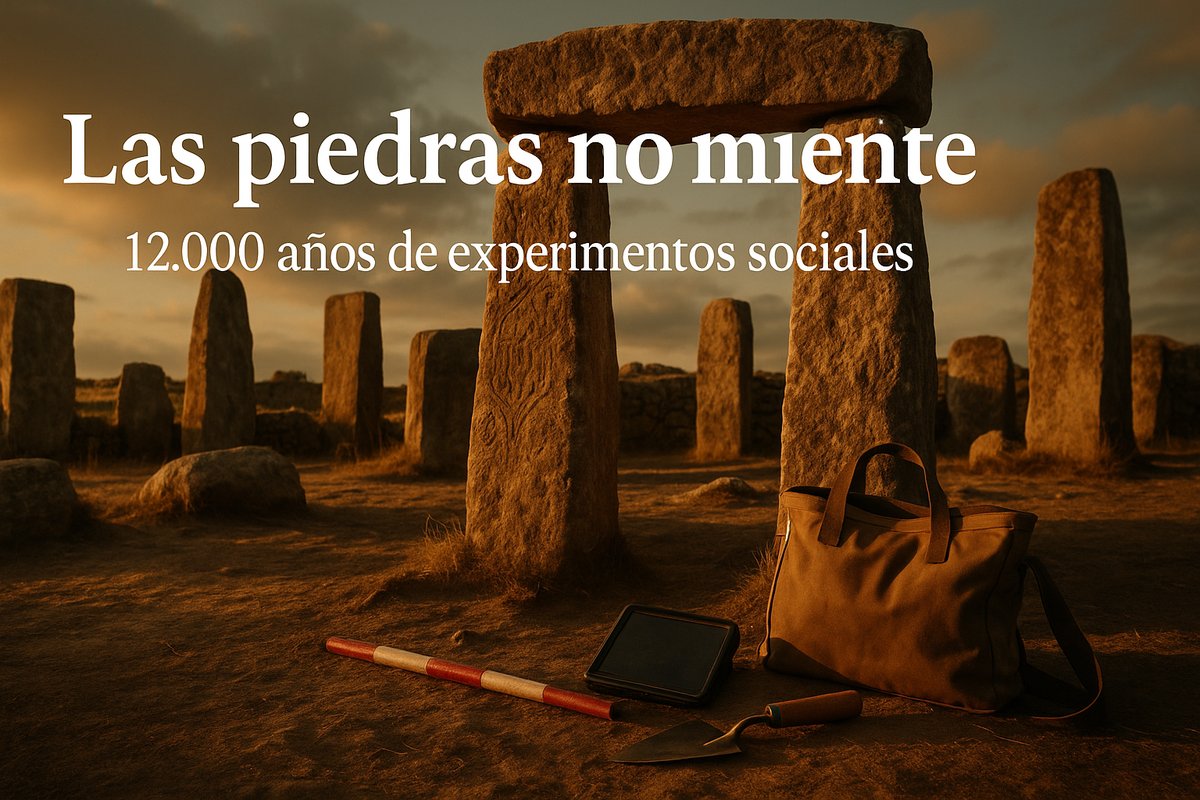
Göbekli Tepe is 12,000 years old and it still defies what we thought we knew about our ancestors. Çatalhöyük shows a society with no apparent hierarchies that functioned for over a thousand years. The remains of Harappa reveal a civilization that thrived without armies or palaces. Stones don't lie, but historians sometimes do.
I've been following these archaeological findings closely for some time, and one thing becomes clear: the official history we were taught in school is incomplete. This isn't due to bad intentions, but because for a long time we only had access to a limited portion of the evidence. That portion tended to come from civilizations that erected monuments to their leaders, not from those that lived in balance.
Now, with more data available, the picture changes.
An Engineer in Archaeologists' Territory
I'm a cybernetics engineer, not an archaeologist. I've spent years optimizing systems in complex environments, and much of my free time analyzing mechanics in games, which has sharpened my eye for behavioral patterns. When I approached archaeology through this lens, the connections started to appear.
Social systems operate with predictable rules, incentives, and vulnerabilities. Civilizations behave like interconnected networks. Looking at history this way makes certain patterns stand out immediately.
What happens when power becomes overly concentrated? Collapse looms. And what if resources pile up in few hands? Conflict arises. In environmental crises, the response depends on how collective decisions are made.
These concepts aren't new to anyone who works with systems. But applying them to thousands of years of human trials reveals unexpected dynamics. I sometimes wonder if a strategy game isn't simulating exactly that: balancing resources to avoid premature ending.
The Experiments History Forgot
We used to view history as a linear path to progress: from hunters to farmers, cities, states, and empires. Archaeology, however, paints a far more varied picture. Humanity has tried nearly every imaginable form of social organization.
There are examples of egalitarian societies that lasted for millennia. Cities with no defenses or armed forces. Cultures that handled disputes without resorting to violence. Economic models based on exchange rather than accumulation. Governance systems where leadership rotated to prevent abuses.
I don't idealize those times. Many attempts ended in failure, whether due to internal flaws or external interference. The key point is that these failures came after genuine experiments, not because the ideas were unworkable from the start.
I think about how, in a multiplayer game, an egalitarian team sometimes outlasts a rigidly hierarchical one. It's a curious parallel, though real history adds layers of unpredictability that no algorithm fully captures.
Patterns in the Chaos
In my work with systems, I've seen that the truly valuable patterns hide in the least obvious data. They demand patience and the right approach to reveal themselves.
When I mapped these historical experiments using network analysis tools, the outlines began to take shape. Recurring elements in societies that lasted. Early warning signs of collapse in others.
What intrigues me most is how ancient solutions to social dilemmas coincide with what we need today. Not out of nostalgia, but because the basic challenges of human coexistence persist. The details change—technology, climate—but not the core.
The Project Behind the Blog
This blog grew out of research that expanded into a larger effort: systematically examining lessons from 12,000 years of social trials for today's problems.
I'm not the only engineer drawn to archaeology, nor the first gaming enthusiast to spot order in disorder. My angle, shaped by years of grappling with complex dynamics, might add something fresh to the debate about our collective future.
The method is straightforward: treat history as a vast laboratory of human organization. Some tests succeeded for centuries; others crumbled quickly. All of them offer lessons.
Examined through modern lenses, that data unearths insights worth reflecting on.
The Questions That Keep Me Up at Night
Why do some societies fall into deep inequality while others sustain equity for generations? What strengthens a civilization against natural disasters? What are the critical tipping points that trigger collapse?
The one that lingers most is: with so many models tested by our ancestors, why do we limit our options to one or two dominant systems?
In the coming months, this blog will unpack these questions. We'll examine archaeological evidence overlooked in standard texts. We'll highlight success stories that outlasted short-lived empires. And we'll consider what relevance they hold for us.
An Invitation to Rethink What's Possible
I don't claim to have definitive answers. On the contrary, this path generates more questions than it resolves. That's the exciting part: we've barely scratched the surface of the diversity in our social trials.
This space isn't meant to impose ideas, but to share discoveries and invite you to join the exploration. From my years working with systems, I know the sturdiest solutions come from crossed perspectives.
Stones don't lie. The remains await interpretation. The patterns come into focus. And the options expand beyond what we'd preconceived.
What if we've been repeating the same mistakes—and the same remedies—for 12,000 years?
Join me to find out what I discovered.