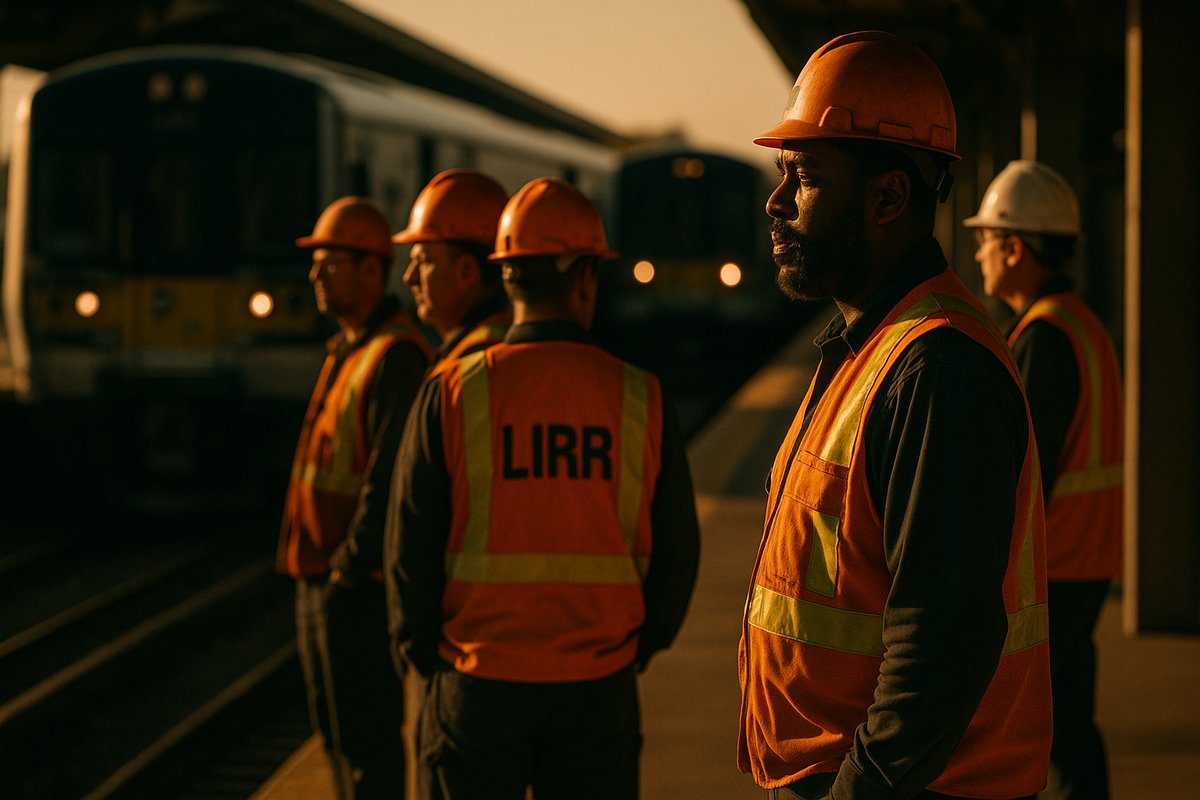
The dominant narrative about the Long Island Rail Road strike is fairly clear. Workers organized, shut down the network, and secured wage increases with real effect. Collective bargaining did its job. The unions showed they still carry weight. The train got back on track and life went on. A tidy story, with a beginning, tension, and resolution. That clean version leaves out the most substantial part.
The narrative has concrete merit. LIRR employees face demanding shifts on a network that has dragged decades of underinvestment and constant political pressure. The wage increases offer tangible purchasing power for real families. And the ability to shut down service on one of the most heavily used commuter lines in the country confirms that collective action remains a tool with force. Ignoring that would be inaccurate.
The MTA has repeated for years that inherited labor rules represent a burden that's hard to sustain. From the standpoint of those who manage complex networks, that concern has some basis: rules accumulated over successive rounds of negotiation can create rigidities that complicate the adoption of new technologies. Two reasonable positions. An agreement that satisfies them superficially. The structural reforms the authority proposed never made it into the final deal.
Here a pattern emerges that shouldn't come as a surprise.
In 1894, Pullman car workers stopped working after their wages were cut without any reduction in rents in the corporate town where they lived. Eugene Debs organized a boycott that paralyzed the railroad across several states. The federal government intervened, Debs ended up in prison, and control remained in Pullman's hands. Economic terms were negotiated. Who decided on the bigger picture was never touched. Workers demonstrated remarkable power to disrupt and translated it into wage improvements. The decision-making structure remained intact.
The same thing happened in the Great Railroad Strike of 1877, when workers in Baltimore and Pittsburgh halted the system in response to unilaterally imposed cuts. The state's response was military. Weeks later, some wages were partially restored. There was no room to participate in decisions about fares, routes, or investment. The price of labor was negotiated. The rules governing it were not.
The recent LIRR conflict repeats that geometry with precision. The unions preserved the historical rules the MTA wanted to change—a real defensive victory. But holding on to what's been won and participating in decisions about the service's future are two different things. One is preservation. The other would be shared governance. That governance was never on the table.
This matters because the rules the MTA calls costly didn't come from nowhere. Most are gains from earlier conflicts. Overtime limits, safety protocols, hiring criteria—each one answers to some prior abuse. Presenting them as the main cause of New York transit's problems inverts causality. New York City transit is expensive and unreliable mostly because of chronically insufficient funding, policies that favored the automobile, and a debt structure that soaks up resources that should go to operations and infrastructure. Labor rules are a symptom, not the cause. Debating them is very convenient for avoiding a discussion of everything else.
I've seen in various organizations that the disconnect between those who run day-to-day operations and those who set strategy generates exactly the rigidities later blamed on staff. The most serious costs rarely come from daily execution. They come from decisions made far from firsthand information. The confrontational model of these negotiations reproduces that gap: management decides, workers resist, a price is agreed on for the truce, and the cycle starts over.
No one in the coverage of this deal points out that the absence of deep changes practically guarantees the same clash will return in the next round. The pressures that caused this strike remain intact. The MTA will push for operational cuts. Employees will defend historical conditions. And the network will stay hostage to that recurring tension. What was signed was a pause, not a solution.
Different models have tried to break that logic. Chile's Cybersyn project in the seventies tested forms of coordination that integrated real-time operational data with management decisions, including workers in the design process. It wasn't perfect or directly replicable, and I'm still exploring its concrete lessons. But it pointed toward something clear: technology can open channels for genuine participation, not just automate or cut staff. The question of whether public transit operators should have a voice in the modernization efforts that affect their jobs and working conditions isn't utopian. It's a matter of organizational design. Structures that ignore that dimension accumulate friction until they blow up.
The counterintuitive point worth keeping is this: the labor rules the MTA wanted to eliminate aren't some relic of the past blocking progress. Many exist precisely because, in earlier rounds where those points were conceded, the outcomes were worse for everyone, including service quality. LIRR passengers, who rightly complained about the shutdown, travel today in a safer environment precisely because some of those costs remain in place. What was presented as an obstacle to modernization can, in several cases, be part of what keeps the operation running.
What kinds of participation channels could break this repetition without sacrificing safety or operational efficiency?