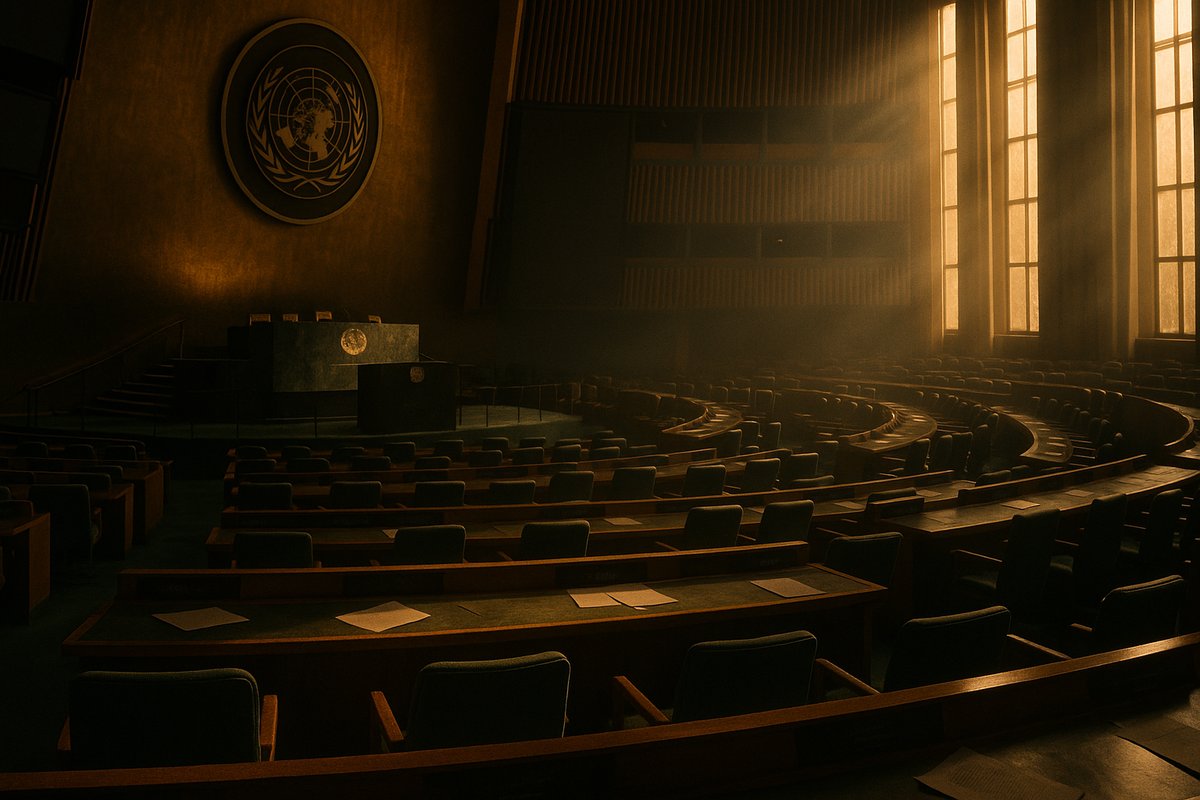
The American military operation that captured Nicolás Maduro in Venezuela exposes a persistent challenge: the multilateral institutions designed to prevent unilateral actions like this one chose silence instead. The UN, born from the lessons of World War II with the ideal of preventing repetitions, offered only measured statements while a single power reshaped the geopolitical landscape of Latin America through force.
This kind of response is not isolated. We've seen it before, and it has had profound effects.
The League of Nations, founded in 1920 to preserve global peace, followed a similar path. Facing the Japanese invasion of Manchuria in 1931, it issued a condemnation without concrete action. In 1935, when Italy attacked Ethiopia, the sanctions were so limited that Mussolini simply brushed them off. By the time Hitler began his expansion, the League had lost all relevance. In 1939, the very body meant to prevent wars had revealed its weakness before powerful members who chose unilateralism instead.
What's happening now evokes some curious parallels. The United States has announced its withdrawal from numerous UN agencies, arguing that the system resists reform and favoring a direct-leadership approach instead. Secretary Rubio pointed to opacity and redundancy as barriers to sovereignty. Meanwhile, China, Russia, and other global actors pursue strategic advantages, eroding universal spaces in favor of bilateral pacts or more nimble arrangements.
From a systems-design perspective, it's fascinating how predictably these structures fail. In any group, if the dominant actors perceive greater benefit in skirting the rules than in following them, the framework collapses. This vulnerability stems from a dependence on consensus, which only works if everyone prioritizes collective stability over immediate gain.
In my experience, I've noticed similar patterns across all sorts of organizations. When better-resourced units start resolving issues through independent channels, central protocols weaken. Sure, in local contexts you can adjust the mechanisms; on the international stage, a breakdown like this could spiral into larger conflicts.
The challenge goes beyond external pressure. These institutions were conceived at a time when unilateralism was assumed to always cost more than it paid off. Today, that logic has flipped: capturing a foreign leader with minimal blowback, or extending economic influence without effective multilateral pushback, changes the incentives entirely.
This brings to mind archaeological findings from ancient societies. Coordination mechanisms among city-states or empires endured as long as cooperation seemed more advantageous than competition. But when technological breakthroughs or economic shifts upset that balance, those systems collapsed quickly. What does that tell us about our own moment?
The encouraging part is that we now have tools unavailable in 1920, or in earlier eras. Algorithmic transparency could redefine these institutions. Imagine a framework where every UN resolution, every Security Council veto, every vote is accessible and verifiable through algorithms that any nation can audit independently.
This isn't about replacing human judgment with code, but about eliminating the hiding places for concealed motives. If a country vetoes a proposal, let its reasoning and interests be laid bare. In cases of humanitarian intervention, let the data and standards be open and contestable.
BRICS countries are already moving in this direction. Their emphasis on inclusive AI, with transparency and citizen voice, challenges Silicon Valley's opaque approaches. Applied to the multilateral sphere, this could force dominant actors to operate with greater accountability, rather than relying on voluntary self-restraint.
Spain, through President Sánchez, advocates for a "sensible internationalism" that combines coherence, commitment, cooperation, and creativity. It's a shrewd approach: it acknowledges the cracks in classical multilateralism while proposing its renewal through contemporary tools.
After years studying how organizations balance competition and cooperation, ASEAN intrigues me in particular. Will they manage to forge a genuinely innovative model, or will they repeat the rivalries that have divided other regions? That question leads me to believe there's room for experimentation.
The future doesn't lie in a return to unchecked hegemonies, nor in clinging to ineffective structures. It's about innovation: testing new forms of coordination that incorporate radical transparency, citizen involvement, and algorithmic checks, making it harder to ignore principles than to abide by them.
I don't have complete answers here. I'm still working through how to merge digital transparency with the discretion diplomacy sometimes requires. But history shows that institutional failures carry serious risks, while technological advances open new paths for collaboration. This is more complicated than it looks, and I'm still digging into it.
Stones don't lie, but historians sometimes do.