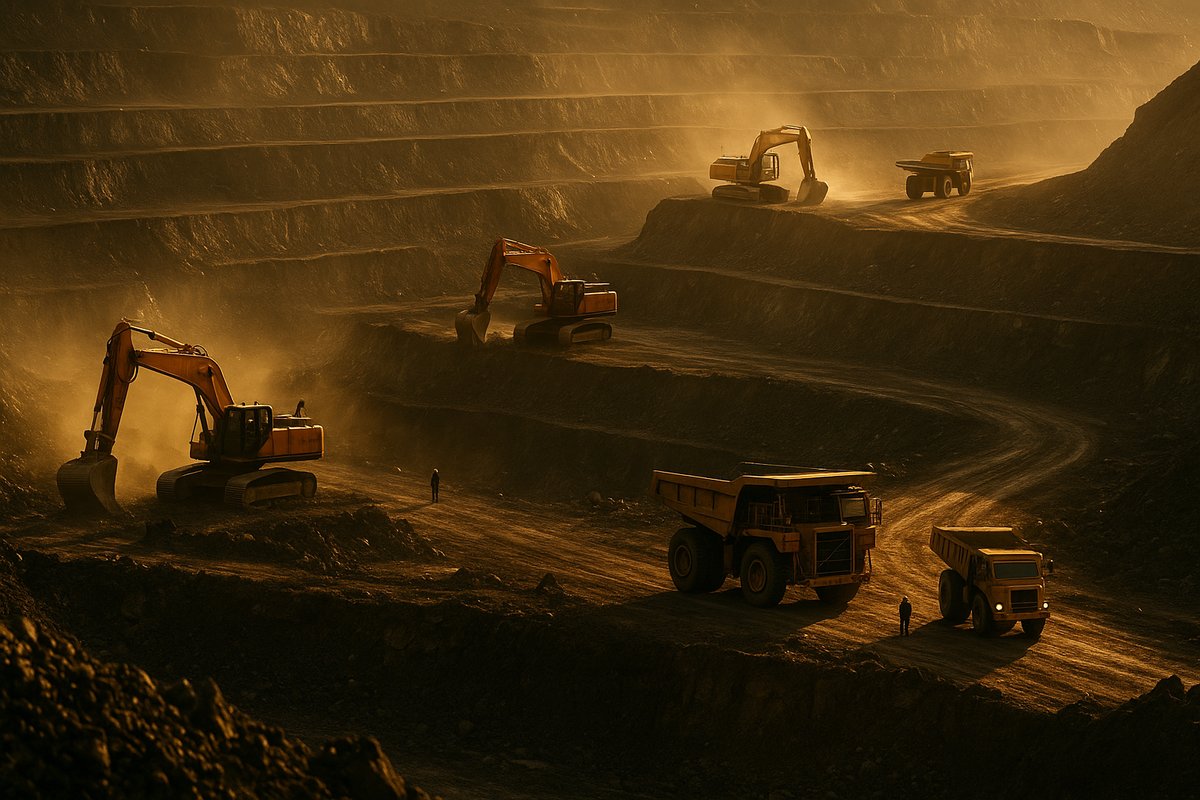
When a system extracts more than it can sustain, it collapses. This isn't a metaphor. It's a technical description of what happens in mines, oil wells, ecosystems, and entire economies when the logic of maximum extraction outpaces the model's capacity for regeneration. What's curious, and also unsettling, is that this trend isn't new. We've seen it before. And we keep being surprised every time it repeats.
The recent collapse at a mine in Sinaloa, where the rupture of a geomembrane left workers trapped underground, is not an isolated accident. Technical reports indicate that at the moment of failure there were twenty-five people in the affected zone. Four were trapped. That's a cold statistic for those who aren't inside. For those who were, it's the concrete result of a structure designed to extract, not to sustain. Geomembranes are containment infrastructure, not production infrastructure. When they fail, it's because something in the chain of decisions prioritized speed or cost over structural integrity. There's always a chain of decisions behind every collapse.
The same pattern appears when examining the socio-environmental impact of the oil industry in southeastern Mexico. The description is almost clinical in its precision: macroeconomic wealth generation coexists with severe degradation of the ecosystem. Translated: someone makes a lot of money while the environment sustaining local communities is systematically destroyed. This isn't a flaw in the model. It's the model working exactly as designed. Wealth rises through one channel. Costs are distributed downward and outward, onto land, rivers, bodies, and communities that don't appear on financial balance sheets.
There are researchers who have spent decades documenting this dynamic. The concept of "total war ecology," recently explored from geopolitical perspectives, offers a useful lens here. The central idea is that modern conflicts, including economic conflicts over resources, collapse the stabilizing effect that institutions normally have on growth. When extraction operates in total war mode, the processes of regulation and balance simply disconnect. What remains is pure extractive logic without a brake: take everything you can before someone else arrives, or before the model collapses.
This trend is not exclusive to the twenty-first century. I recognize this dynamic in civilizations that overexploited their resource bases to the point of no return. Ancient Mesoamerican societies extracted from their fertile lands until the soil was exhausted, leaving ruins that today speak of lessons never learned. The difference between those civilizations and ours isn't technology or sophistication. It's speed. Today we extract faster, we distribute the costs more efficiently toward the margins, and we document the process in real time even as we keep doing it. We have more data than ever about the collapse we're building.
What complicates this analysis is that we're not talking about malicious actors operating in the shadows. Most of those making extractive decisions respond to perfectly rational incentives within their structures. A mine manager who approves the use of a lower-spec geomembrane responds to cost pressures coming from above. An oil executive who signs contracts in ecologically sensitive zones fulfills fiduciary obligations to shareholders. The problem isn't individual malice. It's the architecture of the incentive model, which makes maximum extraction the rational short-term decision, even if it's suicidal in the long run.
This is where game theory offers something concrete. Prisoner's dilemmas aren't resolved by appealing to the players' morality. They're resolved by changing the rules of the game. As long as the costs of structural collapse, whether in mines or oil ecosystems, are externalized onto communities, workers, and future generations, companies will keep making decisions that maximize short-term extraction. The calculation only changes when real costs are internalized into the same model that generates the profits. This isn't an ideological proposal. It's basic incentive math.
There are historical precedents of communities that found ways to manage common resources without destroying them. Elinor Ostrom documented dozens of these cases, from irrigation systems in Japan to fisheries in Spain, where local communities developed sustainable-use rules that survived for centuries. These weren't utopias. They were models with accountability mechanisms, clear extraction limits, and real consequences for those who violated the rules. The difference with our current approach isn't complexity. It's the alignment between those who extract, those who bear the costs, and those who set the rules.
The case of southeastern Mexico illustrates exactly this misalignment. The communities living atop oil resources bear the environmental degradation. Companies and the state capture the macroeconomic wealth. And the rules are set by actors whose geographic and financial distance from the consequences is enough that they never feel them. This isn't a design accident. It's the design itself. Correcting this trend requires more than incremental regulation. It requires redistributing who has a voice in extraction decisions and who bears the costs when the model fails.
I still don't have a clear picture of how this gets implemented at a national or global scale without falling into other institutional traps. There are aspects of resource governance that are genuinely difficult, where local solutions that worked in small contexts don't easily scale to complex economies. What does seem clear, based on the regularities that repeat across collapsed mines, degraded ecosystems, and communities impoverished atop rich land, is that the current model is not a temporary phase of development. It's a trajectory with a known destination.
The collapse in Sinaloa is not an exceptional event. It's a legible symptom of a structure that extracts without sustaining. Oil degradation in the southeast isn't an unfortunate externality either. It's the real cost of an accounting that doesn't count everything. Total war ecology doesn't just describe military conflicts. It describes any model where the logic of maximum extraction suspends the processes that would normally limit the damage. Recognizing the trend is the first step. The second is designing structures where incentives point in a different direction, not because it's idealistic, but because models that don't do this collapse. Always.
Stones don't lie, but historians sometimes do.
Sources:
1. Le Grand Continent — The Ecology of Total War (2026): https://legrandcontinent.eu/es/2026/03/24/la-ecologia-de-guerra-total/
2. Expansión Política — Collapse at Sinaloa Mine Leaves Four Workers Trapped (2026): https://politica.expansion.mx/estados/2026/03/27/colapso-en-mina-de-sinaloa-deja-a-cuatro-trabajadores-atrapados
3. El Tequio — The Socio-Environmental Impact of the Oil Industry in Southeastern Mexico: https://www.eltequiodiario.online/principal/el-impacto-socioambiental-de-la-industria-petrolera-en-el-sureste-mexicano/
4. Elinor Ostrom — Governing the Commons: The Evolution of Institutions for Collective Action (Cambridge University Press, 1990)