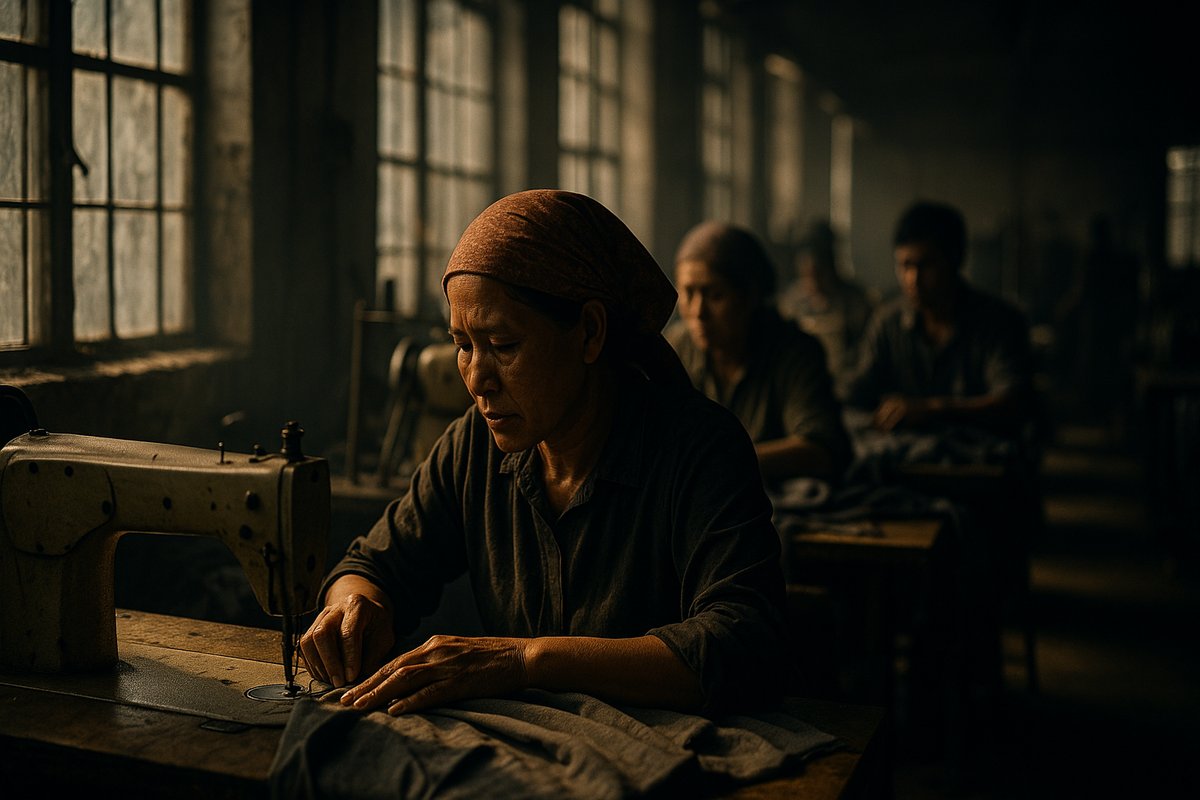
In Yangon, textile workers were detained for distributing flyers. These weren't political pamphlets or calls to insurrection. They were union communications listing meeting times, basic rights, and information about working conditions. The Burmese military junta makes no distinctions: organizing workers amounts, by definition, to a subversive act.
What's striking isn't the repression in Myanmar. That dynamic has been repeating for years. What matters is that it coincided with documentation from IndustriALL, the federation representing more than fifty million workers in extractive and manufacturing industries. Similar reports emerged from Taiwan, Belarus, and Mauritius. Four contexts. Four regimes. One recurring pattern.
Researchers have tracked this regularity for years. Union suppression functions as a method for cutting labor costs. Eliminate collective bargaining and production gets cheaper. Comparative advantage gets built on criminalization. The ITUC Global Rights Index ranks Myanmar among the worst places for labor organizing. The index, however, has no teeth.
The actors involved don't share the same motivations. IndustriALL threatened to escalate pressure on the Burmese junta. The warning carries weight, though its reach remains limited. Governments capable of imposing sanctions aren't moving. The European Union passed a pay transparency directive that got some media attention. Its actual enforcement remains pending in most member states. Companies manufacturing in Myanmar, many headquartered in developed markets, carry on with the calm that comes from a long supply chain and short accountability.
In Taiwan, migrant workers—mostly from Indonesia, the Philippines, and Vietnam—carry a double vulnerability. They lack full labor citizenship, and their home countries have less bargaining power against larger economies. Organizing becomes difficult when immigration status depends on the very employer doing the exploiting. In Belarus, the Lukashenko regime spent years dismantling any independent union structure. Those who tried to organize after the 2020 protests are still paying the price. In Mauritius the same story repeats in export processing zones where labor protections are, at best, decorative.
This pattern shows up across very different settings. When a structure is designed to produce a specific outcome, it tends to produce it consistently, regardless of who's operating it. Union suppression doesn't happen by accident. It's built into the design.
IndustriALL's response functions as a distributed network. There's no single center that can be easily silenced. Pressure over a detention in Yangon can be triggered from Geneva, Berlin, or Mexico City. That redundancy builds resilience. The idea isn't new. The labor International that emerged after World War I started from the same observation: capital already moved without borders, and workers responded by weaving networks that crossed those same borders.
Latin America's dictatorships of the 1970s left a parallel record. Unions that kept external connections managed to survive. Those without them disappeared. The current difference isn't structural but one of speed and scale. Capital moves faster now. Supply chains are more opaque. The same technology that enables coordinating solidarity also enables surveillance to identify organizers before they can build any lasting structure.
The historical record shows a documented, if uncomfortable, result. International union pressure has secured releases and improvements wherever corporate reputation was vulnerable. Against regimes with low reputational cost, the limits become clear. The Burmese junta has no sensitive shareholders and no consumers easy to mobilize. Effectiveness grows when that pressure combines with direct economic consequences for the companies benefiting from the arrangement. That link is still missing. The pay transparency directive sits dormant in implementation processes while companies that prefer opacity buy themselves time.
Companies operating in Myanmar, Mauritius, or Belarus's free trade zones keep reporting healthy margins. Their products reach shelves in markets where consumers have labor rights the manufacturers never knew. No one violates any law explicitly. The union, on the other hand, does.
How resilient can these distributed networks become when surveillance advances at the same pace as coordination?
Sources
1. IndustriALL Global Union — Reports on union repression in Myanmar, 2025-2026
2. ITUC Global Rights Index — International Trade Union Confederation, 2025 edition
3. European Union Pay Transparency Directive (2023/970) — Implementation status by member state
4. van der Linden, Marcel — Workers of the World: Essays toward a Global Labor History — Brill, 2008
5. Amnesty International — Reports on migrant workers in Taiwan and Mauritius, 2024-2025