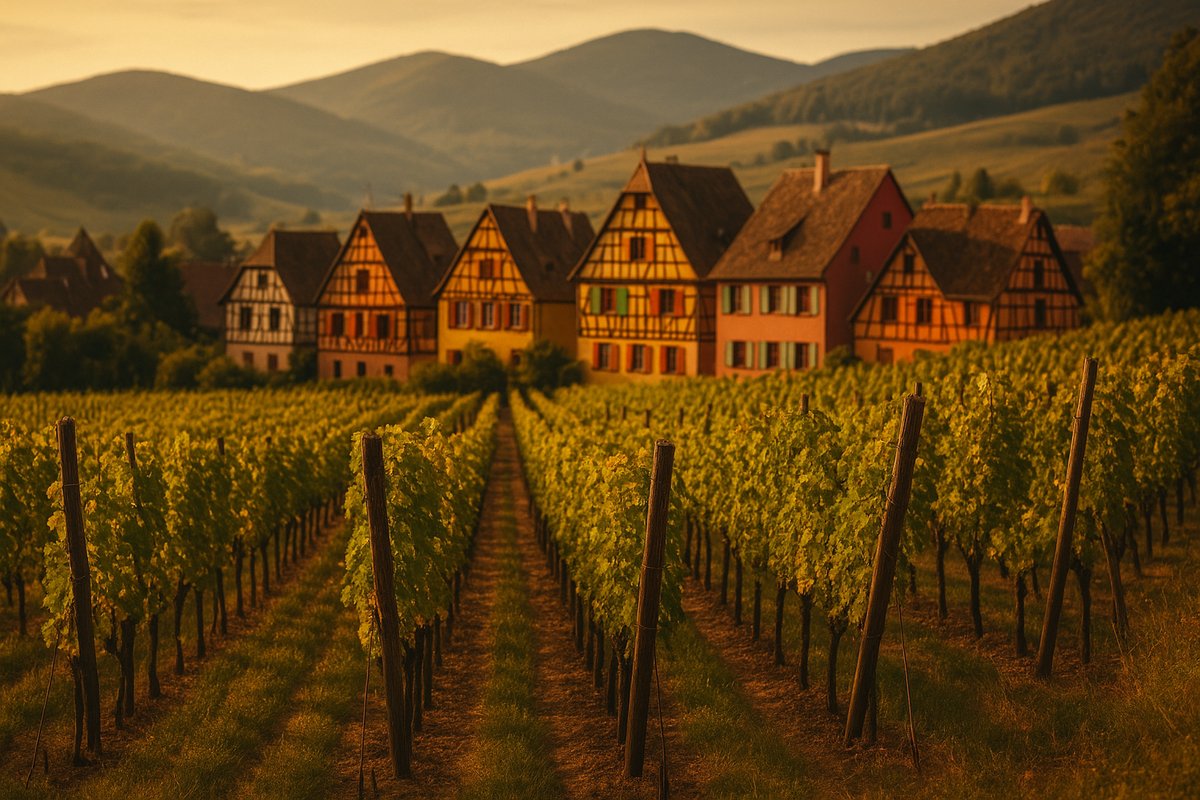
I went to Alsace as a tourist. Colmar, Riquewihr, Ribeauvillé, Eguisheim, Kaysersberg. The wine route, the storybook villages, the timber-framed houses painted in colors that shouldn't work together but do. Each village is a living question: why do certain human systems endure while others crumble?
The question didn't hit me all at once. In Riquewihr, with around eleven hundred residents, there's an active economy, well-kept public space, and an identity that doesn't seem manufactured for tourism. The same in Eguisheim, with just over sixteen hundred residents; in Ammerschwihr, close to sixteen hundred; in Kaysersberg, about twenty-eight hundred. These aren't villages frozen in time or medieval theme parks. They're communities that operate with coherence. What intrigues me is what sustains them across centuries.
Alsace has changed hands: French, German, French, German, and French again. Not by local decision, but by treaties signed in distant capitals by people who probably never set foot in these places. The people stayed put. The borders crossed them. And they kept making wine, speaking Alsatian, keeping the streets clean. A concrete example: Domaine Jean-Baptiste Adam in Ammerschwihr was classified during World War II as deutschfeindlich, hostile to Germany, but it survived because its cellar served as a bomb shelter. The building they wanted to destroy ended up protecting the very people trying to control it. A community's identity doesn't depend on the state that governs it. That's not abstract; it's what happened there.
Jean-Baptiste Adam has spent fifteen generations in Ammerschwihr since 1614. It survived the Thirty Years' War, the French Revolution, and two world wars. In 2004, they converted the vineyards to biodynamic farming, treating the vineyard as a living organism that grows stronger without pesticides or synthetic chemicals. This isn't nostalgia; it's a technical choice grounded in evidence that care outperforms extraction.
Dopff au Moulin in Riquewihr dates back to 1574. In the early twentieth century, Julien Dopff saw a demonstration of the champenoise method in Paris, learned it, and adapted it to Alsace, effectively creating Crémant d'Alsace. This dismantles the idea that lasting means rejecting change. They innovated, but in service of local identity, not against it. Innovation expanded what they were, without replacing it.
Domaine Emile Beyer in Eguisheim counts fourteen generations since 1580. Christian and Valérie Beyer now manage seventeen hectares with Demeter biodynamic certification, tending the soil like a living organism to preserve each wine's distinct character. Three vineyards, centuries of different histories, same underlying truth: durability comes from cultivation, not exploitation.
In Kaysersberg, quotes from Albert Schweitzer adorn the walls. He was born there in 1875. One reads: "Until he extends his circle of compassion to all living things, man will not himself find peace." The idea that resonates is that ethics either expand or contract, and a community that limits its responsibility to its own or the immediate ends up destroying itself. Schweitzer didn't accumulate power; he distributed it through service. That choice connects to what families like Adam, Dopff, and Beyer have done with the land for centuries.
History regularly records the same collapse: structures that exhaust themselves by extracting resources, trust, or identity. Alsace offers the counterpoint. Communities that endure because they cultivate. This isn't utopia; it's verifiable historical record backed by centuries. The difference between extracting and cultivating isn't metaphorical; it's a design principle that appears in biology, engineering, and these vineyards since the sixteenth century.
I still don't have a clear picture of the exact mechanism of transmission. Does small scale make it easier? Territorial continuity? Family structure, which aligns incentives differently than corporations chasing quarterly results? Researchers have studied this for decades and the answers aren't simple. What's evident is that the process exists. These villages aren't accidents; they're outcomes.
These vineyards, and the man born in Kaysersberg a century and a half ago, point to the same thing: sustainable systems didn't wait for modern technologies. They were already working. There's no need to invent them; it's enough to recognize them, study them seriously, and explore which foundations can be adapted to other contexts, even without four hundred years of history or vineyards in the Vosges.
The image that stayed with me from the trip isn't the most striking one. It's a door in Eguisheim, on a circular street that wraps around the village like a ring. A dark wooden door with a number I've already forgotten. Someone painted it, someone looks after it, and someone will keep looking after it when I'm no longer around to see it. I don't know who, but the fact that it's cared for speaks to the environment around it. Systems that endure do so because, in every generation, someone decides the care is worth it.
Stones don't lie, but historians sometimes do.
Sources:
1. Jean-Baptiste Adam — Domaine history: https://www.jb-adam.com/en/content/9-our-history.html
2. The Sorting Table — Jean-Baptiste Adam profile: https://www.thesortingtable.com/grower/jean-baptiste-adam/
3. Dopff au Moulin — History of the Dopff family: https://www.dopff-au-moulin.fr/en/our-estate/the-dopff-familys-history/
4. Domaine Emile Beyer — Rue des Vignerons: https://www.ruedesvignerons.com/en/domaine/222/domaine-emile-beyer
5. Albert Schweitzer quotes — Psicoactiva: https://www.psicoactiva.com/blog/frases-celebres-de-albert-schweitzer/