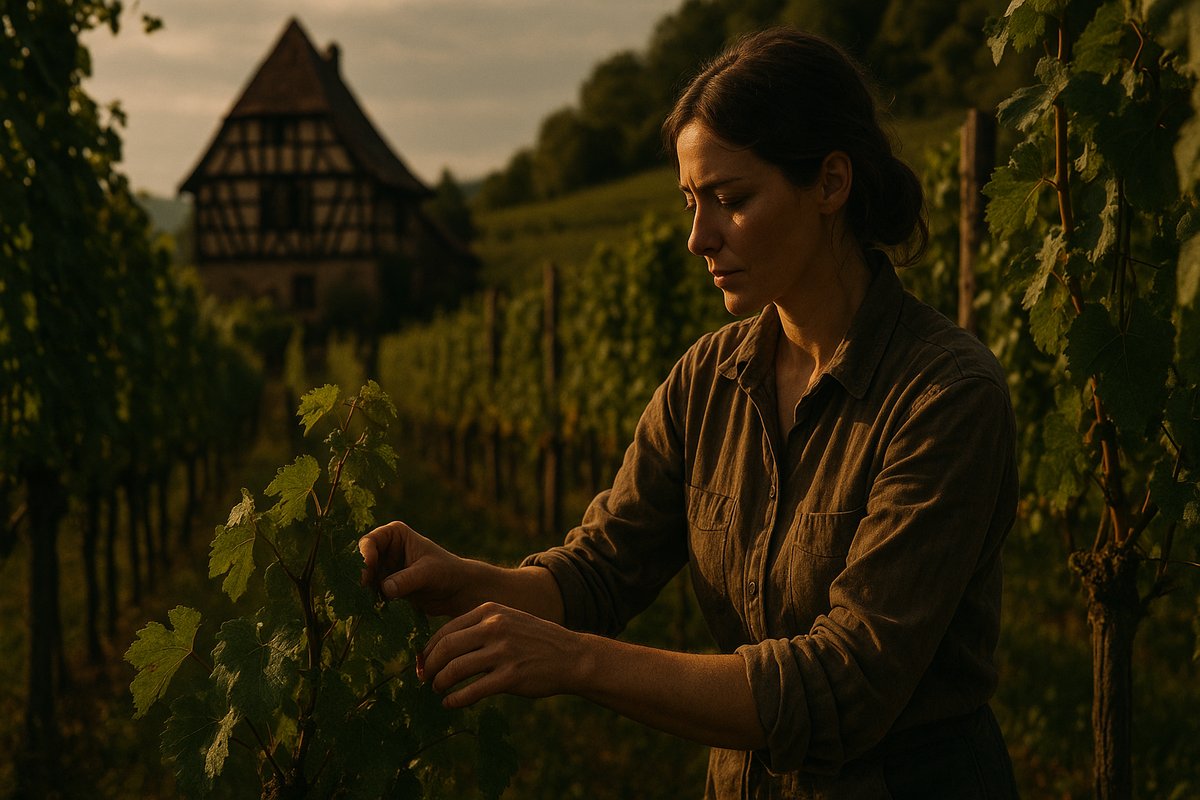
Alsace doesn't prepare you for Alsace. You arrive expecting just another European region, with its functional buildings and reasonable infrastructure, and what you find is something else entirely: medieval villages that don't look preserved so much as simply alive, three-century-old houses with clean windows and intact façades, new tractors parked in front of wooden gates that have stood there since before Mexico existed as a nation. There are no open-air museums because none are needed. People live inside.
The contrast with Stuttgart, less than two hours away by car, is hard to process. Stuttgart has its own logic: industrial efficiency, postwar architecture, the energy of a city that rebuilt its identity around production. It works. But Alsace is something else. It's a region that seems to have decided, at some collective and probably undeclared moment, that certain things are not negotiable. The streets. The façades. The vineyards. The way it cares for what already exists.
Valerie works her vineyard with a precision that has nothing folkloric about it. This is not the romanticized image of the European peasant that one imports from afar. She is a woman who knows every vine by name, who knows which year was difficult and why, who talks about the land the way an engineer talks about their design: with technical respect and something more than technique. Watching her work is to understand that there are ways of relating to one's surroundings that don't fit neatly into any modern category. It isn't tradition for nostalgia's sake. It isn't sustainability as a brand. It's simply a way of being in the world that assumes what's in front of you deserves care.
Albert Schweitzer was born a few kilometers from there. Günsbach, specifically. I didn't go looking for it. It came up in a conversation, on a sign, in the natural logic of the region. And once you start to understand what Schweitzer proposed, the Alsatian landscape takes on a different dimension.
His central concept is deceptively simple: all life deserves respect. Not as a religious commandment, not as ecological sentimentality, but as rational ethics. Schweitzer argued that any being with a will to live recognizes, deep down, that same will in other beings. To kill, harm, or destroy without necessity is not just a cruel act: it's a logical contradiction with our own existence. He called this Ehrfurcht vor dem Leben, reverence for life. He spent decades developing the idea not at a desk but in a hospital he built in Gabon, where he also played the organ and studied Bach. The man was, let's say, hard to pigeonhole.
What interests me most about Schweitzer isn't the biographical anecdote but his diagnosis. He wrote, with an uncomfortable clarity, that Western civilization fell into decline when it abandoned that ethical foundation. Not when it lost technology or stopped growing economically. When it stopped treating life as something that deserves respect by default. When calculation replaced ethics. When utility became the only criterion.
That diagnosis resonates in ways Schweitzer probably didn't anticipate. I've tracked patterns across twelve thousand years of human organizational structures: cities, empires, cooperatives, agricultural communities, egalitarian experiments that worked for generations and then collapsed. One constant that keeps showing up is exactly this: organizations that lose their underlying ethical foundation don't collapse all at once. They degrade. They become efficient in the emptiest sense of the word. They optimize without knowing what for. At some point they stop serving life and become structures that serve only themselves.
The peasant cooperatives of Bajo Aguán in Honduras, which I wrote about some time ago, are an example of the opposite: communities that maintain a functioning ethical foundation under extreme pressure. Not because they read Schweitzer. But because reverence for life, when it exists, needs no name. It shows in how decisions are made, in who has a voice, in what gets protected when a choice must be made.
Alsace works, I think, for similar reasons. Not because it has a particularly brilliant government, nor because its inhabitants are genetically predisposed to order. But because there's an implicit ethic in the way people relate to what they have. The medieval houses are well maintained not because some law demands it, but because destroying them would be a contradiction with something the region knows, collectively, even if it doesn't put it in those terms. Valerie's vineyard is not a hobby or an investment. It's a relationship.
This is more complicated than it sounds. I'm not saying Alsace is perfect, or that it has solved the problems the rest of Europe carries. There are tensions here too, there is politics, there are generations that leave and don't come back, there are unanswered questions about what happens when tourism displaces agriculture. I don't have a simple reading of what I saw.
What is clear to me is this: reverence for life is not a philosophical luxury. It's an engineering rule. Structures that incorporate it, explicitly or implicitly, tend to be more resilient. Those that abandon it tend to optimize themselves into fragility. We've seen it in organizations, in cities, in empires. The pattern isn't new.
What I take back to Mexico isn't a solution. Mexico has its own complexity, its own stories of communities that care for what they have and structures that destroy whatever they touch. What I take with me is an attitude. The question Schweitzer formulated over a century ago, and which Alsace seems to answer without knowing it: what do you treat as though it deserves to exist?
That question changes how an organization is designed, how a decision is made, how public policy is built. Not because it's poetic, but because it's rational. Structures that never ask themselves that question eventually answer it in the worst possible way.
Stones don't lie, but historians sometimes do.
Sources:
1. Schweitzer, Albert. The Philosophy of Civilization (1923). Prometheus Books, 1987.
2. Schweitzer, Albert. Out of My Life and Thought: An Autobiography. Johns Hopkins University Press, 1998.
3. Brabazon, James. Albert Schweitzer: A Biography. Syracuse University Press, 2000.
4. Région Grand Est. Documentation on Alsatian architectural heritage. Archives départementales du Bas-Rhin.
5. Scott, James C. Seeing Like a State: How Certain Schemes to Improve the Human Condition Have Failed. Yale University Press, 1998.