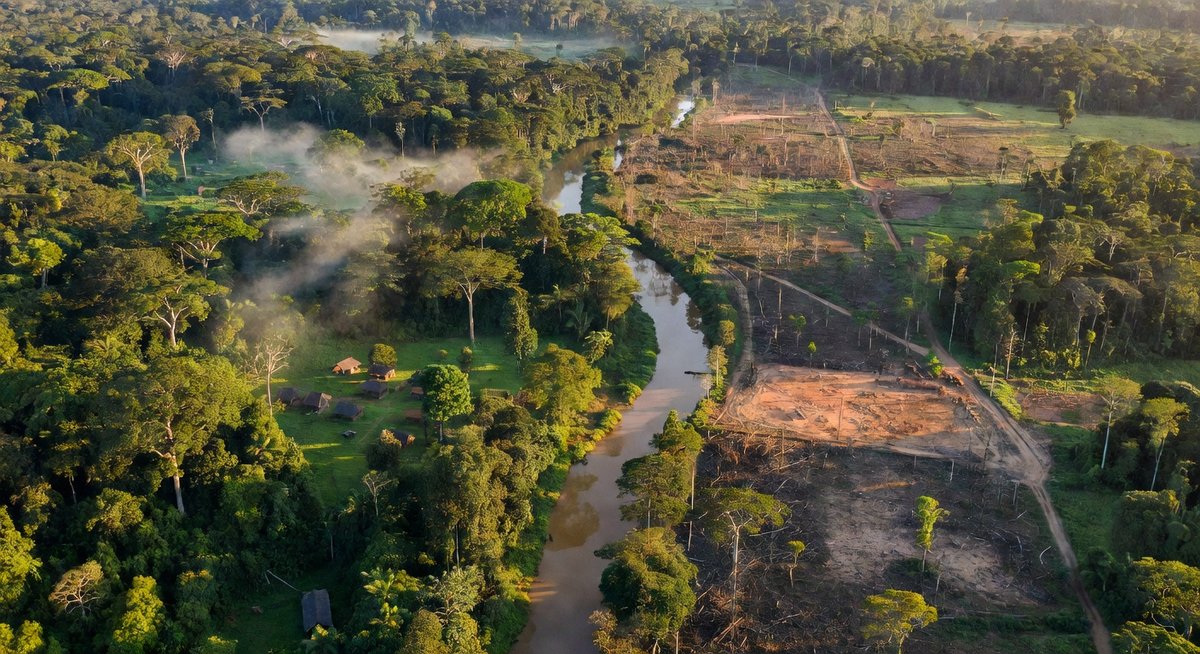
There's a number that deserves a place in every climate meeting, every conservation forum, and every debate on green financing: 14% versus 38%. That gap reveals the difference in ecosystem disturbance between Amazonian indigenous territories and zones under state administration. Where communities retain real control, disturbance is limited to 14%. Areas managed by national governments reach 38%. That's not a minor variation. It's more than double. And yet the governance models that dominate climate policy keep betting on the very scheme that produces worse results.
The centralist version has its own internal logic.
States argue that only they possess the legal, financial, and technical scale needed to manage a continental ecosystem. The Amazon regulates the climate across much of South America, stores carbon at a planetary scale, and holds biodiversity we still haven't fully catalogued. Given that complexity, fragmenting authority among scattered communities seems risky. International bodies prefer a single interlocutor: a ministry that signs agreements, an apparatus that generates auditable reports. It's operationally convenient. The problem is that this convenience doubles the degradation.
This view also feeds on real failures of local management. There are territories where organized crime and illegal logging have overwhelmed any community authority. No one should idealize these structures as infallible in the face of extreme violence. Acknowledging that much is basic. Still, an organization that fails under extreme pressure doesn't demonstrate inferiority. Above all, it shows the absence of the institutional and legal backing it needs to hold its ground.
The records complicate this official version in an uncomfortable way.
Elinor Ostrom documented how communities that craft their own rules for shared resources frequently outperform both state management and the market. Her case studies of fisheries, irrigation systems, and communal forests all showed the same dynamic: deep local knowledge, rules fitted to place, and accountability among neighbors who share the territory. It wasn't romanticism. It was verifiable social design. What we find in the Amazonian data follows that same pattern.
From the standpoint of complex systems, this shouldn't be surprising. A centralized model applies general rules from a distance. A distributed one responds with immediate, on-the-ground information. The difference in speed, granularity, and incentives is structural. The distant official doesn't share the same interests as the community that lives off the forest and needs it to endure two decades from now. The most effective decisions happen where the information resides, not where formal power is concentrated.
Andean terraces sustained entire societies for centuries through crop rotation and water management that didn't depend on central bureaucracy. When those designs were displaced by colonial and state approaches, degradation accelerated in documentable ways. I'm no archaeologist, but the findings reveal adaptive structures with built-in error correction. The Amazon isn't experiencing an anomaly. It's repeating an ending we already know.
So why do governments ignore these records? Incentive analysis explains more than any technical model.
Hydroelectric companies pushing dams don't benefit from strengthened communities capable of vetoing them. Agribusiness needs state interlocutors who can hand over territory easily. Financing mechanisms channel resources through structures that justify their own existence. If communities achieve better results without intermediaries, the intermediary loses its reason to exist. States prefer the narrative that conservation requires their direct control, because that narrative enables control whenever it's convenient.
There are concrete proposals on the table: biodiversity corridors, dam-free river sanctuaries, independent monitoring committees. None of them yet have binding mechanisms. Not because they're technically unworkable, but because the actors with real power have no incentive to relinquish authority. The gap between the data and the policies doesn't reflect ignorance. It reflects a deliberate choice about who gets to be in charge.
There's no shortage of findings. Researchers have spent decades documenting this superiority. What's missing is the admission that the problem isn't just one of knowledge but of power: the model that performs worse is also the one that concentrates resources wherever it's convenient for those making the decisions.
That leaves an uncomfortable fact to close on. Those indigenous territories, without access to the trillions in international climate financing, without massive bureaucracies or specialized technology, preserve the ecosystem more than twice as well as all those structures combined. If that doesn't change the conversation, the question is no longer what the records say. It's who has a real interest in making sure we keep failing to listen to them.