A small plane crashes into a skyscraper in Beijing. The impact, the smoke, and the initial reports existed for a few hours within the global news ecosystem. Then, nothing. Searches that return inconsistent results, stories vanishing from news portals, an administrative silence that doesn't feel like traditional censorship but something more precise and surgical.
This isn't a theory about the crash itself. It's an observation about what happens once the event occurs. The real problem isn't confirming whether the collision happened. The infrastructure to make something like this nearly impossible to trace already exists, already operates, and is already migrating toward contexts that swear they'll never need it.
I've seen these patterns before, in other contexts: systems built with a stated purpose that end up serving entirely different ends. There's no need for explicit lies. It's enough that the design works as intended.
China maintains, according to Freedom House records and Citizen Lab analysis, one of the most refined digital censorship systems in the world. It's not limited to blocking keywords. It operates through real-time narrative management, as researchers call it. When an event threatens to generate unwanted conversation, the content doesn't disappear abruptly with a warning. It degrades. It loses visibility in internal search engines, drops out of trending topics, reshares get limited without notice, and original versions get edited without leaving a trace. The result isn't an obvious void but a kind of informational anemia: the story technically still exists, but it becomes nearly impossible to find.
What sets this case apart is the speed. We're not talking about years of sustained rewriting, as happened with certain historical chapters of the last century. We're talking about an event that, according to early coverage, took less than a day to become hard to find through the usual channels. That represents a qualitative leap.
This is where the problem stops feeling distant. The technical capabilities that enable this rapid erasure—algorithmic moderation at scale, centralized content prioritization, cascading depublication across platforms—aren't inventions exclusive to one type of regime. They're the same capabilities developed in democracies under names like security, child protection, or fact-checking.
The structure repeats itself under different labels. When Ofcom in the UK demands access to encrypted chats, the official reason is combating crime and protecting minors. No one denies those risks are real. Still, the architecture being built is, in its design, similar to the one that allows an event to vanish from collective memory. The difference isn't in the code. It's in the name given to it and in who flips the switch.
Gutenberg's printing press democratized knowledge, yes. But it also made clear that whoever controls the channels of reproduction and distribution decides, in practice, what survives in historical memory. Copyist monks played a role equivalent to administrators with full access: they could edit, correct, or simply choose not to copy. Recommendation algorithms and moderation teams serve that function today, only at a planetary scale and with less transparency than a medieval monastery.
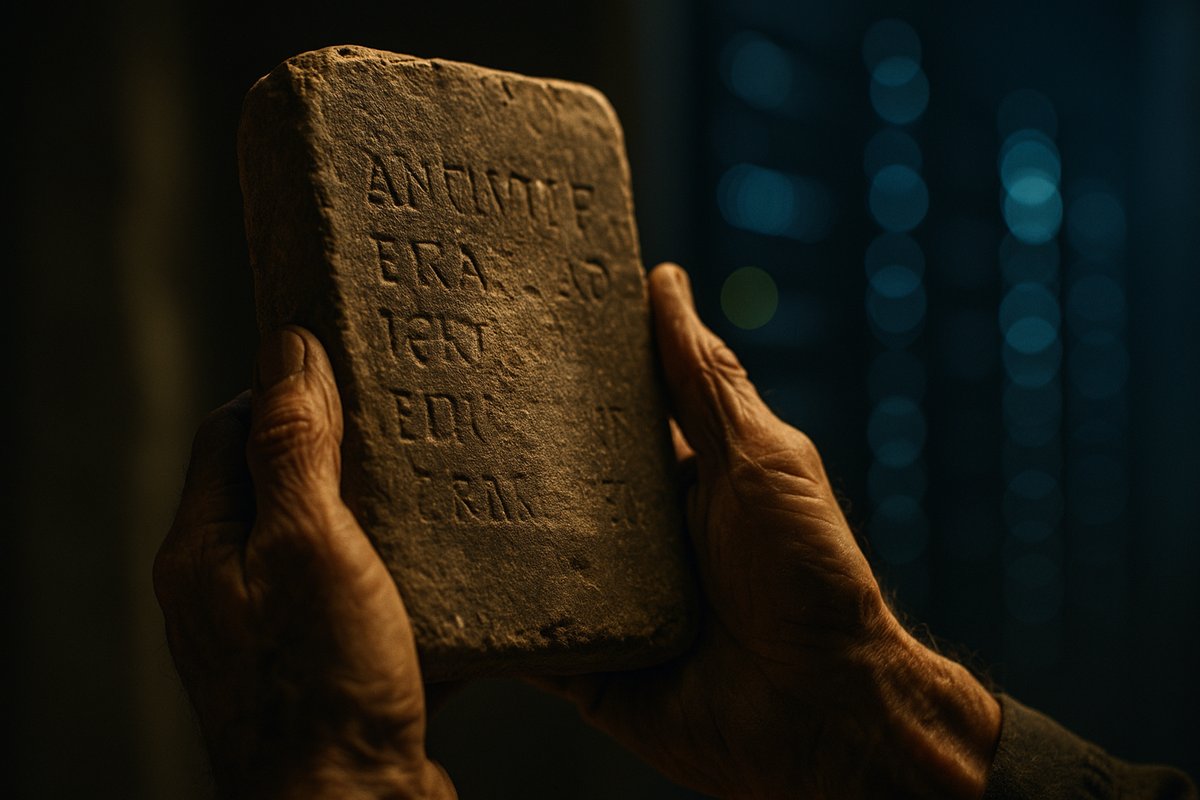
I think about ancient inscriptions carved in stone. Some emperors ordered the names of their predecessors erased to rewrite their own legacy. Other inscriptions remained hidden for centuries until archaeologists recovered them. That physical durability contrasts with the fragility of today's digital records, where a single algorithm change can make something as if it never existed.
Who benefits? In one case, the benefit is narrative control and perceived stability. In others, platforms reduce legal exposure while governments gain crisis-management tools without having to call it censorship. The companies that sell these moderation systems get an exportable product that adjusts itself to fit each market.
The case of titles that quietly disappear from catalogs follows the same logic. There's no need to ban them. It's enough that they stop appearing in relevant searches and that distribution becomes impractical. The book exists, in theory. For all practical purposes, it doesn't.
I still don't know exactly where to draw the line between legitimate moderation and narrative erasure. Some content causes real harm and warrants intervention. The same tool can drive in a nail or shatter a window, and the lack of public transparency about who decides when to use it for what remains troubling. The criteria shift according to geopolitical pressures, while the names we use for them stay reassuring.
The good news: these systems still depend on centralized infrastructures. And the history of information shows that centralization eventually generates its own counterweights. The printing press broke the monastic monopoly not because the gatekeepers allowed it, but because the technology became impossible to contain. Distributed archives, leaks, and citizen fact-checking networks represent imperfect attempts to build collective memory outside single points of erasure.
It's worth documenting outside the platforms every time a news event disappears without explanation: screenshots, independent archives, distributed records. Not out of paranoia, but because any memory system, biological or digital, becomes vulnerable if it has only one backup point.
Are we going to wait until these erasure capabilities become fully normalized under names like online safety or child protection, or will we demand, while there's still room to do so, that the distinction between moderating and erasing be recorded somewhere that can't be edited away in cascade?