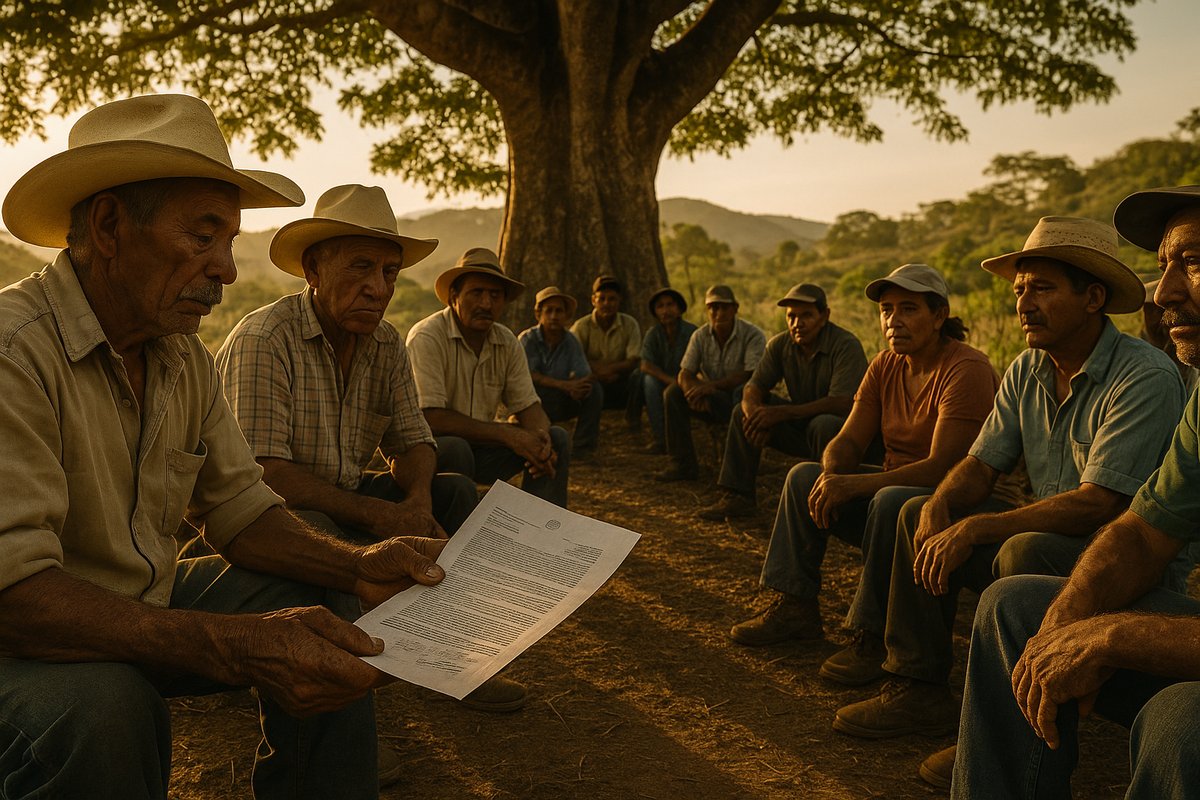
Fourteen peasant cooperatives in Honduras's Bajo Aguán region have regained their legal status amid a wave of armed attacks. The "9 de agosto" cooperative faced an incident that resulted in a loss of life, precisely after obtaining the legal recognition it had pursued for years. The UN has condemned this violence, and yet the cooperatives keep at their work.
It's a situation that invites reflection: the State grants official recognition with one hand while, with the other, it seems unable to stop the threats from armed groups. Legal status offers a step forward, but real protection requires more. In recent years, at least 19 peasants have lost their lives in the region, and still, these organizations persist in their effort to organize.
This kind of dynamic is nothing new. In Central America's agrarian reforms of decades past, cooperatives faced legal recognition followed by systematic tensions. In places like Guatemala, El Salvador, and Nicaragua, these movements became flashpoints precisely because they proposed alternatives to the control of large estates.
Something similar happened with the ejidos in Mexico during the Revolution. First came constitutional support, then landowner pushback. In Europe, agricultural cooperatives defied both authoritarian Nazi regimes and Soviet centralization, since both sought to dominate food production in a unified manner.
What's curious is how these cooperatives operate without relying on advanced technological tools. No apps to coordinate production, no algorithms to allocate resources, no digital platforms for group decision-making. People simply gather, discuss, vote, and share the risks. It's a basic form of human organization that nonetheless proves its effectiveness.
In my experience, I've seen how technology can both centralize and decentralize power depending on context. These Honduran cooperatives show that genuine decentralization doesn't require blockchain or artificial intelligence. It just takes people committed to pursuing real autonomy. This connects directly with themes I explore in my work, where I question neoliberalism and highlight the emergence of sovereign forms of social organization as viable alternatives to extractivism.
The violence directed against them doesn't seem incidental. It's part of a pattern that threatens the dominant extractive model. If 14 cooperatives manage to organize successfully, they inspire others to try. If they produce food without intermediaries, they prove that large landowners aren't essential. If they make collective decisions, they challenge the power structure in the countryside.
The groups attacking them don't operate alone. They receive funding, intelligence, and coordination to strike at key moments of vulnerability. We've observed similar strategies in Colombia with cooperatives tied to crops, in Brazil with land movements, and in Paraguay with similar peasant groups. But the encouraging part is that, despite it all, these communities build support networks that strengthen them.
Legal recognition without physical safeguards reveals the cracks in the contemporary State. It can grant rights on paper while failing to make them effective. It's like handing over a property deed in the middle of an open conflict. Even so, these cooperatives offer something invaluable: collective control over the means of production, managed democratically. It's neither private nor state property, but a third way that unsettles opposite extremes.
In the Bajo Aguán, every assembly is an act of resistance. Every group decision affirms independence from the hacienda system. Every distributed harvest is proof that options exist beyond extractivism. It brings to mind, in a brief mental detour, the Basque Mondragón cooperatives: they withstood dictatorships and adapted to global economies without losing their communal essence. Coming back to the point, these experiences show that persistence pays off.
History suggests that cooperatives which survive the initial phase of tensions tend to consolidate and grow. Those born in periods of economic crisis in the United States are still operating today. Mondragón's cooperatives in the Basque Country weathered authoritarianism and European upheavals. Israeli ones evolved while keeping their cooperative foundation.
The pattern suggests that the initial intensity is temporary. If they survive the first years, they develop defenses and alliances that make them more solid. The challenge for these 14 in Honduras lies in reaching that stage. They have legal backing, operational structure, and global support. But they face opponents with resources to prolong the conflict. Their future depends on international pressure, government shifts, and broader regional dynamics.
What's intriguing is that they're experimenting with organizational models the industrialized world had considered obsolete. While hubs like Silicon Valley centralize economic power through innovation, Honduran peasants are reviving ancestral ways of sharing it. I don't have all the answers on how to balance legal recognition with real security. But I do appreciate how these cooperatives contribute to relevant social experiments. They suggest that community organization remains alive in the 21st century, inviting us to consider alternatives to the neoliberal status quo.
Stones don't lie, but historians sometimes do.