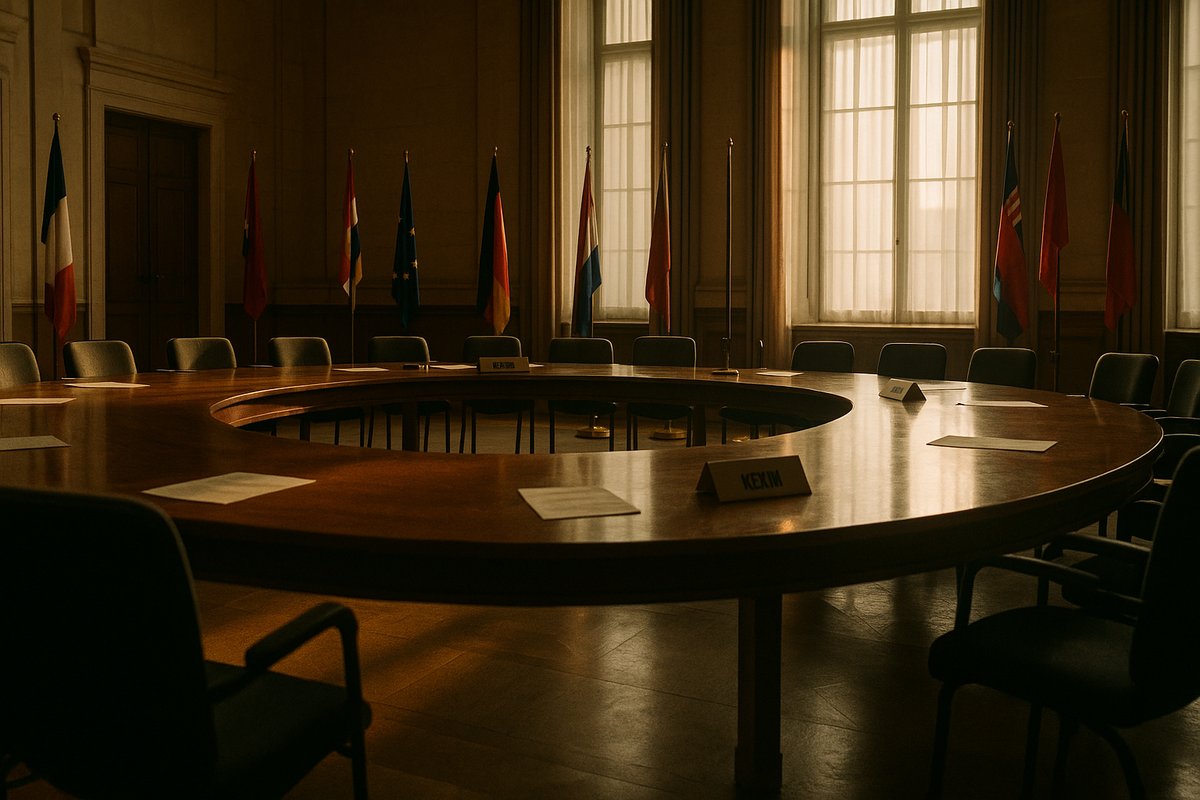
Thirty delegations gathered under the institutional roof of the ILO in Geneva. They represented governments that share, at least formally, a commitment to the social and solidarity economy. Brazil and Colombia led the initiative. There was genuine enthusiasm, carefully worded declarations, and press releases circulated in three languages. The Group of Friends on SSE was officially established. The institutional version describes it as a historic advance toward a more equitable economic model.
The logic surrounding this launch has internal coherence. At a moment of pressure on multilateralism, the voluntary coordination of thirty governments around the cooperative economy sends a tangible political signal. The 2025 International Year of Cooperatives offers momentum, the ILO the platform, and emerging economies the visible leadership. For those who have worked for years on the margins of the international economic order, having this language reach Geneva is not trivial.
The diplomatic capital this represents for Brazil and Colombia is concrete. It positions them as agenda-builders rather than recipients of policies drafted elsewhere. The ILO reinforces its own space in debates on alternative development. International cooperative organizations gain legitimacy that may open doors to multilateral financing. These benefits are real.
The question the official coverage evades is simpler and more uncomfortable: who wasn't in that room?
The United States wasn't there. China wasn't there. India wasn't there. Neither were Germany or Japan. These five economies account for more than half of global GDP and, above all, dominate the institutions that set global financial rules. Their absence is not a protocol detail. It defines the structural limitation of the entire effort.
This pattern shows up in other contexts. When those who control the critical variables remain outside the agreement, the exercise operates only on secondary factors. A group of thirty governments without a single G7 economy can produce exchange of practices, documents, and visibility. It cannot reform the conditions of access to international capital, nor IMF criteria, nor the accounting standards that systematically disadvantage cooperatives relative to corporations.
There is another absence that gets less attention: cooperative members and solidarity-economy workers themselves as subjects with binding voice, not merely as beneficiaries of what others decide on their behalf. The distinction matters. An intergovernmental forum that discusses SSE without their direct participation reproduces, even with better intentions, part of the logic it claims to correct.
The historical record doesn't lie. The ILO was born in 1919 with ambitious promises about decent work that took decades to become standards with any real force. The 1944 Declaration of Philadelphia reaffirmed principles of social justice that still coexist with supply chains built on forced labor and union repression. The 2012 International Year of Cooperatives generated genuine political attention and almost no regulatory change in the financial markets that matter. What we should be asking now is not whether the intentions are good, but whether the design differs from that of its predecessors.
The answer, architecturally, is no. This is a voluntary coalition with no binding mandate and, as far as has been made public, no formal mechanisms for follow-up or accountability. In systems engineering terms, this has a precise name: a protocol without an error function. Models incapable of detecting failure simply don't learn. They declare, they convene, they publish. The same inequalities carry over into the next budget cycle.
This doesn't mean the exercise lacks value. The leadership built among emerging economies has concrete applications outside Geneva: it can be used to negotiate in other forums, justify domestic policies, or weave alliances at the General Assembly. The visibility gained by cooperative organizations can translate into resources. None of this is negligible.
The limit deserves to be named precisely, without cheap cynicism or expensive naivety. Symbolic legitimacy is not the same as effective governance. A space where experiences are shared while the financial structures that decide which economies are viable remain designed by the absent parties is not, from an architectural standpoint, a mechanism of structural transformation. It is a space of cultural resistance with institutional backing. That is already something, though not exactly what the press releases suggest.
The proliferation of working groups, thematic years, and voluntary platforms within the UN system has never correlated clearly with reduced concentration of wealth. There are more mechanisms dedicated to equity than at any other time, and global inequality is also registering its highest recorded levels. This doesn't prove causation, but it demands scrutiny of what function these spaces actually serve.
One fact that remains striking: the world's largest cooperative by membership, AMUL in India, was built with no multilateral backing whatsoever, and while facing active opposition from the financial institutions of its time. It was driven by an engineer who understood structures and a politician who understood local power. Geneva did not intervene.
What real capacity do these voluntary protocols have to change the rules still being written by those who chose not to take a seat in the room?