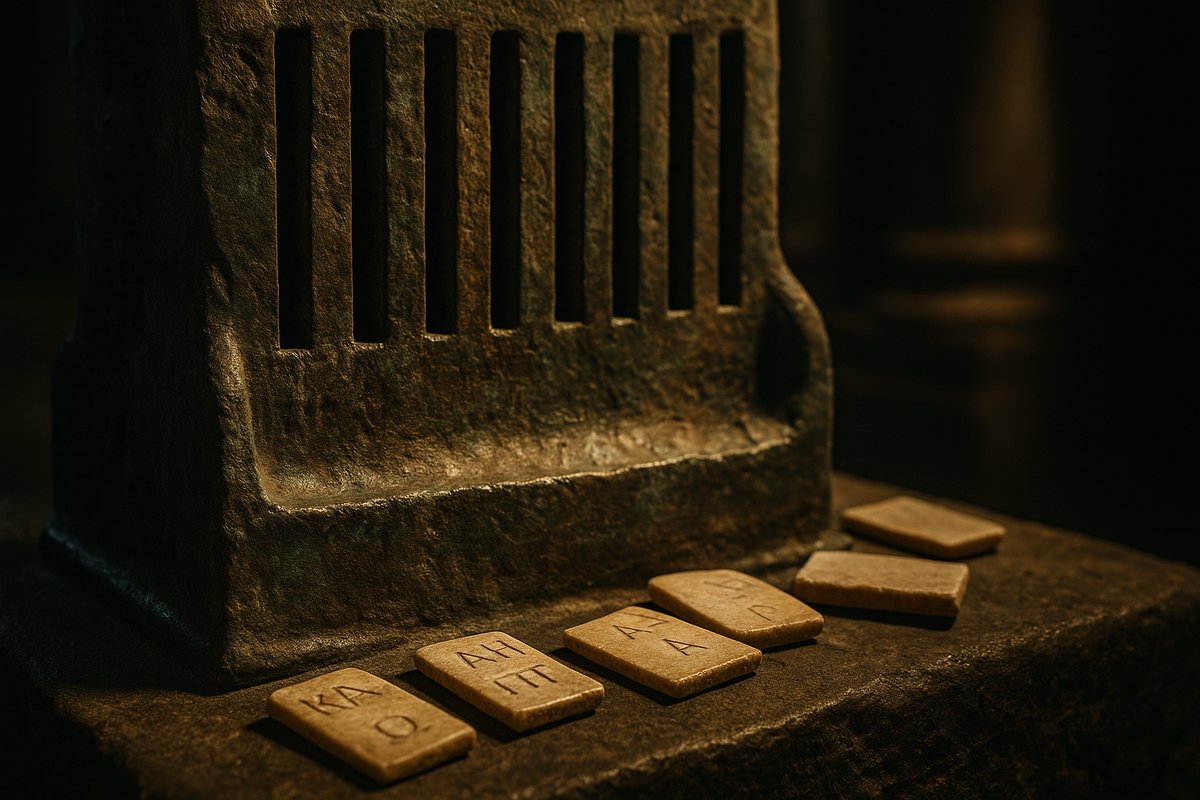
A bronze machine with columns of vertical slots received ivory tablets engraved with the names of Athenian citizens. A lever released black and white balls that fell through a side tube, and chance decided who would govern the city that year. It wasn't a game. The kleroterion was the beating heart of Athenian government for nearly two centuries.
What's most striking isn't its mechanical sophistication but the philosophical conviction behind it. The Athenians knew about elections. They used them for specific military posts because they understood that strategic talent isn't distributed at random. But to govern the city and sit on the five-hundred-member Boulé that set the public agenda, they preferred the lottery. The reasoning was clear and forceful: election by vote always favors the wealthy, the eloquent, and those who already command networks of power. The lottery breaks that cycle.
More than two thousand years ago, that city decided that real democracy required interrupting the reproduction of privilege. Then we forgot almost all of it.
It isn't hard to see why that amnesia proved convenient. Modern representative democracies built elections into a synonym for legitimacy. Voting became the central ritual of popular sovereignty. Current numbers reveal, with growing discomfort, that elected parliaments don't look like the populations they represent. They look like clubs. In most consolidated democracies, legislators tend to be wealthier, more educated, more male, and whiter than the society they claim to represent. That's not an accident. It's a structural consequence of the model.
Elections come with costs. Candidacies, campaigns, media visibility. Whoever can't finance those costs, or doesn't belong to the networks that sustain them, simply doesn't compete. Game theory calls this elite capture: when incentives consistently favor one group, that group ends up dominating the process. Not through conspiracy but through the accumulation of advantages. Formal selection processes tend to keep producing the same type of person and the same kind of decision.
The result is rising institutional distrust, climbing electoral abstention, and a widespread sense that parliaments speak a language foreign to the majority.
Here's where the data surprises. Since Ireland's first Citizens' Assembly in twenty sixteen, more than seven hundred deliberative processes based on citizen sortition have been documented across different countries. These aren't marginal experiments or academic proposals. They're real processes with real citizens making decisions that elected parliaments had avoided for years.
The Irish case is the most cited because its results are hard to dismiss. An assembly of ninety-nine citizens selected by lottery, designed to reflect the country's demographic diversity, deliberated for months on issues the elected parliament had systematically dodged: same-sex marriage and access to abortion. The assembly recommended changes. Those changes went to referendum. Ireland approved them. The parliament that had blocked those decisions for years turned out not to be necessary to make them.
In Belgium, the parliament of the Ostbelgien region permanently integrated a sortition-based citizens' chamber into its governing structure. Not as an optional consultation, but as an institutional component. In France, the Citizens' Convention for Climate, running from twenty nineteen to twenty twenty, produced one hundred and forty-nine concrete environmental policy proposals, several of which were folded into national legislation. In Latin America, Chile's constitutional process included forms of citizen participation that, while not pure sortition, recovered the logic that representation can't be purely electoral.
The connection to the participatory budgeting pioneered in Porto Alegre in the nineties isn't coincidental. That Latin American tradition of involving citizens directly in public spending decisions was, in many ways, a laboratory for what's now being tested at larger scale.
The Athenian kleroterion had a Renaissance parallel that few remember. Florence used, for generations, a system called imborsazione: names of eligible citizens were kept in leather bags, and offices were filled by drawing names at random. The Medici, once they consolidated power, didn't abolish the system outright. They manipulated it from within by controlling which names went into the bags. The historical lesson isn't that sortition is perfect. It's that whoever holds power always finds a way to capture the processes that threaten it.
Any honest proposal for democracy by lottery has to confront that vulnerability. Who defines the pool of eligible citizens, who designs the selection process, who facilitates the deliberations. If those decisions remain in the hands of the same actors the lottery is meant to displace, the result may be nothing more than an appearance of participation that legitimizes decisions already made.
In statistical sampling, a random draw is only representative if the sampling frame is complete and free of bias. If the list from which names are drawn systematically excludes certain groups, randomness saves nothing. Democratic sortition faces the same technical problem. The quality of the process depends on the quality of the registry and the independence of whoever administers it.
Technology could help, though with caution. Researchers have spent years exploring how stratified sampling algorithms might ensure that a citizens' assembly accurately reflects a society's demographic makeup — not just in gender and age, but in geography, education level, economic status, and ethnic background. A computationally well-designed lottery could produce a more representative chamber than any election.
There are also ongoing experiments with AI-assisted facilitation tools for multilingual assemblies that would allow simultaneous deliberation across multiple languages without losing nuance. National scale, always the standard argument against sortition, is starting to look like a solvable technical problem rather than a conceptual limit.
But the risks of algorithmic manipulation are real. A system that nobody fully understands, managed by actors with specific interests, can produce results that look random without being so. The transparency of the process matters as much as its design. The bronze kleroterion was public, visible, and verifiable by anyone present. Any digital equivalent would have to be too.
It still isn't clear how the tension between scale and legitimacy gets resolved in this model. The citizens' assemblies that have worked best are relatively small, with enough time to deliberate, expert facilitation, and clear mandates. Scaling that up to permanent national decision-making is a different challenge, and it would be dishonest to present it as already solved.
What does seem clear is that the question isn't whether sortition can fully replace elections. It's why we've dismissed for so long the possibility that well-designed chance might produce more genuine representation than voting. The Athenians used both mechanisms for different purposes, with different criteria. We collapsed everything into one, and then act surprised when that single process fails to deliver what it promised.
The bronze machine of the kleroterion sits in the Ancient Agora Museum in Athens. You can see it. It still works. It's been sitting there for more than two thousand years, waiting for someone to ask it the right question.
What does it say about us that it's taken this long to ask?
Sources:
1. Buchstein, H. (2010). Demokratie und Lotterie: Das Los als politisches Entscheidungsinstrument von der Antike bis zur EU. Campus Verlag.
2. Gastil, J. & Wright, E. O. (Eds.) (2019). Legislature by Lot: Transformative Designs for Deliberative Governance. Verso Books.
3. Landemore, H. (2020). Open Democracy: Reinventing Popular Rule for the Twenty-First Century. Princeton University Press.
4. Citizens' Assembly Ireland (2018). Third Report and Recommendations of the Citizens' Assembly: The Eighth Amendment of the Constitution. Government of Ireland.
5. OECD (2020). Innovative Citizen Participation and New Democratic Institutions: Catching the Deliberative Wave. OECD Publishing.