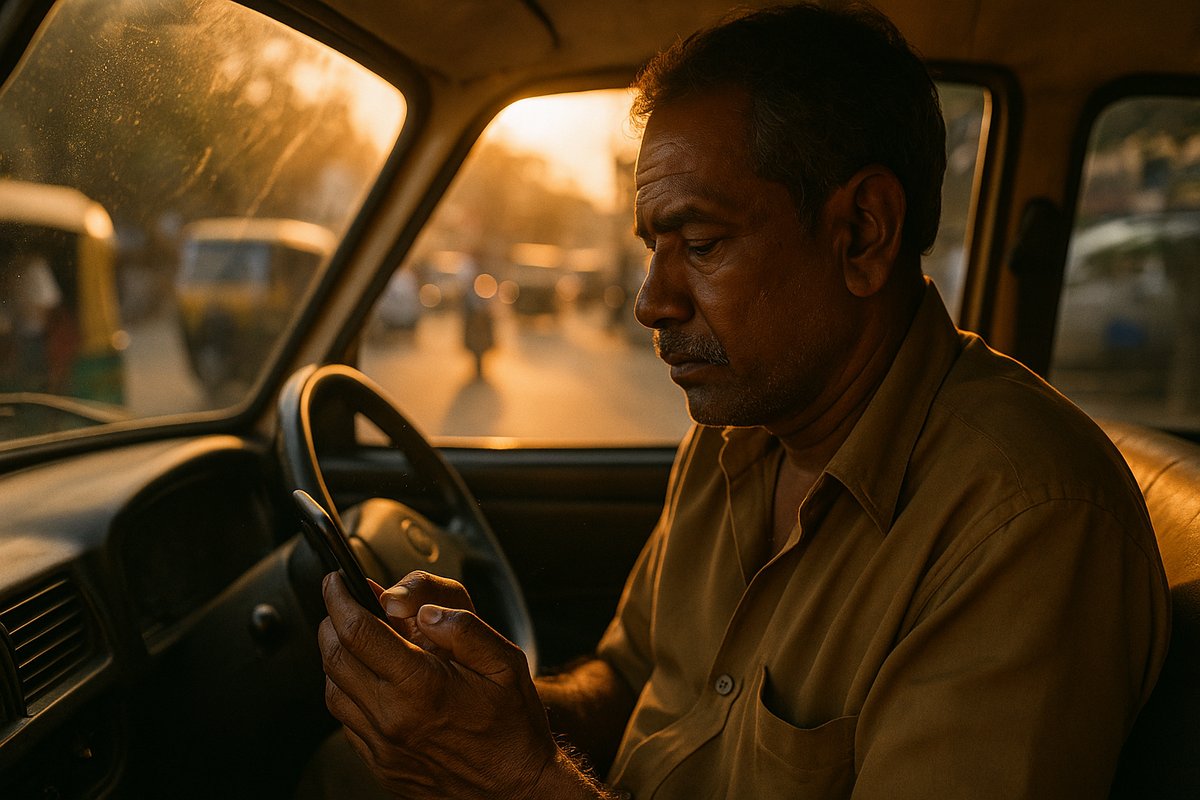
A driver in Bangalore opens the app. He sees something different. The commission the platform withholds is smaller. The rest stays among the drivers because he himself is, technically, one of the owners. Bharat Taxi wasn't born as a symbolic gesture. It emerged as a direct response to a model that extracted value from millions of drivers while dominant platforms racked up losses for distant investors.
Platform worker unions in India grew tired of rising commissions and opaque algorithms. Instead of continuing to negotiate limited regulations, they decided to build their own infrastructure. It's not an isolated case: the platform cooperativism consortium has documented parallel experiences in Kenya, South Korea, Mexico, and South Africa. All of them start from the same diagnosis. The value generated by whoever's behind the wheel shouldn't flow mostly to shareholders who never sit in it.
What distinguishes the Indian case is the scale of the problem it faces. India concentrates one of the largest gig economies on the planet. Millions depend on platforms that alter conditions without consultation. When a matching system decides who gets each ride and at what fare, that decision defines daily income without offering any real appeal. Bharat Taxi tries to invert that equation.
The question that rarely appears in the enthusiastic coverage is the one that matters most. Who controls the code. Unions drove the organization. Local cooperatives contributed membership and initial capital. Developers write and maintain the assignment system. In the 1844 Rochdale model, the weavers literally ran everything. They weighed the sugar. They kept the books in plain view of anyone. Visibility was physical.
Here transparency has to be algorithmic, and that's where the complexity increases. Who audits the code that weighs distance, wait time, and passenger rating? Is there an open repository where any member can review the rules? These operational details, from the exact number of active drivers to the structure of the technical committee, reveal whether nominal ownership translates into real control or just into a story.
This kind of tension shows up in other contexts too. A cooperative can have democratic bylaws, regular assemblies, and equitable surplus distribution. Even so, it depends on an outside vendor for servers and algorithms. If that third party can modify the code without asking the assembly's permission, collective ownership becomes more official story than actual mechanism. Real power lies with whoever runs the machine.
Good intentions often collide with persistent technical dependencies. It's worth experimenting with open audits, but the task is not trivial. The immediate consequence is felt in the driver's pocket: lower fees withheld, higher net income. Dominant platforms face, for the first time, organized competition emerging from developing economies — a different scenario than dealing with isolated national regulators.
The coordination between India, Kenya, South Africa, and Mexico suggests blocs building their own responses to the extractive model exported from the north. This isn't a formal alliance with treaties. The pattern of simultaneous efforts, documented by the same consortium, points to a will to reduce dependence on outside technology.
The Rochdale parallel helps calibrate expectations. Those twenty-eight weavers solved a concrete problem — buying flour without chalk in it — without a master plan. That small, verifiable act sparked a movement that today generates billions in revenue according to the World Cooperative Monitor. Bharat Taxi seeks to solve something just as concrete: keeping an algorithm from arbitrarily setting the value of a workday. The difference lies in the nature of the medium. In 1844 you opened a ledger in front of everyone. Today you'd need to open the repository. I'm still not sure any of these cooperatives has actually done that.
I keep turning this point over in my mind. The early cooperatives used physical records that anyone could touch and verify. That simplicity disappears in digital systems unless auditable access is designed in from the start. The risk is reproducing the same asymmetries under a new name.
Who really audits the code that decides what a driver's day is worth?