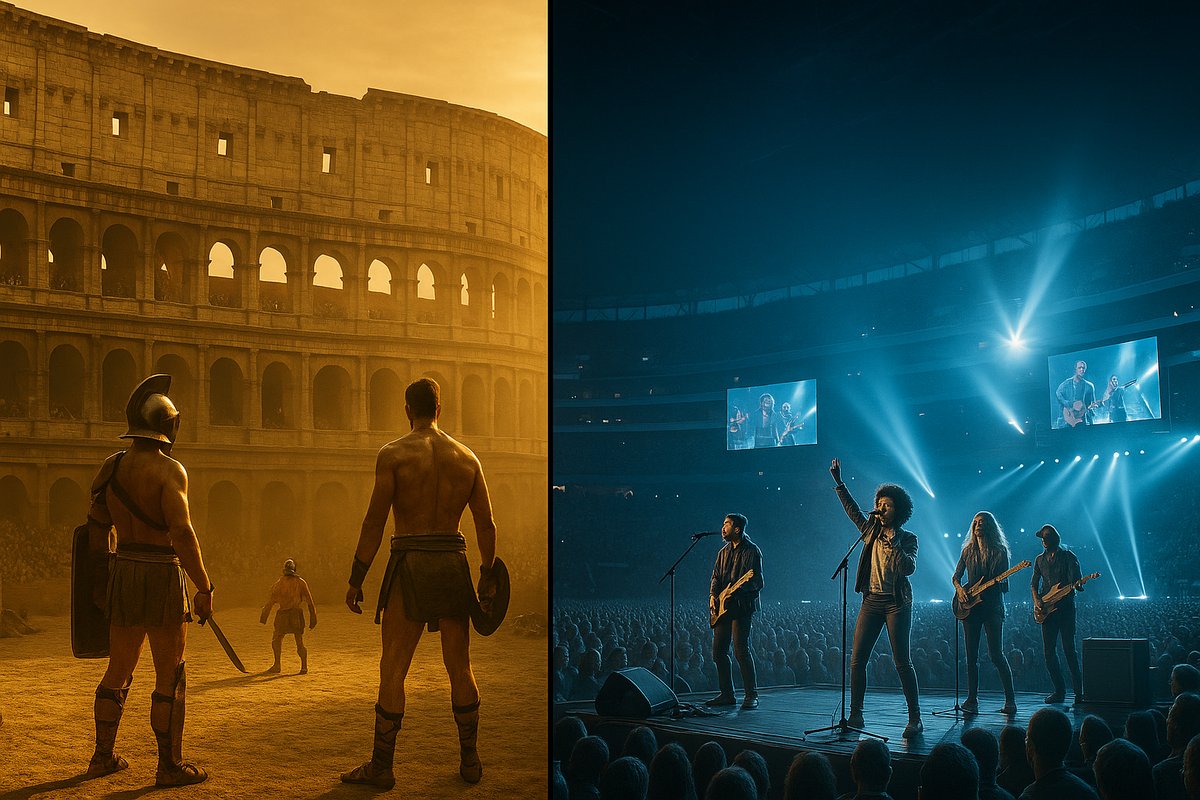
Bad Bunny sang in Spanish during the Super Bowl halftime show and nobody asked for subtitles. Millions of Americans listened to reggaetón without translation, and the world kept spinning. This moment illustrates something archaeologists have documented for centuries: the most successful empires don't destroy the cultures they encounter — they absorb them and turn them into tools of power.
Rome perfected this technique two thousand years ago. Rather than banning local gods, it folded them into the Roman pantheon. Gladiatorial combat wasn't a purely Roman invention, but an adaptation of Etruscan funeral rituals. Latin spread not only through military imposition, but because it mixed with local languages, creating new forms of communication that people adopted voluntarily.
The United States operates on the same logic, but at global scale and digital speed. It doesn't need legions to conquer cultural territories. It has something more powerful: an entertainment machine that turns cultural resistance into exportable content. What's interesting here is how this connects to patterns I've seen in other historical contexts, where voluntary adaptation strengthens rather than weakens.
Reggaetón was born in Puerto Rico as urban protest music, rooted in African-American hip-hop and Caribbean rhythms. It was music from the margins, from communities the system had left behind. But watch what happened: instead of censoring or marginalizing the genre, the American entertainment industry adopted it, polished it, and turned it into a global product. Bad Bunny now fills stadiums in the United States singing in Spanish, but his music is produced, distributed, and monetized through American corporate structures.
This is no coincidence. It's the same pattern we see with food. The hamburger, that seemingly all-American symbol, has German origins. Immigrants from Hamburg brought their meat-preparation techniques, which adapted to local taste and became \"American food.\" Now McDonald's operates in more than 100 countries, exporting an industrialized version of what was originally immigrant cuisine. I sometimes think, watching from Mexico, about how these chains sit on every corner, reminding me that cultural fusion can enrich without erasing origins.
The process is fascinating in its subtlety. The United States doesn't impose its culture directly; instead it creates an ecosystem where other cultures can thrive, as long as they integrate into its distribution and monetization systems. It's assimilation by absorption, not elimination. Could there be alternatives — more balanced models of cultural exchange? I think so, and they're worth exploring.
Consider the use of the term \"Latino.\" This word, which supposedly celebrates the cultural diversity of Latin America, actually homogenizes dozens of distinct cultures under a label that makes market segmentation easier. A Mexican, an Argentine, and a Salvadoran have different histories, traditions, even languages, but in the American market they're all \"Latinos\" who consume \"Latino content\" produced by \"Latino talent.\"
The appropriation of the name \"America\" to refer exclusively to the United States is perhaps the boldest example of this strategy. An entire continent became synonymous with a single country, and the rest of the world adopted this naming convention without questioning it. When someone says \"American music\" or \"American values,\" we automatically think of the United States, not Brazil, Mexico, or Chile.
The Romans did something similar when they called any culture that didn't speak Latin \"barbarian.\" It wasn't necessarily an insult, but a way of categorizing everything that existed outside their system. Over time, being \"civilized\" meant adopting Roman customs, and conquered peoples began to see their own traditions as primitive or incomplete. In my experience, I've seen how these dynamics persist in modern forms, but also how communities resist creatively.
The difference is that the United States perfected the process. Instead of imposing its culture directly, it builds the platforms where all cultures can \"compete\" for global attention. YouTube, Netflix, Spotify, Instagram — all American companies that define how culture is consumed across the entire world. It doesn't matter if the content is Korean, Nigerian, or Colombian; it gets distributed through American algorithms that determine what goes viral and what remains invisible.
K-pop is another perfect example. South Korea developed a sophisticated music industry, but its global success depended on American platforms. BTS didn't conquer the world on talent alone, but because it learned to navigate the American media ecosystem: television appearances, collaborations with established artists, social media strategies designed for Western algorithms. This makes me think of digressions like the rise of Japanese anime, which followed a similar path, integrating without losing its unique essence.
This dynamic creates an illusion of cultural diversity while centralizing economic control. We can listen to music in Korean, watch shows in Spanish, and eat Thai food, but the profits flow to the same corporations. It's surface-level multiculturalism with monoculture economics underneath. I'm no expert in global economics, but I keep exploring how this could be balanced for mutual benefit.
Archaeologists have found evidence that Rome operated in a similar way. In conquered provinces, people kept their local traditions, but trade, administration, and education ran according to Roman norms. Local citizens could maintain their cultural identities, as long as they participated in the Roman economic system.
The interesting question is whether this pattern is sustainable. Rome eventually collapsed, in part because the cost of maintaining such a diverse empire outstripped its capacity to generate wealth. The United States faces similar challenges: maintaining global cultural hegemony requires constant investment in technological infrastructure, content, and distribution platforms.
China is experimenting with a different model: instead of absorbing outside cultures, it's exporting its own culture through apps like TikTok and e-commerce platforms. It's a more direct strategy, less subtle than the American one, but potentially more efficient. Perhaps hybrid models — genuine international collaborations — offer viable alternatives.
What's fascinating is that cultures that completely resist assimilation often end up marginalized, while those that find creative ways to negotiate with the system can thrive globally. Bad Bunny singing in Spanish at the Super Bowl isn't cultural resistance — it's successful negotiation. He keeps his linguistic identity while gaining access to the biggest media platform in the world.
I admit I don't have a clear answer as to whether this is good or bad. Cultural assimilation can be a subtle form of imperialism, but it can also be a mechanism that lets minority cultures reach global audiences. A Puerto Rican artist can keep his language and rhythms while reaching millions of listeners he never could have reached without these platforms. This is more complicated than it looks, and it invites reflection on how to play this game without losing one's essence.
Perhaps the key lies in understanding the game well enough to play it without losing your identity in the process. Cultures that have survived for millennia have done so by constantly adapting without abandoning their essence. The challenge now is doing that at digital speed and global scale. There's hope in that adaptability, and I believe alternatives like independent cultural networks can help.
Stones don't lie, but historians sometimes do.