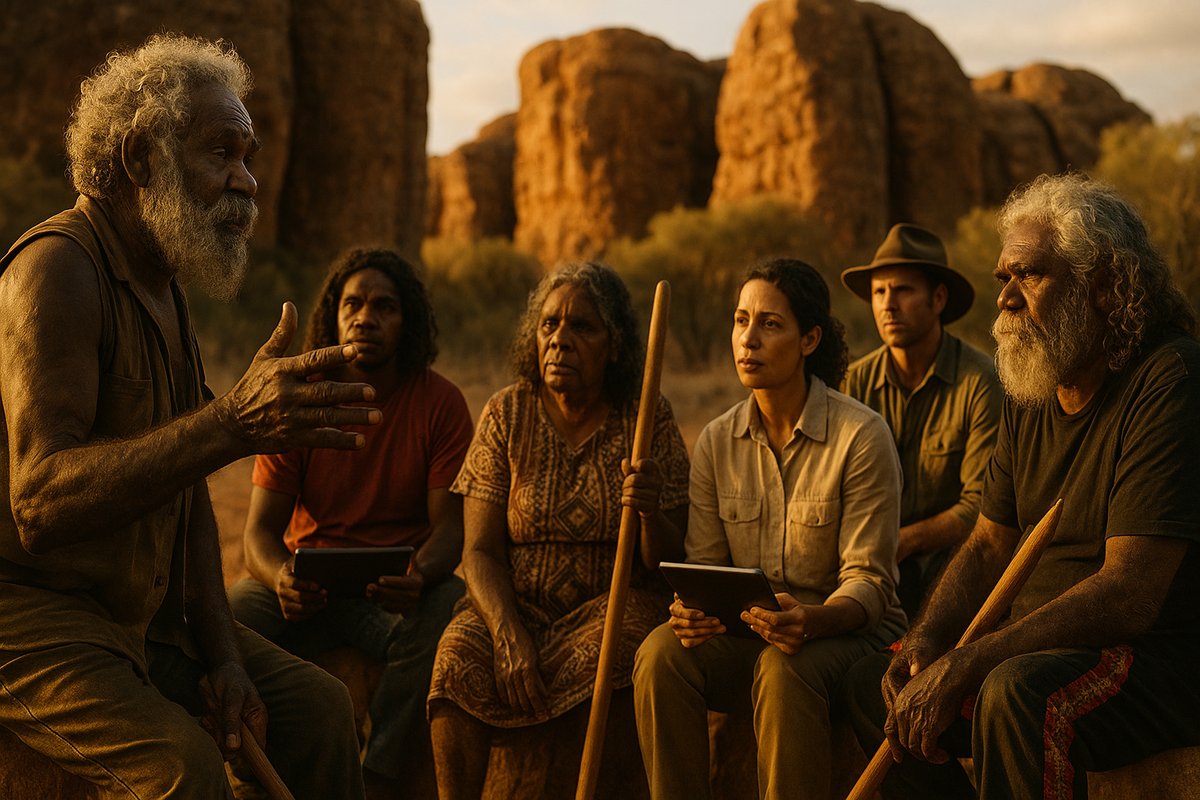
The Rirratjingu Aboriginal Corporation, in its emerging leadership programs, examines governance models that compare traditional protocols with contemporary systems. This is not just a local initiative: it's an experiment that reveals universal patterns about how to design resilient systems of human coordination. I recognize these patterns from other contexts where combining ancestral protocols with modern tools overcomes the limitations of each approach taken alone.
Australian indigenous governance systems operate under principles that any systems designer would recognize as robust: distributed decision-making, consensus protocols, feedback mechanisms, and long-term planning. Over more than 50,000 years, these communities developed social technologies that withstood extreme environmental pressures, climate shifts, and resource crises. Archaeological evidence shows that these systems didn't merely survive: they thrived under conditions that collapsed other civilizations.
The Rirratjingu workshop confronted a familiar problem: how to maintain the coherence of traditional systems while integrating modern tools to address contemporary crises like short-termism. It's the same dilemma organizations face when trying to preserve their culture while adapting to new technologies. In my experience, I've seen that indigenous systems carry millennia of field-testing that offer valuable lessons.
This makes me think of the Iroquois Confederacy, where six nations developed consensus-based governance protocols that weighed the impact of every decision on seven future generations. The system functioned for centuries, influenced certain aspects of the U.S. Constitution (though scholars debate the degree of this influence), and, though severely impacted by colonization, the Confederacy continues to exist today. Historical records indicate these models were not utopias: they were sophisticated social technologies with specific mechanisms for resolving conflicts, distributing resources, and maintaining long-term stability. (A curious detail: while reading about American history, I once got sidetracked by how these principles seeped into founding documents, which led me to wonder why we don't use them more today.)
The same pattern repeats across other cultures. Ayni systems in the Andes, ubuntu in Africa, village assemblies across different continents: all developed similar protocols for coordinating human groups sustainably. This is no coincidence. These are convergent solutions to universal problems of social coordination.
What's interesting here is that these systems operated with what, in systems engineering, we'd call "distributed redundancy" and "fault tolerance." If one node failed, the system had protocols to redistribute functions without collapsing the overall structure. Modern Western systems, by contrast, tend to concentrate critical points of failure: if one key leader leaves or a primary resource fails, everything wobbles.
The contemporary crisis of short-termism that the Rirratjingu workshop addresses isn't just a cultural problem: it's a systemic design flaw. Western systems optimize for quarterly metrics or short electoral cycles. Indigenous systems optimize for intergenerational stability. These are different architectures solving different problems, and this connects directly to the themes of my book on resilient human coordination.
But here's the experimental opportunity: what happens if we combine the long-term planning of indigenous systems with modern communication and data analysis tools? The Rirratjingu are testing exactly that. They use digital technology to facilitate community consultations, but maintain traditional consensus protocols. They apply data analysis to monitor environmental impact, but still evaluate every decision in terms of seven generations.
This is hybrid engineering: taking the best of each system and creating something new that surpasses the limitations of both. Traditional systems can be slow to process complex information. Modern systems can be fast but shortsighted. The combination could offer speed with wisdom, efficiency with sustainability. I'm no expert in all indigenous cultures, but this looks promising.
This experiment goes beyond Australia. In Mexico, peasant cooperatives apply similar principles: they maintain collective decision-making structures while integrating modern technologies to improve productivity and market access. Across different continents, indigenous communities are developing hybrid models that preserve ancestral protocols while leveraging contemporary tools.
The results are still being documented, but preliminary indicators suggest these hybrid models can offer greater organizational resilience than purely traditional or purely modern systems. The key lies in identifying which elements of each system are transferable and which are specific to their cultural context. I'm still exploring this topic, and there are aspects I don't fully understand.
I'm not proposing to romanticize indigenous systems or demonize Western ones. I'm proposing that we experiment with intelligent combinations that draw on millennia of trial and error in human coordination. Systems that have survived this long have something to teach us about designing resilient organizations.
The Rirratjingu experiment is an invitation to rethink our models of social coordination. Not as a return to the past, but as an evolution toward systems that combine ancestral wisdom with modern possibilities. We still don't know if it will work at scale, but it's worth experimenting with alternatives that have proven their effectiveness across millennia.
Stones don't lie, but historians sometimes do.