There are books you read and close thinking "how interesting." And there are books you close and then sit staring at the ceiling for a while. The Invisible Coup fell into the second category. Not because everything it says is new, but because it connects dots I had scattered around, and the picture they form together is uncomfortable.
The central thesis revolves around forces that don't need tanks or elections to change the order of a society. They operate from within, slowly, using legitimate institutions, moral discourses, and social movements as vehicles. One of those vehicles, which honestly wasn't on my radar, is liberation theology.
I was ignorant of almost everything about it. I knew it existed, that it came from progressive sectors of the Latin American Catholic Church, that it had something to do with the poor and social justice. But I hadn't understood its political architecture or how certain external actors used it as a lever. Liberation theology isn't simply faith mixed with politics. In some of its more radical expressions, it becomes a project for reconfiguring social power using the language of the sacred. That has consequences that go far beyond the parish.
What the book calls the "invisible coup" are structural transformations that no one voted for directly, that don't appear in headlines as revolutions, but that end up moving the pieces on the board in ways that take years to become visible. It's the kind of change that we systems engineers recognize well: it's not the catastrophic failure that brings everything down in a single moment, it's the slow degradation that nobody detects until the structure no longer responds the way it should.
This intersects in an interesting way with a conversation I had with my father-in-law some time ago. We were talking about migration, a topic that hits very close to home in Mexico and is very complex. He holds a position that initially sounds harsh but that, once you hear it in full, has a logic that's hard to refute: every migrant who arrives in a new country has a responsibility to integrate. Not to erase themselves or give up their culture, but to learn the language, understand the rules, contribute to the system they're joining. That's the part of the contract that falls to the one who arrives.
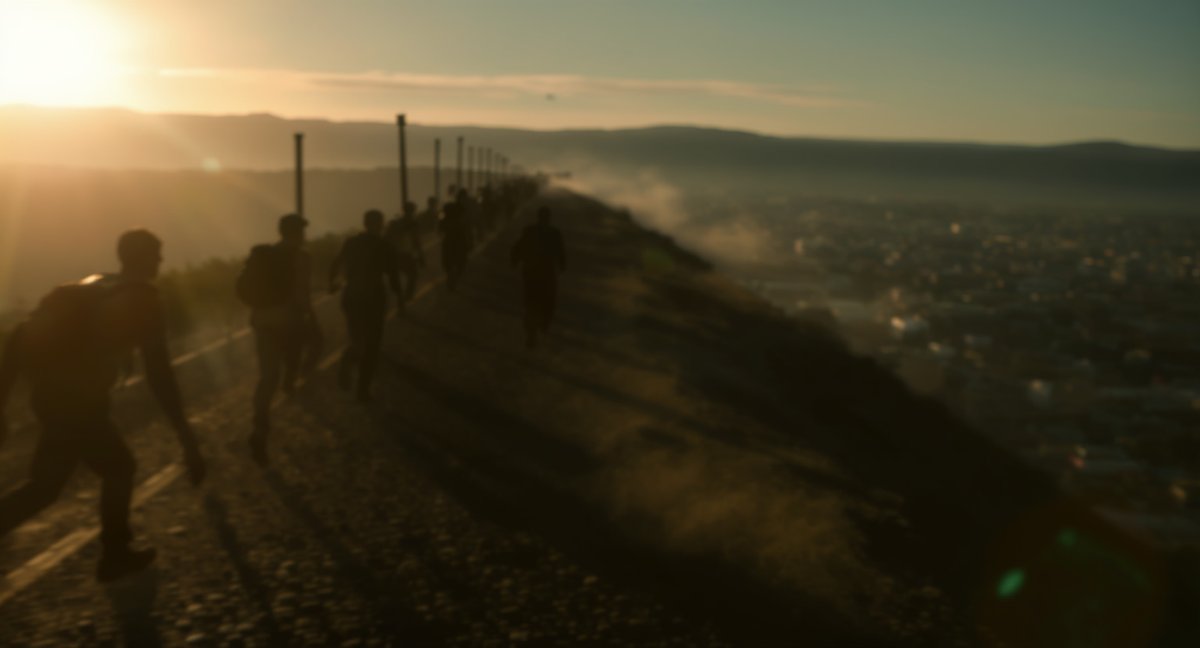
Illegal migration complicates this in ways that go beyond the moral debate about borders and human rights. From a structural analysis standpoint, massive undocumented migration introduces variables that the receiving country's economic models hadn't accounted for: pressure on public services, distorted labor markets, communities that form in parallel to the formal model without integrating into it. I'm not saying migrants are the problem. I'm saying that migration without structure, without process, without integration, generates real friction that ends up affecting everyone, including migrants who arrived earlier and did integrate.
This is where the book's themes and the conversation with my father-in-law connect in a way that took me a while to articulate. Certain movements that appear humanitarian or focused on social justice on the surface may be consciously used to generate that structural destabilization. It's not that every activist who defends migrants' rights is part of a plan. Most act in good faith. But the organizations that coordinate them, the ones that fund the caravans, the ones that provide legal counsel to evade deportation, the ones that create institutional sanctuaries—those, in many cases, do respond to agendas that have little to do with migrants' well-being and a lot to do with weakening the receiving state's capacity to govern its own territory.
Historically, this pattern isn't new. The Romans saw it with the migrations of Germanic peoples in the 4th and 5th centuries. It wasn't a military invasion in the classic sense. It was massive migratory flows that the Empire tried to manage, accommodate, integrate, and that ended up being one of the factors in its irreversible transformation. Not the only factor, of course. Structures collapse under multiple simultaneous pressures. But the disintegration of cultural and administrative cohesion was part of the process. The stones of Ravenna and Constantinople tell that story without any theatrics.
What's interesting about the analysis is that it doesn't propose that migration itself is the weapon. It proposes that deliberately chaotic management of migration can be. There's a huge difference between a country that receives migrants with clear integration processes, that demands compliance with laws, that offers viable legal pathways, and a country that's pressured to open its borders without integration mechanisms, without the capacity for selection, without resources to absorb the flow. The first builds more complex and resilient societies. The second creates the conditions for resentment, polarization, and instability that someone, somewhere, can exploit.
I acknowledge there are aspects of this discussion I still haven't fully worked out. The line between a fair migration policy and a migration policy used as a tool of control is thin and depends a lot on context. And there are actors who weaponize the argument of "national sovereignty" to justify plain and simple xenophobia. That's real too, and it needs to be named as well.
But one thing is certain: integration is not optional. Not as a demand for forced assimilation, but as a basic condition for social functionality. Societies that have successfully absorbed waves of migration, from postwar Germany to contemporary Canada, did so through active integration processes, with clear expectations for those arriving and real resources to facilitate that process. Not with open borders lacking structure, nor with closed borders lacking humanity. The middle ground requires political will and honesty about the real costs of both extremes.
The "invisible coup" operates precisely in that space where honest conversation becomes impossible. Where pointing out the real problems of uncontrolled migration automatically makes you a racist. Where defending cultural integration makes you complicit in oppression. That discursive paralysis isn't accidental. It's part of the process. If you can't talk about the problem clearly, you can't solve it. And if you can't solve it, the structure keeps degrading while someone, somewhere, watches and waits.
The question I'm left with isn't "who's behind all this?" That leads to conspiracies that oversimplify what is genuinely complex. The more useful question is: what conditions are we creating or allowing that certain actors can exploit? That one does have concrete answers. And those answers begin by recovering the capacity to have uncomfortable conversations without the debate shutting down before it even starts.
Stones don't lie, but historians sometimes do.
Sources:
1. Figueroa, J. The Invisible Coup — central thesis on non-electoral structural transformations
2. Stark, R. The Rise of Christianity — on how religious movements operate as vectors of political transformation
3. Ward-Perkins, B. The Fall of Rome and the End of Civilization (2005) — on migration and systemic disintegration in the late Roman Empire
4. Huntington, S. Who Are We? The Challenges to America's National Identity (2004) — on cultural integration and social cohesion
5. Castles, S. & Miller, M. The Age of Migration (2009) — on migration systems and their structural effects