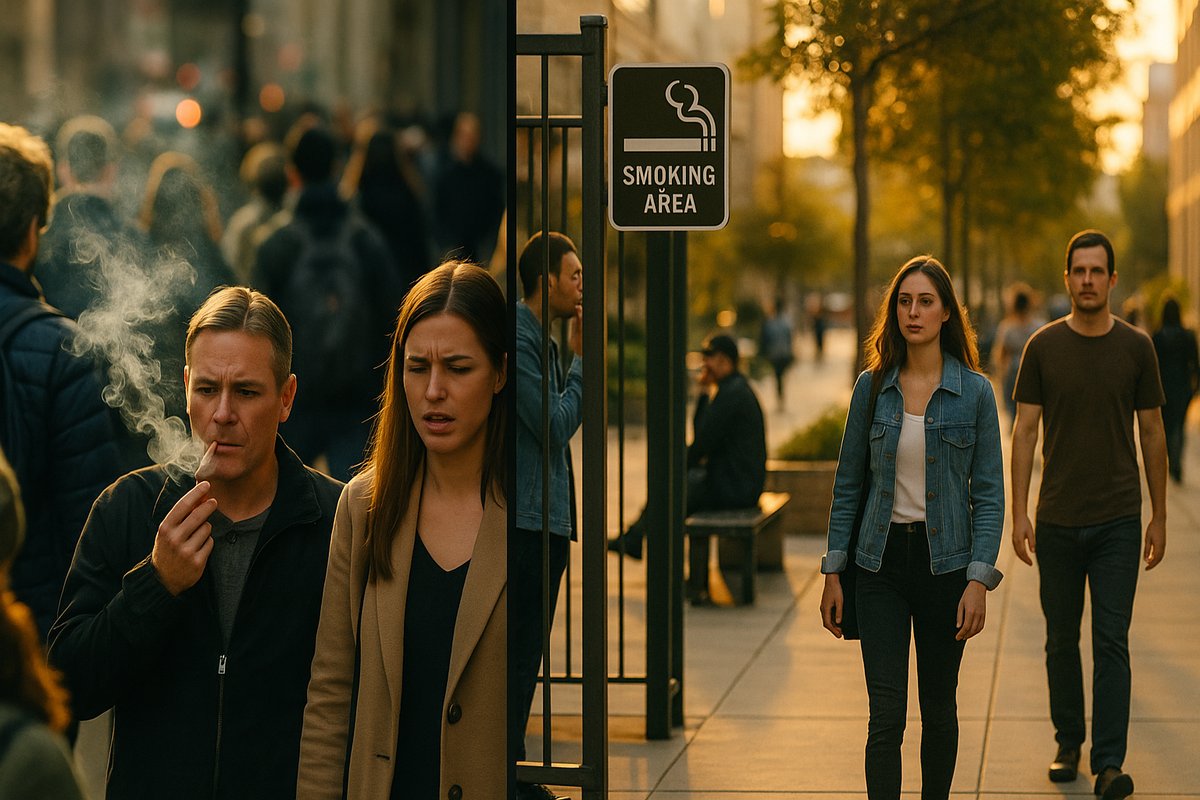
Walking behind someone smoking on the street produces one of those everyday annoyances nobody asks for, but almost everyone experiences. The smoke arrives without warning, surrounds you, and even if you cross to the other side, you've already inhaled something you didn't choose. It's not a major conflict. It's a routine intrusion, accepted as part of the urban landscape. That acceptance reveals a deeper problem.
In the article about coffee I explored how a substance becomes woven into collective rituals until questioning it starts to feel out of place. Tobacco followed a similar path, with one key distinction: the smell of coffee doesn't invade someone else's space. Cigarette smoke does. That spillover onto third parties—a cost others bear without choosing it—turns the issue into one of social design, beyond individual health.
The central point isn't to deny the right to smoke. That right exists. What matters is defining how far it extends when one person's freedom breaks into the air someone else breathes.
Smoking took root thanks to a solid cultural history. It represented maturity, defiance, belonging. Twentieth-century cinema elevated it into an emblem of elegance. Family and friends made it everyday before we could judge it clearly. Among young people, peer pressure completed the cycle: smoking meant growing up, joining the group, leaving childhood behind. That story stuck because it touched real longings for identity. To reverse it, you have to understand its appeal, not just reject it.
What's notable is that urban design already demonstrates the capacity to change behavior without imposing absolute bans. Tokyo offers a concrete case. In several areas, smoking on public streets is restricted or banned, but dedicated smoking booths are installed, with proper ventilation and clear signage. The smoker keeps their space. Everyone else enjoys the shared air without interference. Nobody sacrifices rights; an effective division is simply achieved. Walking through the streets of Mexico City or European cities, where cigarettes flow freely on sidewalks, doorways, and terraces, the difference is obvious. No city is ideal, but Tokyo solves a coexistence problem that elsewhere remains ignored.
This problem evokes the dilemmas of game theory: each smoker acts in their immediate interest, but the aggregate produces a shared environment that worsens for non-smokers. Without clear rules, individual comfort prevails. With precise rules and designated areas, the equilibrium benefits everyone. This isn't dogma. It's organization.
Practical proposals are easy to sketch out. Bounded areas in plazas and parks, equipped with ashtrays, possibly covered and set away from pedestrian routes. A mandatory minimum distance—five meters as a reasonable baseline—from doorways, windows, lines, bus stops, and crosswalks. On terraces and semi-open areas, the default should be smoke-free, with a separate section for smokers if the establishment chooses, but with genuine separation: not a sign a few feet from the non-smoking tables.
Cigarette butts deserve separate attention. They're the most common waste in cities, they accumulate heavy metals, poison soil and sewers, and their presence at the entrances of shops and buildings reflects poor management. Installing ashtrays at store entrances isn't an excessive burden. It's basic responsibility. Consistent fines for dropping them on the ground would change habits faster than any awareness campaign.
Another rarely addressed aspect is smoking breaks at work. Five minutes, four times a day, five days a week, fifty weeks a year: a hundred hours annually that a smoker takes informally, while a non-smoker rarely gets anything equivalent. I'm not proposing eliminating those breaks. I'm suggesting that, if they're a benefit, they should be extended to everyone without distinction. Fairness lies in recognizing comparable breaks for those who don't smoke. That this is missing from so many workplace policies shows how much remains unexamined.
None of this calls for hostility toward smokers. The considerate smoker—and there are plenty—steps away, picks the right spot, puts out their cigarette carefully, avoids lines and entrances. That behavior exists and deserves recognition. Campaigns that promote that identity—smoking with awareness of others—have more impact than those focused on lung damage. The story of the considerate smoker is a cultural resource for change, still largely unexplored.
For those who want to quit, support should be accessible and judgment-free: support groups, therapy, substitutes, hotlines. Not as punishment, but as a real alternative. That someone wants to quit and finds no options points to a structural gap, not a personal failure.
There's a thread connecting the coffee article and this one: substances and habits normalized in collective settings generate costs that fall on others. Sometimes in health. Sometimes in time. Sometimes in the air someone breathes without having asked for it. Designing those settings with intention—clear rules, spatial divisions, accountability—isn't authoritarianism. It's what allows different habits to coexist without some people's effects landing on everyone else.
I still don't have a clear political path for applying this in contexts of lax regulation and even weaker enforcement. The problem is harder than it looks. But the first step is abandoning the idea of public space as an anarchic zone where everyone acts without regard for their neighbor. The second is building structures where the smoker has their corner and everyone else has theirs.
Stones don't lie, but historians sometimes do.
Sources:
1. World Health Organization — Report on the Global Tobacco Epidemic, recent editions
2. Tokyo Metropolitan Government — Regulations on smoke-free zones in public streets
3. WHO Framework Convention on Tobacco Control (FCTC) — articles on public spaces
4. National Institute of Public Health (Mexico) — studies on secondhand smoke exposure
5. Nash, J. — Non-Cooperative Games, Annals of Mathematics, 1951 (game theory framework applied to social coordination)